
Car Accidents | Winchester, Front Royal, Harrisonburg and the Shenandoah Valley
Steps After a Spinal Cord Injury in a Virginia Car Accident
A plain-language guide to the stages, from emergency care to a possible lawsuit, for injured people and their families.
Published November 5, 2026
A spinal cord injury car accident process in Virginia usually moves in stages, from medical care to a possible lawsuit. Each stage affects the next, so knowing the order can help families plan. This guide explains those stages in plain language. Correll Law Firm’s Winchester and Harrisonburg offices handle car and commercial truck crash cases for people across the Shenandoah Valley, Richmond and Henrico County. For background on the injury itself, see the firm’s spinal cord injury overview.
What does the typical step-by-step process look like from the first free case evaluation through litigation or settlement in a Virginia car accident spinal cord injury case?
The process usually moves through medical care, crash reporting, evidence gathering, insurance discussions, filing, and then settlement or litigation (a lawsuit and the court process that follows). The order depends on the facts of the crash and the injury, and some steps overlap.
This is a confidential meeting where you describe what happened and the firm reviews your facts. It carries no obligation to continue, so you can ask questions and decide what comes next.
Medical treatment does not stop when the legal steps begin. Care continues through every stage, and the records from that care become central evidence. Gathering records, talking with an insurer and preparing a filing may all happen at the same time.

What spinal cord injuries are most common in car accidents?
Spinal cord injuries from car crashes often affect the neck or the back. Sudden impact, compression or fracture can damage the bones of the spine and the cord inside them.
The spinal cord has three layers of protective tissue. Cerebrospinal fluid surrounds it and acts as a cushion against shock, according to the NINDS spinal cord injury overview.
Where the injury happens matters. Nerves in the neck (cervical) send signals to the head, neck, shoulders, arms, hands and diaphragm. Nerves in the chest (thoracic) reach the chest muscles and many organs. Lower back nerves (lumbar and sacral) send signals to the hips, legs and feet.
An injury between C1 and C4 can stop breathing, because those nerves control the diaphragm. This is one reason emergency care comes first.
Doctors describe injuries as partial or complete. A partial injury lets some signals pass. A complete injury blocks signals below the injury point. Symptoms can change over time, and some appear hours or days after a crash.
Step 1: How does medical care and documentation start after a spinal cord injury?
Emergency evaluation and imaging usually come first. The records from those early visits become central evidence of the injury.
Follow the treatment plan from the doctors treating you. Attend follow-up visits, keep copies of discharge papers, and write down new symptoms and medications. A simple daily journal can show how the injury limits work, sleep, driving or household tasks.
Keep proof of time missed from work, such as pay records or a letter from an employer. These records help show how the injury affects income over time.
Medical bills and records of lost work time are usually gathered as the case develops, not all at once. Gaps in treatment can make it harder to link later symptoms to the crash, so keeping follow-up visits matters.
Step 2: Does a driver have to report a crash with a spinal cord injury to police?
Virginia requires a driver involved in a crash with injury or death to stop and report it to police immediately (Va. Code §§ 46.2-371, 46.2-894).
In an accident that kills or injures someone or damages an attended vehicle or other attended property, the driver must also immediately stop as close to the scene as possible without obstructing traffic, report their name, address, driver’s license number, and vehicle registration number to the State Police or local law-enforcement agency (or to the injured person if they appear able to understand and retain the information, the other driver or an occupant, or the property custodian), and render reasonable assistance to any injured person; a driver whose own crash injuries prevent this must, as soon as reasonably possible, make the report to the State Police or local law-enforcement agency and make a reasonable effort to locate the person struck, the other driver or an occupant, or the property custodian and give them their name, address, driver’s license number, and vehicle registration number (Va. Code § 46.2-894). That help can include taking an injured person to a doctor or hospital when treatment is apparent or requested (Va. Code § 46.2-894).
Under Va. Code § 8.01-243, unless otherwise provided in that section or by other statute, every action for personal injuries, whatever the theory of recovery, shall be brought within two years after the cause of action accrues. Those are two separate rules.
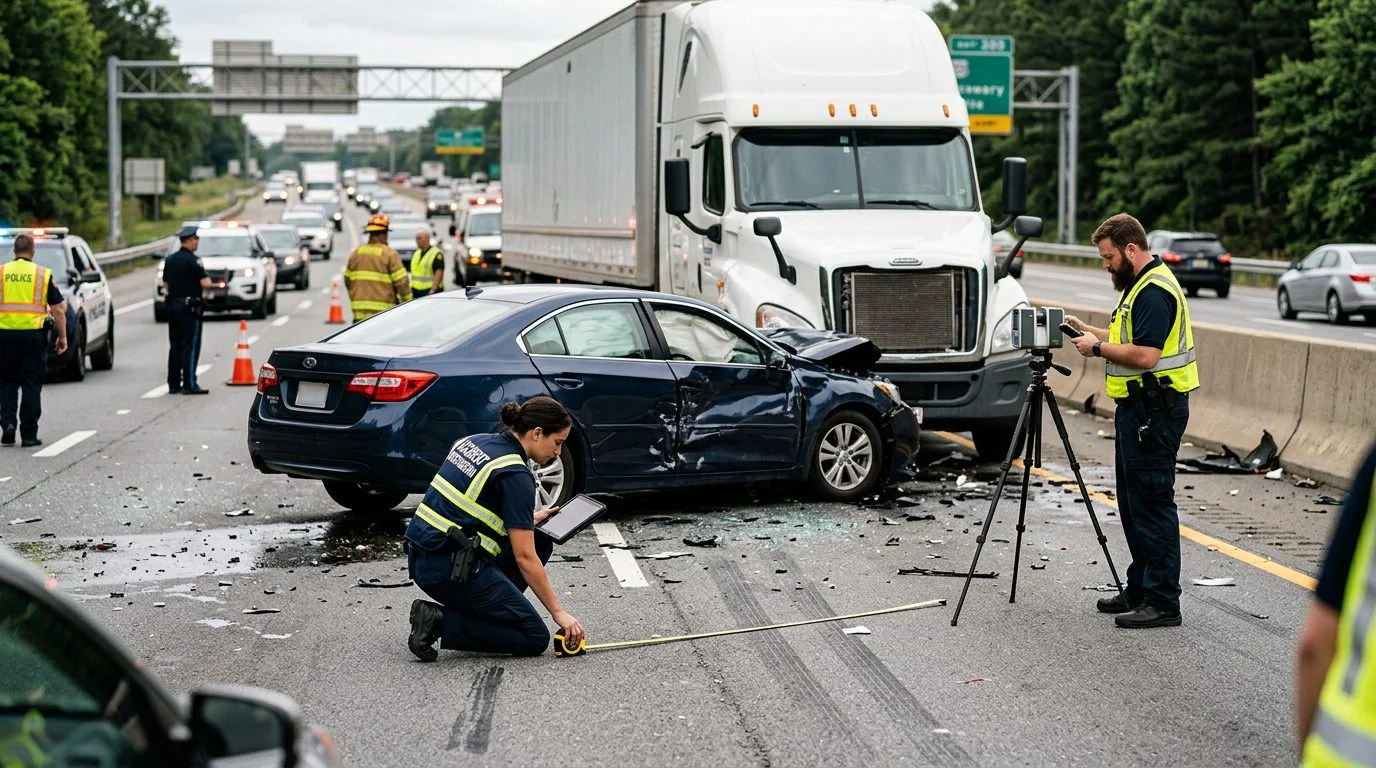
A police crash report is often one of the first records of where and how the crash happened. It can list the drivers, witnesses and what the officer observed at the scene.
Step 3: What evidence is gathered in a spinal cord injury car accident case?
The main evidence usually includes the crash scene, the vehicles, the medical records and the police report.
Photos of the scene, vehicle damage and road conditions can be useful. Witness names and how to reach them matter, because memories fade over time.
Traffic camera and dash camera footage can show the sequence of events where it exists. Footage can be overwritten or lost over time, so early requests matter.
In a commercial truck crash, the carrier may keep driver logs, maintenance records and inspection records. These can be requested as part of the case and can show how the truck was operated and kept.
Outside medical experts and accident reconstruction analysts may review the medical and crash evidence. A key question is causation.
Step 4: How do insurance companies and questions of fault affect a spinal cord injury claim?
Insurance adjusters often ask for recorded statements, medical authorizations and records early. Questions about fault can shape what follows.
An insurance claim is a negotiation with an insurer. A lawsuit is a case filed in court. Some cases stay in claim talks, while others move into court.
Virginia follows contributory negligence: if you are found even partly at fault, you may be barred from recovering, with limited exceptions. Talk to a lawyer about your facts.
Before giving a recorded statement, you may wish to speak with the firm first.
Step 5: What is the deadline for filing a spinal cord injury lawsuit in Virginia?
Virginia generally allows two years from the date of injury to file a personal injury lawsuit (Va. Code § 8.01-243(A)); the clock runs from the date of injury, not the date of discovery, with narrow exceptions.
Some claims carry notice requirements that run out sooner, so you may wish to speak with the firm promptly. For example, a claim against a county, city or town requires a written statement of the claim within six months after it accrues (Va. Code § 15.2-209). Va. Code § 15.2-209 reads: “Failure to provide such statement shall not bar a claim against any county, city, or town, provided that the attorney, chief executive, or mayor of such locality, or any insurer or entity providing coverage or indemnification of the claim, had actual knowledge of the claim, which includes the nature of the claim and the time and place at which the injury is alleged to have occurred, within six months after such cause of action accrued.” Va. Code § 15.2-209 reads: “Every claim cognizable against any county, city, or town for negligence shall be forever barred unless the claimant or his agent, attorney, or representative has filed a written statement of the nature of the claim, which includes the time and place at which the injury is alleged to have occurred, within six months after such cause of action accrued.”
That statute is strictly construed. It also says a missed statement does not bar the claim if the locality’s attorney, chief executive, or mayor, or any insurer or entity covering the claim, had actual knowledge of the claim, including its nature and the time and place of injury, within that six-month period. Timing matters, so it helps to act early.

Step 6: What happens during litigation, mediation, and settlement or trial?
A lawsuit begins when a complaint is filed with the court and served on the defendant. The case then moves into discovery, the formal exchange of information.
Discovery can include written questions, requests for records, and depositions (sworn interviews held outside the courtroom). Some cases resolve through negotiation or mediation, a meeting with a neutral person who helps both sides talk. Others go to trial.
A settlement is a decision the injured person makes. The timeline varies with each case.
Virginia allows punitive damages for actual malice, or for willful or wanton conduct or recklessness showing a conscious disregard for the safety of others, capped at $350,000 (Va. Code § 8.01-38.1).
The steps in this guide are general. The spinal cord injury car accident process varies with each case.
Frequently asked questions
Can a company be responsible when its driver causes a truck crash in Virginia?
Truck crashes can involve more than one party, depending on the facts.