
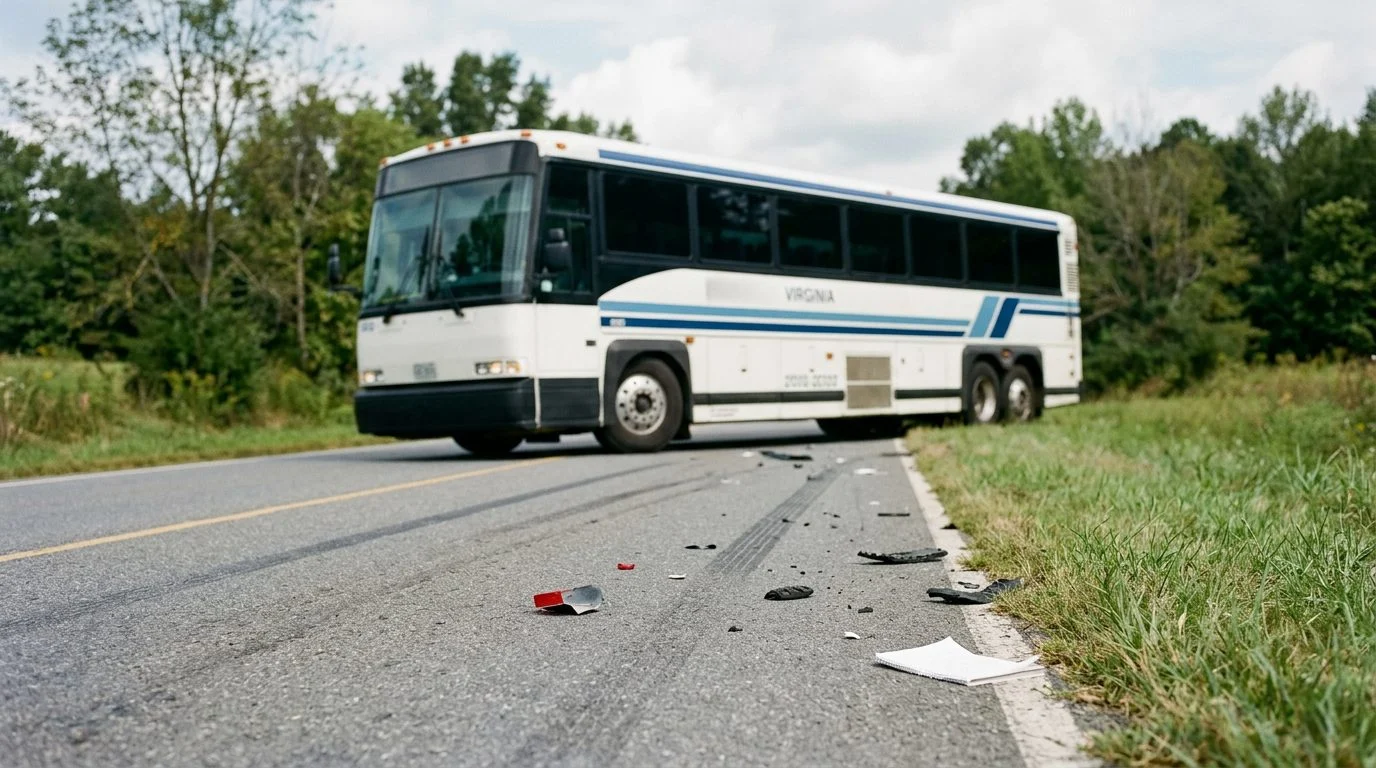
Commercial vehicle accidents | Virginia
Bus Crash Evidence Can Disappear Fast. Here Is What to Protect First.
Buses record more than most drivers realize, and much of it is stored for a short time. Knowing which records matter can help families protect the facts while they are still available.
Published November 9, 2026
After a bus crash, you may be hurt, shaken and dealing with a lot at once. Still, some of the most useful proof can disappear quickly. To preserve evidence after a bus crash, start with driver logs, maintenance records, dashcam video, electronic data recorder information and dispatch records.
This page explains what each record can show, why it can be lost, and how Virginia’s reporting and filing timelines fit in.
What Evidence Should Be Preserved After a Bus Crash, Such as Driver Logs, Maintenance Records, Dashcam Footage, and Electronic Data Recorder Information?
Most of the useful proof comes from five kinds of records. They are held by the bus company, by the vehicle itself, or by people at the scene. Each one can show what the bus and driver were doing before impact.
Which items matter most depends on the facts of each crash. A rear-end collision on a busy highway raises different questions than a crash on a city street in the Shenandoah Valley. For that reason, this page explains each category rather than offering a checklist that fits every case.
Some records sit with the bus company. Others sit on the vehicle, and some, such as scene photos, may already be on your own phone. Knowing where each one lives helps you ask for it in the right place and at the right time. Bus companies also run their own schedules for repairing and returning vehicles to service, so early action matters.
If you were hurt in a bus crash in Virginia, you may have a claim, and the firm can talk through your situation with you. Talk it through with Correll Law Firm — we can walk you through how a situation like yours is usually handled and what your options are.
Why Bus Crash Evidence Can Disappear Quickly
Bus evidence can disappear quickly because a bus is a working vehicle. After a crash, it may be towed, cleaned, repaired or reassigned to another route. Each step can change or remove parts that would show what failed.
Video and electronic data can also be lost through routine habits. Many camera and recording systems write over older files on a regular cycle unless someone asks for them to be kept. Once overwritten, the data often cannot be recovered.
Memory fades too. Witnesses move, change phone numbers and forget small details that later matter. Photos and notes taken at the scene may be the only early record of the road, the weather and where the vehicles came to rest.
That is why a written request to keep the records should go out early. The request creates a dated record that the evidence was asked for. The FMCSA publishes national statistics on crashes involving large trucks and buses, so federal regulators track this kind of crash.
Driver Logs and Maintenance Records
Driver logs record a driver’s hours, duty status and trips. They can help show whether the driver was rested and on schedule. Federal rules require motor carriers covered by these rules, other than private nonbusiness carriers of passengers, to have each driver record duty status for each 24-hour period. A driver used by more than one motor carrier during any 24-hour period at the driver’s home terminal must submit a copy of the record of duty status to each motor carrier, and the driver must retain a copy of each record of duty status for the previous 7 consecutive days, in the driver’s possession and available for inspection while on duty (federal driver log rules).
Maintenance and inspection records show the history of brakes, steering, tires, lights and other safety parts. They show what was checked, what was repaired and when. Federal rules require motor carriers to inspect, repair and maintain their vehicles systematically. Motor carriers, other than private nonbusiness carriers of passengers, must keep those records where the vehicle is housed or maintained for 1 year, and for 6 months after the vehicle leaves the carrier’s control (federal maintenance rules). The original or a copy of a periodic inspection report must be retained for fourteen months from the date of the inspection report, and where the vehicle is housed or maintained (periodic inspection rules).
Repair records after the crash matter too. They show which parts were damaged, replaced or removed. These records usually sit with the bus company, so early written requests matter.
Dashcam Footage and Electronic Data Recorder Information
Dashcam and onboard video can show the road, traffic, signals, lighting and the driver’s actions in the moments before impact. Some buses carry interior cameras as well as exterior ones. Footage may show both the road and the cabin.
Electronic data recorder information is data a vehicle may store about events around a crash. The NHTSA event data recorder page says recorders in commercial vehicles may preserve technical vehicle, occupant, driver-input, restraint and crash information useful for investigating and reconstructing a crash. Not every bus stores the same data, so the vehicle’s own equipment needs to be checked.
Keeping the data in its original form matters. Downloading and reading it usually takes a qualified technical analyst. Outside analysts can explain what the numbers mean, but the data’s value rests on whether it stayed unchanged. Ask in writing that the vehicle and its equipment be kept as they are.
Other Records That Can Help Show What Happened
Dispatch and communication records show when the trip was planned, what the driver was told and how the company tracked it. Dispatch messages also help show the timing of events, which is often the hardest fact to rebuild later. Route and schedule information, company policies and driver training records can show how the trip was supervised.
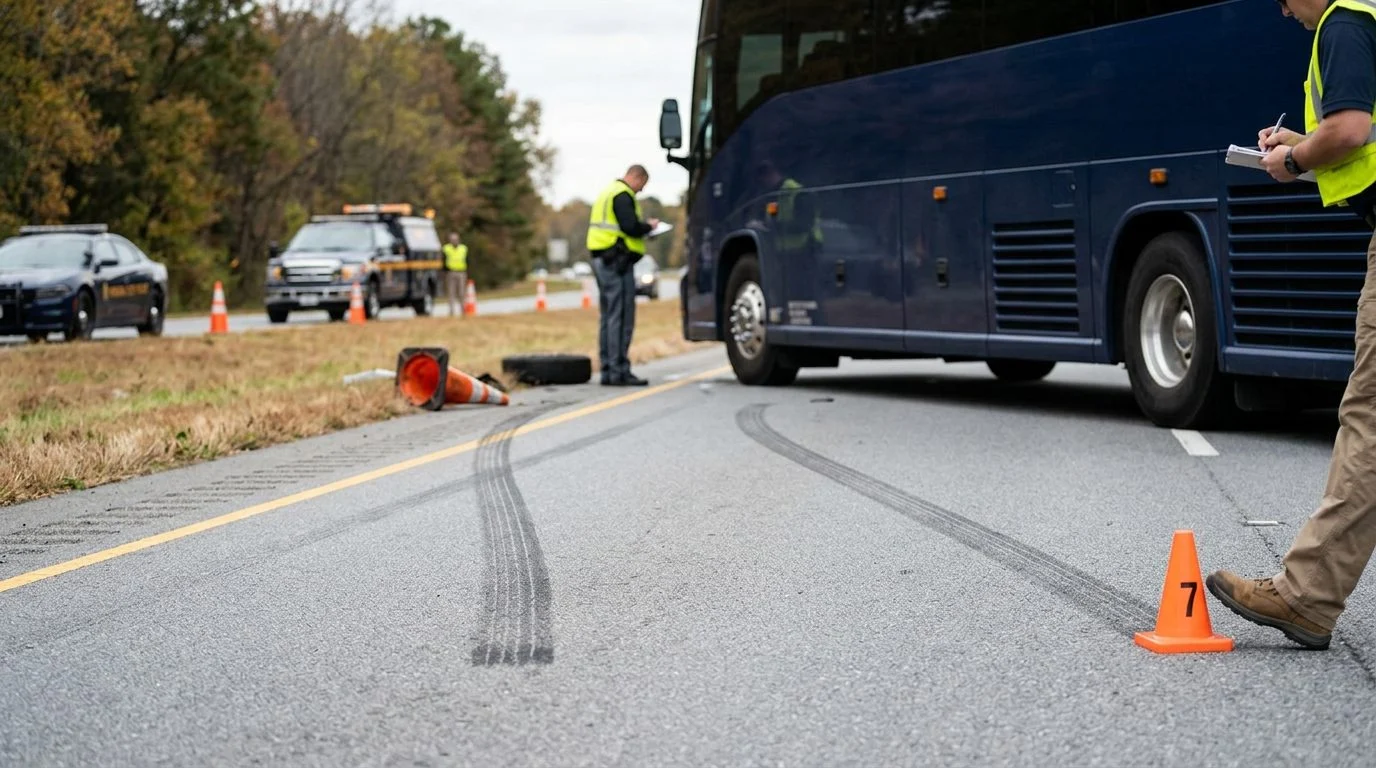
Early records from the scene matter just as much. The police crash report, photographs of the scene and vehicles, witnesses’ names and addresses, and any written statements all help build the timeline.
Medical records and treatment notes document the injuries and link them to the crash. Keep every visit summary, test result and therapy note, even when an injury seems minor.
Personal items matter too. Keep the clothing and shoes worn during the crash, along with any phone photos and messages sent that day. Do not discard damaged items.
Virginia Crash Reporting and Filing Deadlines
Virginia requires a driver involved in a crash with injury or death to stop and report it to police immediately (Va. Code §§ 46.2-371, 46.2-894).
Virginia generally allows two years from the date of injury to file a personal injury lawsuit (Va. Code § 8.01-243(A)); the clock runs from the date of injury, not the date of discovery, with narrow exceptions.
For the wider picture of truck and commercial vehicle crashes, see the truck accident lawyer guide.
Not sure what your next step is?
Talk it through with Correll Law Firm — we can walk you through how a situation like yours is usually handled and what your options are.
How Fault and Evidence Are Connected in Virginia
Virginia follows contributory negligence: if you are found even partly at fault, you may be barred from recovering, with limited exceptions. Talk to a lawyer about your facts.
Evidence often bears on fault. Video can show signals and speed. Data can show braking. Maintenance records can show whether a known problem was fixed. Dispatch records can show how the schedule was set.
Courts also look at causation. Early preservation of evidence matters. The record of what happened is the proof the case rests on.
Steps Injured People and Families Can Take to Keep Evidence Safe
Start with what you control. Photograph your injuries, the vehicles and the scene as soon as you safely can. Keep medical and billing paperwork in one folder. Save texts, emails and voicemails about the crash.
Write a detailed account of events while memory is fresh. Include times, directions, weather, traffic and what people said. Update it later, but keep the first version too.
Keep originals unchanged. Original files, such as photos on a phone, carry more weight than screenshots. Do not repair, wash away or throw away damaged items.
Families of someone killed in a bus crash face a different set of records. Keep the decedent’s personal, medical and employment papers together. Keep copies of anything sent by the bus company.
A Virginia wrongful death action is filed by the decedent’s personal representative within two years of the death (Va. Code §§ 8.01-50(C), 8.01-244(B)), on behalf of the family members the statute protects. The timing rule is in Va. Code § 8.01-244.
Finally, keep one organized folder with dates, names and copies of each record. A simple index makes it easier to see what is missing.
Frequently Asked Questions
Can dashcam footage from a bus help in a Virginia injury case?
It can, if the footage is kept in its original form and has not been overwritten.
Do all buses have an electronic data recorder?
No. Not every bus stores the same data, so the vehicle’s equipment has to be checked.
Do bus companies have to keep maintenance records?
Yes. Federal rules set minimum keeping periods for these records, as described above.