Truck Accidents in Richmond
Serious Truck Crash? Get the Help You Need Now
When a commercial truck collision leaves you injured, the stakes are high. Correll Law Firm represents Richmond residents in truck accident claims—from initial injury through recovery.
Published October 01, 2026
Truck Accidents in Richmond: What You Need to Know
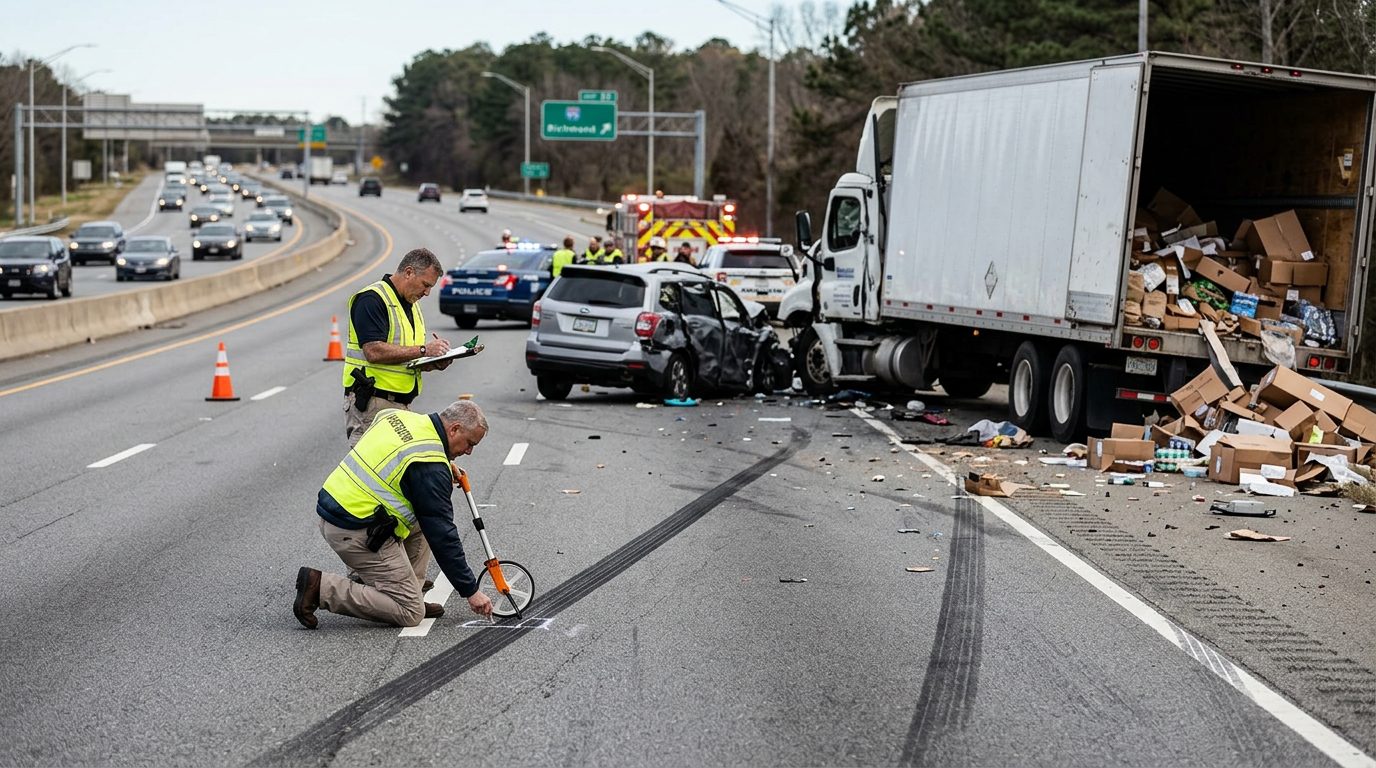
Truck accidents in Richmond can be far more dangerous than typical car crashes because commercial trucks are much heavier than passenger vehicles and need more distance to stop. When a truck collides with a car or another vehicle, the force and mass involved often result in severe or catastrophic injuries—injuries that change lives in an instant.
If you’ve been in a truck accident in Richmond, Henrico County, or anywhere in the Shenandoah Valley region, understanding what happened, who is responsible, and what comes next matters. This guide walks you through the realities of truck accidents and the steps you should take.
Not sure what your next step is?
Talk it through with our team — the first case evaluation is free, confidential, and carries no obligation.
Truck Accidents in Richmond: A Serious Reality
Truck accidents differ fundamentally from car accidents because of the sheer size and weight of commercial vehicles. A fully loaded tractor-trailer can weigh 80,000 pounds or more. When that mass hits a passenger vehicle traveling at highway speed, the occupants face forces far beyond what a typical car crash produces.
Richmond sits at the intersection of two major trucking corridors: Interstate 95 and Interstate 64. These routes carry commercial traffic daily, connecting the Port of Virginia to inland distribution centers and regional markets. Local roads throughout Henrico County and the surrounding area also see heavy truck traffic. With this much truck traffic, crashes are a real risk on Richmond-area roads—and when they happen, the consequences are often severe.
Truck accidents frequently result in traumatic brain injuries, spinal cord injuries, crush injuries, internal bleeding, and burns. Some accidents are fatal. The reason is simple: the physics of the collision overwhelm the protective structures of a car. Airbags, crumple zones, and seat belts help, but they cannot fully protect occupants from the force of a multi-ton truck.
Common Causes of Truck Accidents in Richmond
Truck accidents rarely happen by chance. Most are caused by one or more preventable factors.
Driver fatigue and hours-of-service violations are among the leading causes. The Federal Motor Carrier Safety Administration (FMCSA) enforces strict rules limiting how many hours a truck driver can work without rest. When trucking companies pressure drivers to exceed these limits, or when drivers ignore them, fatigue impairs judgment and reaction time—just as alcohol does. A fatigued driver cannot stop in time or avoid a hazard.
Mechanical failure and poor maintenance cause many accidents. Trucking companies are required by law to maintain their vehicles properly. Brakes that don’t work, tires that blow out, steering systems that fail, and coupling devices that come loose all create accidents. When a company cuts corners on maintenance to save money, people get hurt.
Improperly loaded or unsecured cargo shifts during transit, throws the truck off balance, and can cause a jackknife (when the trailer swings out from under the tractor). Cargo that falls onto the roadway creates secondary accidents. Federal rules bar a driver from operating a commercial truck, and a motor carrier from requiring or permitting it, unless the cargo is properly distributed and adequately secured.
Braking system failure deserves special mention. A truck’s braking system is complex. If brakes fail on a downhill grade—common on Virginia’s highways—the driver loses the ability to slow or stop. Jackknife accidents often result from improper braking or brake failure.
Poor road conditions and weather affect trucks more severely than cars. Rain, ice, and snow reduce traction. Potholes and debris on I-95 and I-64 can cause a driver to lose control. Trucks need more distance to stop on wet or icy roads.
Speeding and unsafe lane changes are driver errors that happen daily. A truck traveling too fast for conditions cannot stop in time. Changing lanes without checking blind spots—which are enormous on trucks—causes collisions with vehicles the driver never saw.
Dump Truck Accidents in Richmond
Dump trucks pose specific risks on the road. Dump trucks have large blind spots on all sides, making it difficult for drivers to see vehicles, pedestrians, and cyclists nearby. Their high center of gravity makes them prone to rollover, especially on curves or when cargo shifts.
Cargo spillage is a major hazard. When a dump truck’s bed isn’t fully raised or is raised improperly, gravel, dirt, or debris spills onto the roadway. This creates a slippery surface that causes following vehicles to lose control. Debris can also strike vehicles directly, causing accidents and injuries.
Dump trucks are often operated by smaller contractors who may not maintain their vehicles as rigorously as larger trucking companies. Liability in a dump truck accident can involve the driver, the dump truck owner, the company that hired the truck, the site that loaded it, and others—making these cases complex.
Injuries from Truck Accidents
The injuries caused by truck accidents are often severe because of the force involved.
Traumatic brain injuries (TBI) range from concussions to severe damage that causes long-term cognitive and behavioral changes. According to the Brain Injury Association of America, TBI can result in memory loss, difficulty concentrating, personality changes, and loss of independence. Recovery is often incomplete, and lifetime care costs can be substantial.
Spinal cord injuries can cause partial or complete paralysis. The National Institute of Neurological Disorders and Stroke (NINDS) notes that spinal cord injury severity depends on the location and extent of damage. Some people regain partial function; others do not. The lifetime medical costs and need for ongoing care are enormous.
Crush injuries occur when a vehicle is compressed between the truck and another object. These injuries cause internal bleeding, organ damage, and often require emergency surgery and extended hospitalization.
Burn injuries can result from fuel leaks, cargo fires, or electrical fires following a crash. Burn injuries are painful, require specialized medical care, and often result in permanent scarring and disfigurement.
A catastrophic truck accident can change a person’s life forever. Medical bills mount quickly. Lost wages accumulate. Families struggle to adapt. This is why holding the responsible parties accountable matters—and why you need experienced legal representation.
Have questions about what happened?
Ask our team directly. The first conversation is free, confidential, and there is no obligation to continue.
What to Do After a Truck Accident in Richmond
If you’re in a truck accident, your immediate priorities are safety and evidence.
Move to safety. If you can do so safely, move your vehicle out of traffic. If you cannot, stay in your vehicle with your seat belt on and wait for emergency responders.
Call 911. Report the accident and request police and emergency medical services.
Document the scene. Take photos of all vehicle damage, the accident scene, road conditions, traffic signs, and the truck’s license plate and company markings. Get the names and phone numbers of any witnesses.
Get information. Record the truck driver’s name, license number, company name, and insurance information. Note the truck’s company name, phone number, and any identifying marks.
Seek medical attention. Even if you feel fine, see a doctor. Some injuries—internal bleeding, spinal injuries, brain injuries—don’t cause immediate pain. A medical evaluation creates a record and identifies injuries early.
Report to police. Obtain a copy of the police accident report. This is crucial evidence.
Notify your insurance company. Report the accident to your insurer, but do not discuss fault or accept any settlement offer.
Do not discuss the accident with the truck driver, the trucking company, or their insurance company. Anything you say can be used against you. Let your attorney handle all communication.
Who Is Liable in a Truck Accident?
Determining liability in a truck accident is more complex than in a typical car accident because multiple parties may share responsibility.
The truck driver may be liable if they were speeding, fatigued, distracted, or violated traffic laws. However, the driver is rarely the only responsible party.
The trucking company is responsible for maintaining its vehicles, training drivers, ensuring compliance with federal safety regulations, and hiring qualified drivers. If the company failed in any of these duties and that failure caused the accident, the company is liable.
Third parties may also be liable. A cargo loader who improperly loaded the truck, a maintenance contractor who failed to repair brakes, a manufacturer who made a defective part, or a shipper who provided hazardous cargo all could bear responsibility.
Insurance coverage is complex. Commercial trucking policies typically carry higher liability limits than personal auto insurance. Determining which insurance applies, what the limits are, and how to recover requires in-depth knowledge.
Why You Need a Truck Accident Lawyer
Trucking companies and their insurers have experienced legal teams and substantial resources. They investigate accidents quickly, preserve evidence in their favor, and work to minimize liability. If you try to handle a truck accident claim alone, you’re at a severe disadvantage.
A truck accident lawyer understands federal and state trucking regulations. The FMCSA enforces detailed rules about driver hours, vehicle maintenance, cargo securement, and driver qualifications. Violations of these rules are evidence of negligence.
Evidence preservation is time-sensitive and technical. Electronic logging devices (ELDs) record driver hours, vehicle location, and engine diagnostics. Maintenance records, driver logs, dispatch records, and training files all matter. Trucking companies know this and may not preserve evidence unless a lawyer demands it. Once evidence is lost, it’s gone forever.
A thorough investigation identifies all liable parties and the full scope of your damages. Medical experts help quantify the long-term effects of your injuries. Economists calculate lost wages, loss of earning capacity, and lifetime care costs. This comprehensive approach helps make sure your claim reflects the full scope of your losses.
Correll Law Firm Serves Richmond Truck Accident Victims
Correll Law Firm represents people seriously hurt in truck accidents across Richmond, Henrico County, and the entire Shenandoah Valley region. We handle commercial vehicle accidents, catastrophic injuries, traumatic brain injuries, spinal cord injuries, and wrongful death cases.
We investigate thoroughly. We consult with medical experts, engineers, and economists. We hold trucking companies and their insurers accountable. Correll Law Firm has offices in Winchester and Harrisonburg, serving the region from the Shenandoah Valley to Richmond and beyond.
Want to know where you stand?
Tell us what happened and our team will walk you through the options available to you, at no cost.
Frequently Asked Questions
How long do I have to file a claim after a truck accident in Virginia?
Virginia law generally allows two years from the date of injury to file a personal injury lawsuit, but evidence can disappear and witnesses’ memories fade, so contacting an attorney quickly is important (Va. Code § 8.01-243).
What damages can I recover in a truck accident case?
You may recover medical expenses, lost wages, pain and suffering, loss of enjoyment of life, and in cases of permanent disability, the cost of lifetime care and assistance.
What is a jackknife accident?
A jackknife occurs when a truck’s trailer swings out from under the tractor, often due to braking failure, improper braking, or loss of traction, creating a dangerous V-shape that can strike multiple vehicles.
Should I talk to the trucking company’s insurance adjuster?
No. Anything you say can be used against you. Let your attorney handle all communication with insurers and the trucking company.
What evidence is most important in a truck accident case?
Electronic logging device data, maintenance records, driver logs, dispatch records, photos of the scene, witness statements, and the police report are all critical.
If you or someone you care about was hit by a truck in Richmond or Henrico County, you may have a claim. Contact Correll Law Firm for a free case evaluation today.
Act Quickly
Evidence at a crash scene can disappear, and witness memories fade fast. The sooner you contact an attorney, the better your case can be preserved and investigated.
What Happens After a Truck Accident
Immediate Steps
Seek medical attention for injuries, document the scene if safe, gather witness information, and report the crash to police. Do not admit fault or sign anything without legal advice.
Insurance & Legal Claims
Notify your insurance company, but remember that commercial truck operators and their employers often have large insurance policies. An attorney protects your rights during negotiations.
Investigation & Evidence
Truck accidents require careful investigation—driver logs, maintenance records, load documentation, and black box data all matter. Early action preserves critical evidence.
Your Recovery
Medical bills, lost wages, and pain and suffering add up fast. We help you understand what damages may be recoverable and pursue fair compensation.
Why Correll Law Firm for Your Truck Accident Case
Focused on Serious Injury
We handle serious injury cases, including catastrophic injuries, traumatic brain injury, spinal cord damage, and wrongful death. Your case gets the attention it deserves.
Serving Richmond & Henrico County
With offices in Winchester and Harrisonburg, we serve injured residents throughout the Shenandoah Valley and Richmond area.
Thorough Case Investigation
Truck crashes demand detailed investigation. We work to uncover driver negligence, mechanical failure, improper loading, and corporate liability.
Free Case Evaluation, No Fees Unless There Is a Recovery
We offer a free, confidential case evaluation to discuss your case. No attorney’s fee unless we win. Clients may remain responsible for costs accrued in the case.
Common Questions About Truck Accidents in Richmond
How long do I have to file a claim?
Virginia law generally allows two years from the date of injury to file a personal injury lawsuit (Va. Code § 8.01-243). However, evidence can disappear and witnesses' memories fade, so contacting an attorney quickly is important.
What damages might I recover?
You may pursue recovery for medical expenses, ongoing treatment and rehabilitation, lost wages, pain and suffering, and other losses caused by the accident. Each case is unique.
Who is liable in a truck accident?
Liability may rest with the truck driver, the trucking company, the vehicle owner, a maintenance contractor, or the cargo loader—sometimes multiple parties. A thorough investigation identifies who is responsible.
Should I talk to the insurance company?
Report the accident to your own insurer, but be cautious with the other side's insurance adjuster. An attorney can handle communications and protect your rights during settlement discussions.
Ready to Discuss Your Truck Accident Case?
Related practice areas
- Truck Accident Lawyer in Virginia | Correll Law Firm
- Traumatic Brain Injury Car Accident Lawyer Virginia