
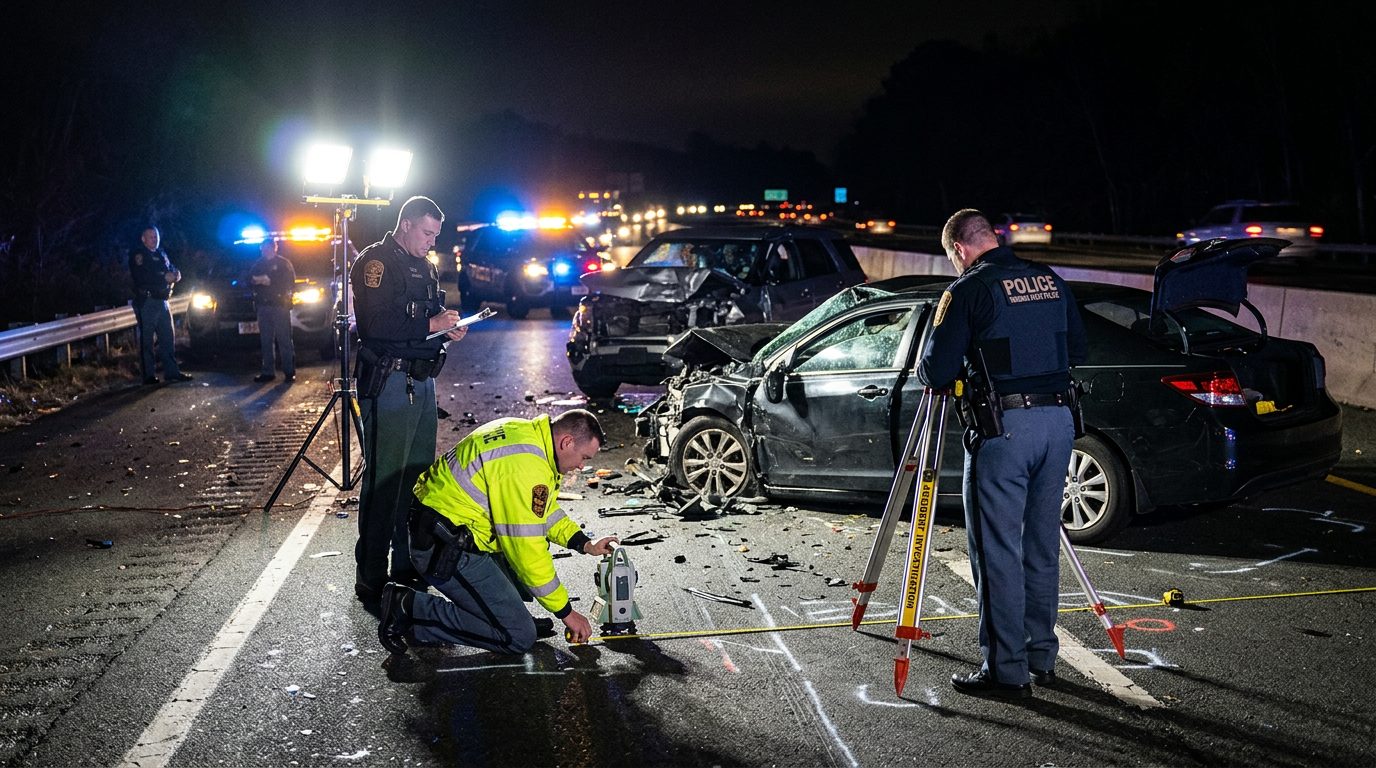
Car Accidents | Virginia
Reporting a Virginia Crash Cannot Wait
Here is what that means and why acting quickly matters.
Published October 27, 2026
How long do I have to file a police report in Virginia? The law sets no number of days, so waiting is never a safe plan.
Many people only learn it after a crash has already happened.
The short answer: Virginia requires reporting right away
Virginia requires a driver involved in a crash with injury or death to stop and report it to police immediately (Va. Code §§ 46.2-371, 46.2-894).
The driver must then give their name, address, driver’s license number and vehicle registration number to the State Police or a local law enforcement agency, or to the injured person, the other vehicle’s driver or occupant, or the custodian of the damaged property.
The driver must also give reasonable help to an injured person. That includes taking the person to a doctor, surgeon or hospital when treatment is apparently needed or the person asks for it.
The statute sets no number of days. A later date is not a safe assumption. If you are unsure which other steps apply to your crash, ask the officer who responds.
Not sure what your next step is?
Talk it through with Correll Law Firm — we can walk you through how a situation like yours is usually handled and what your options are.

Police report deadline versus the lawsuit deadline
The two-year number people remember is a deadline to file a lawsuit, not a deadline to report a crash. Virginia generally allows two years from the date of injury to file a personal injury lawsuit (Va. Code § 8.01-243(A)); the clock runs from the date of injury, not the date of discovery, with narrow exceptions. The lawsuit rule is in Va. Code § 8.01-243.
These are two separate clocks. Reporting a crash follows the immediate duty described above. A lawsuit follows a filing deadline that runs on its own schedule. Meeting one does not meet the other.
Some claims carry notice requirements with deadlines that arrive before the filing deadline.
When the crash involved a death
The same immediate reporting duty applies when a crash kills someone. The rule covers any crash involving injury or death.
A Virginia wrongful death action is filed by the decedent’s personal representative within two years of the death (Va. Code §§ 8.01-50(C), 8.01-244(B)), on behalf of the family members the statute protects. The filing deadline appears in Va. Code § 8.01-244. The action itself is described in Va. Code § 8.01-50.
The personal representative brings a wrongful death action, but a fetal death action is brought by and in the name of the natural mother, or, if she dies or is under a disability, by the administrator of her estate, her guardian, or her personal representative (Va. Code § 8.01-50).
Losing someone in a crash brings enough to handle. Knowing who files the case and when can take one question off the list.
Practical steps after a crash
Your first priorities are safety and medical care. A clear record of the scene comes next. These steps help:
- Call 911 or the local police number if anyone is hurt.
- Move to a safe spot if you can do so without added risk.
- Get medical attention if anyone is hurt, even if the injury seems minor. The National Institute of Neurological Disorders and Stroke describes traumatic brain injury as caused by a bump, blow or jolt to the head, so any head impact deserves a medical check.
- Write down the other driver’s name, the vehicle’s plate number, and the time and place of the crash.
- Take photos of the vehicles and the scene while they are still there.
Keep notes factual and brief. Stick to what you saw and heard.

When it may be worth discussing your situation with a lawyer
You may wish to talk with a lawyer when a crash is still being sorted out, an injury is still being assessed, or a family has lost a loved one. Who was at fault is often the first question people face. Virginia follows contributory negligence: if you are found even partly at fault, you may be barred from recovering, with limited exceptions. Talk to a lawyer about your facts.
The firm focuses on car and truck crashes, catastrophic injuries and wrongful death. It has offices in Winchester and Harrisonburg and serves people from the Shenandoah Valley to Richmond and Henrico County.
Frequently asked questions
Does the same rule apply to a truck crash?
Yes.