
Truck Accidents | Virginia
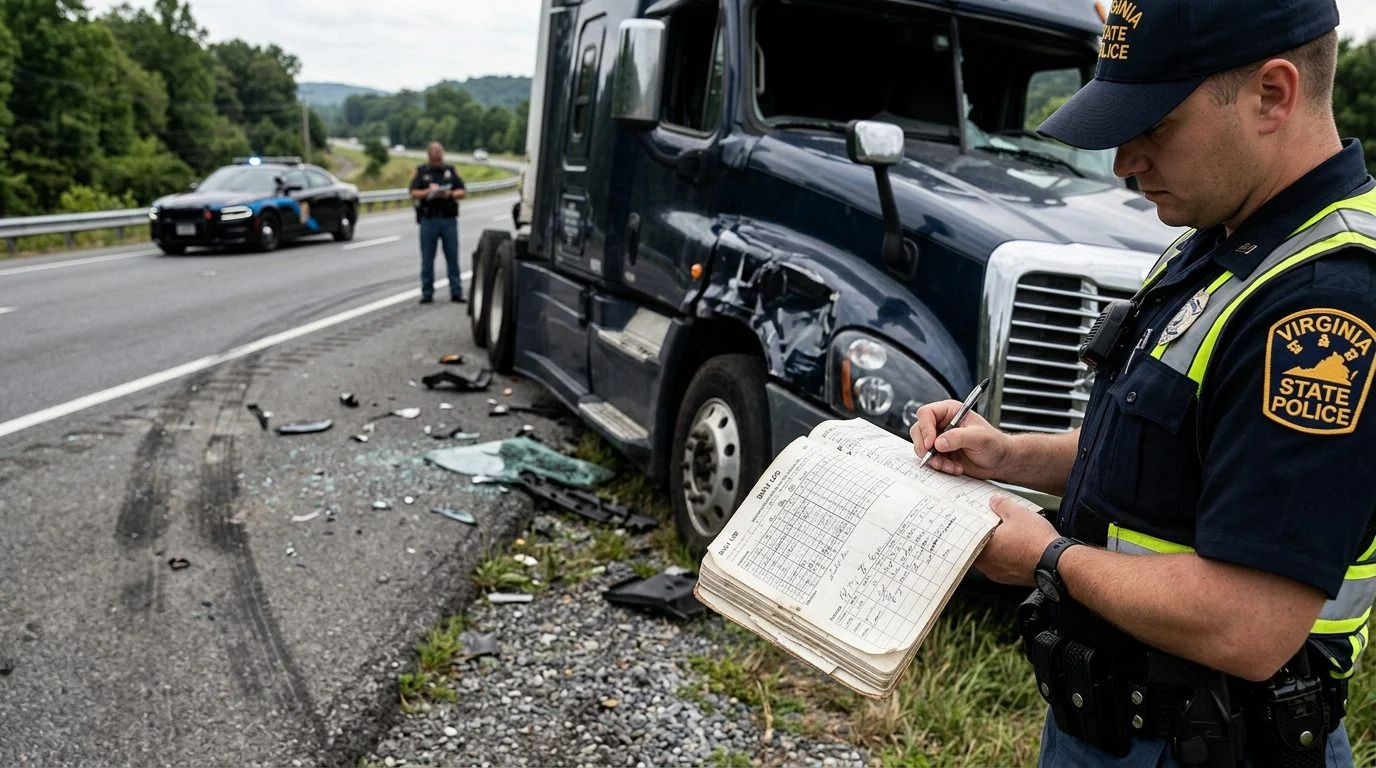
Trucking Company Logbooks After a Crash in Virginia
How driver logs and hours-of-service records can matter in a truck crash claim, and why it helps to act early.
Published October 30, 2026
What truck crash records are and why they can matter after a serious injury
After a truck crash in Virginia, people usually want to know which trucking company records, such as logbooks, exist and what they show. These records describe what the driver and the company were doing before a crash, and they can matter when a serious injury is involved.
The main records are driver logs, electronic logging device data, engine or event data, driver and carrier files, maintenance and inspection records, and dispatch or location data. Most of them are held by the driver and the trucking company, not by the injured person. They are usually not in anyone’s hands at the scene.
Whether any record matters depends on the facts of the crash, the injuries and the claims involved. For a broader guide to serious injury claims, read the catastrophic injuries guide.
Not sure what your next step is?
Talk it through with Correll Law Firm — we can walk you through how a situation like yours is usually handled and what your options are.

Virginia crash reports and the duty to report
Virginia requires a driver involved in a crash with injury or death to stop and report it to police immediately (Va. Code §§ 46.2-371, 46.2-894). The rule about immediate notice of these crashes is also written in Va. Code § 46.2-371.
This duty is separate from the deadline to file a lawsuit. The two-year period covered later in this article is a deadline for filing a lawsuit (Va. Code § 8.01-243). It is not a deadline for reporting a crash.
A police crash report is one of the first records that documents the scene, the vehicles and the people involved. It is a different document from the company’s own logs and files, so it does not replace them. You can read about requesting a copy in the guide to getting a Virginia crash report.
Paper logbooks and electronic logging devices
A driver’s record of duty status is the log that shows what a driver was doing across each day. Federal rules require a motor carrier to make each driver record duty status for each 24-hour period (49 C.F.R. § 395.8).
Older logs were filled in by hand. An electronic logging device, or ELD, is equipment connected to the truck that records driving time automatically. Federal rules list what an ELD must record, including date, time, location, engine hours, vehicle miles, and the identity of the driver and the vehicle (49 C.F.R. § 395.26). When the truck is moving and nothing has been logged for an hour, the device adds an intermediate entry. That gives a more continuous picture than a handwritten page.
Logs show categories of time: driving, on duty but not driving, sleeper berth and off duty. They can show when a truck was moving and when the driver was resting. Their limits matter too. A log is only as accurate as the entries in it. Federal rules say that no driver or motor carrier may make a false report in connection with a duty status (49 C.F.R. § 395.8).
Records from different companies can then be compared with each other.
Hours-of-service rules and how inaccurate logs are identified
Hours-of-service rules limit how long a driver may drive and how long a driver may work. A driver may not drive without first taking 10 consecutive hours off duty. A driver may not drive after 14 consecutive hours that begin once the driver comes on duty after that break. Under 49 C.F.R. § 395.3, except as otherwise provided in § 395.1, a property-carrying commercial motor vehicle driver is barred from driving once 14 consecutive hours have passed after the driver comes on-duty following 10 consecutive hours off-duty, and the driver may drive a total of 11 hours within that 14-hour period.
The rules also require a consecutive 30-minute break after more than 8 hours of driving time, with some exceptions. 49 C.F.R. § 395.3 reads: “Except for drivers who qualify for either of the short-haul exceptions in § 395.1(e)(1) or (2), driving is not permitted if more than 8 hours of driving time have passed without at least a consecutive 30-minute interruption in driving status.” Weekly limits apply as well, depending on whether the carrier runs trucks every day of the week.
Reviewers often test a log by comparing it with other records. Fuel receipts, toll records, engine data, GPS data and dispatch messages can show where a truck was and when it moved. If the times and places do not line up, the entry may raise questions. The reason for a mismatch depends on the facts.
A log problem matters most when it connects to the crash.
Engine and event data recorders in the truck
Many heavy trucks have an electronic control module that can store some information around a sudden event, such as a hard stop or a collision. Whether a given truck has this capability depends on its make, model and equipment.
Whether stored information still exists depends on the vehicle and on what was preserved after the crash. A truck that is repaired, reset or put back into service can lose data that was not saved first. Federal rules also let companies destroy older records at the discretion of management once the minimum retention periods end, but they do not excuse compliance with any other governmental body’s lawful requirements for longer retention periods (49 C.F.R. § 379.3).
Event data is only as useful as the record of how it was downloaded, stored and read. Someone should be able to show who pulled the data, when, and with what tools. Without that chain of custody, it is harder to rely on what the data appears to show.
The specific information a module can hold varies by vehicle, so the records themselves should be reviewed rather than assumed.
Driver qualification files and carrier safety records
A motor carrier must keep a driver qualification file for each driver it employs. That file may be kept with the driver’s personnel file (49 C.F.R. § 391.51).
The qualification file for a driver must include the driver’s application for employment, copies of motor vehicle records from licensing authorities, road test records and medical examiner’s certificates. A carrier must keep the file for as long as the driver works for it and for three years after that, except for records that may be removed three years after their execution as provided in § 391.51(d) (§ 391.51).
These files can bear on whether a carrier followed its own safety steps before putting a driver on the road. Records of past violations, training and testing may be relevant. What these files show varies by company and by the facts of the case.
A carrier’s safety records exist at the company level as well as for each driver. A driver’s file and the company’s own safety program are separate sources, and both can matter.
Not sure what your next step is?
Talk it through with Correll Law Firm — we can walk you through how a situation like yours is usually handled and what your options are.
Maintenance, inspection and roadside inspection records
Carriers must keep records of inspection, repair and maintenance for each vehicle they control. Those records must show the date and nature of the work (49 C.F.R. § 396.3).
The rule also says parts and accessories must be in safe and proper operating condition at all times. That includes the frame, suspension, axles, wheels and steering systems (§ 396.3). Maintenance records must be kept where the vehicle is housed or maintained for one year, and for six months after the vehicle leaves the carrier’s control (§ 396.3(c)).
Roadside inspections create another record. An inspection report shows what an inspector found at a particular time and place. The Commercial Vehicle Safety Alliance says commercial vehicle inspections may examine a driver’s record of duty status and hours-of-service compliance (CVSA inspection levels).
Maintenance records and inspection reports are compared with the equipment in the crash. Parts that were replaced or removed after the crash can be important, so records of later repairs deserve attention.
Dashcam video, GPS, cell phone and dispatch records
Many trucks carry dashcams. Some carriers use GPS tracking, which can show a truck’s route, stops and movement over time. Whether this video and location data still exists depends on the company’s own practices. Once minimum retention periods end, companies may destroy records at their discretion, but this does not excuse compliance with the lawful requirements of any other governmental body prescribing longer retention periods (49 C.F.R. § 379.3).
Dispatch and messaging records show when a driver got a load, a delivery time or a route change. A driver’s log shows duty status, while a dispatch record shows what the company asked the driver to do. The two can be read together.
Phone records and device use may also be relevant. How such records are obtained depends on the facts and on the legal process that applies.
Witness names and contact details recorded at the scene can help match these records to the events of the crash. Dates, times and locations written down early make that matching easier.
Why timing matters when records may be lost or changed
Records can be overwritten, replaced, repaired or discarded through normal business practices. The sooner they are identified, the easier they are to compare with the rest of the evidence.
Virginia generally allows two years from the date of injury to file a personal injury lawsuit (Va. Code § 8.01-243(A)); the clock runs from the date of injury, not the date of discovery, with narrow exceptions. Some claims carry notice requirements that run out sooner than two years.
For wrongful death, a Virginia wrongful death action is filed by the decedent’s personal representative and must be brought within the time limits specified in § 8.01-244 (two years after the death) (Va. Code § 8.01-50(C), § 8.01-244(B)), on behalf of the family members the statute protects.
A reader may wish to talk with a lawyer about which records apply to their own facts. The timing of requests is part of that discussion.

Which truck crash records may matter for a serious injury claim
Each record can answer a different question. Logs show duty time. Electronic logging device data adds automatic entries. Event data may capture a sudden event. Driver files, maintenance records, inspection reports, dashcam video, GPS data and dispatch messages each add another piece.
Talk to a lawyer about your facts.
Records do not tell a complete story alone. Each one must be read with the crash report, the injuries and the other evidence. What matters depends on the facts.
The firm’s Winchester and Harrisonburg locations serve clients across the region. It serves people across the Shenandoah Valley, including surrounding localities. Readers in Richmond and Henrico County can see the Richmond page and the Henrico County page.
Frequently asked questions
Can a trucking company logbook show a driver broke hours-of-service rules?
A log can show time that does not fit the federal limits, and reviewers often compare it with other records. Whether a violation occurred depends on the facts.
How long do trucking companies keep logbooks?
Federal rules require carriers to keep records of duty status and supporting documents for at least six months from the date of receipt (49 C.F.R. § 395.8).
Do dashcam or GPS records always exist?
Not always. Whether they still exist depends on the equipment and on the company’s retention practices.