
Car and Truck Accidents | Virginia
What Happens After You File a Police Report in Virginia
A plain-language guide from Correll Law Firm to what a crash report contains, what it does not decide, and the practical steps that often follow a crash.
Published October 29, 2026
What happens after you file a police report? The officer’s written report becomes the official record of the crash. It describes the vehicles, the people involved, the scene and any injuries the officer sees. It is evidence, not a final ruling on who was at fault. This guide explains each step in plain language, from the scene to the file that may matter later in a Virginia injury claim.
Why a Police Report Matters After a Crash
A police report is the official written account of a crash. It records when and where the crash happened, who was involved, what the road and vehicles looked like, and what injuries were visible or reported.
People often look at the report first after a crash that causes injury. Insurance adjusters, lawyers and courts may all ask for it. It gives a neutral starting point for facts that could otherwise be disputed weeks later, when memories have faded.
The report does not replace other proof. Medical records, photos, repair estimates and witness accounts all help show what happened. Still, the report is often the first place those facts are written down by someone other than the drivers.
Serious injuries raise the stakes. People with head, spine or other lasting injuries need to understand how the report fits into a longer claim. The catastrophic injury page offers more detail on serious injury claims.
Not sure what your next step is?
Talk it through with Correll Law Firm — we can walk you through how a situation like yours is usually handled and what your options are.

What Police Do at the Scene After You File a Report
At the scene, officers first check on injuries. They make sure medical help is on the way and that traffic does not hit the crash.
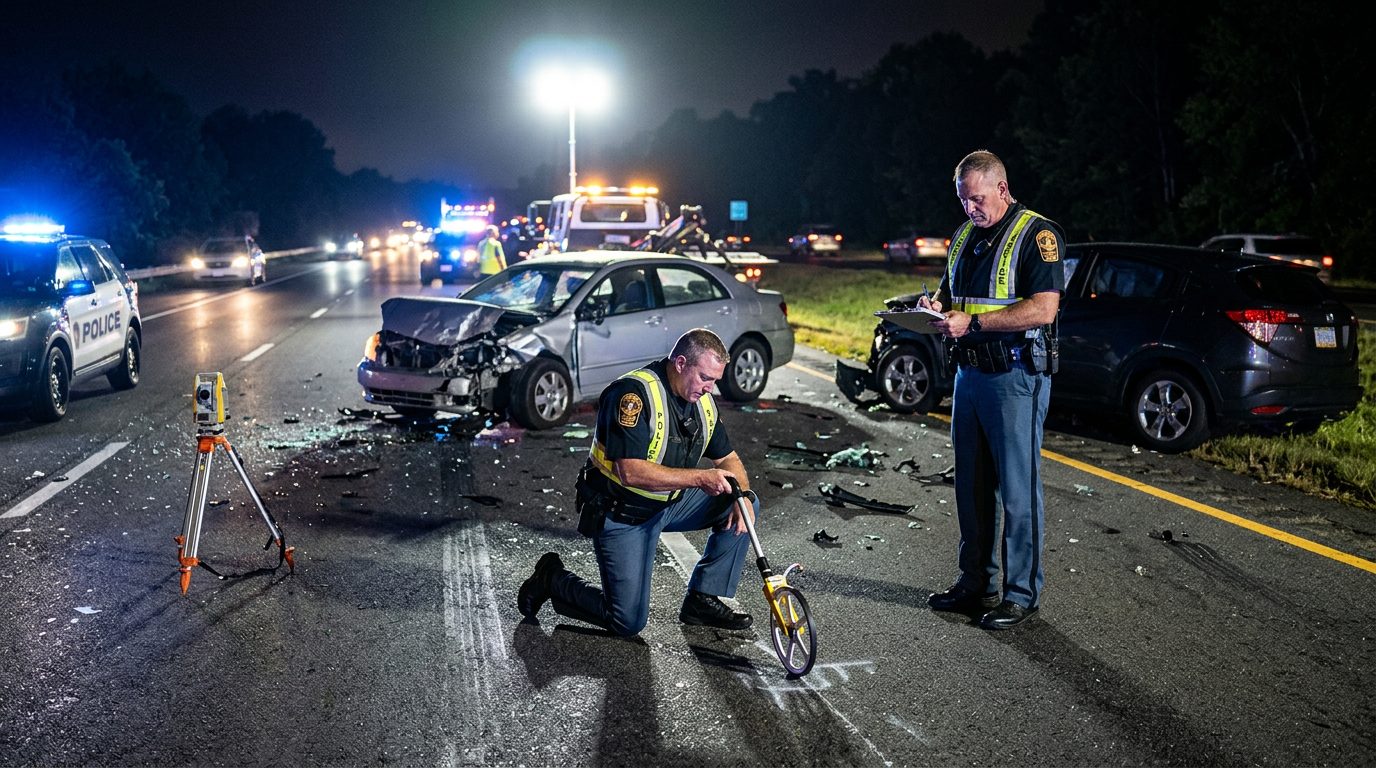
Officers usually note where each vehicle came to rest, the damage to each one, skid marks, debris, traffic signals and road and weather conditions. They may photograph the scene and measure distances. These details fade quickly once vehicles are moved and the road reopens.
Officers often speak with drivers, passengers and witnesses before they leave. They listen to each person’s account and note who saw what. An officer may also ask a driver to explain what happened in their own words.
The officer usually writes the report after the scene, not on the roadside. That is why facts you give at the scene, and facts you recall soon after, matter. Write down what you remember while it is fresh, and note the names of anyone who stopped to help.
What Information Police Ask For and the Statement You May Be Asked to Give
Police usually ask for your name, address, driver’s license number and vehicle registration number. They also ask for insurance information, the make and model of your vehicle, and the time and location of the crash.
Virginia law sets out the information a driver must share after a crash with injury (Va. Code § 46.2-894). Having these items ready at the scene saves time and avoids errors later.
Police may also ask each driver, passenger and witness for a statement. A statement is a short account of what the person saw, heard or did. It becomes part of the file and may be compared with what others say.
When you give a statement, stick to facts you know. Say so when you are unsure of something, such as speed or distance. Avoid guessing about fault or how badly someone was hurt. A short, honest “I don’t know” is better than a guess that proves wrong.
What Happens After the Officer Leaves: Follow-Up and Contact
After the officer leaves, the report usually goes through review. A supervisor may check it for accuracy and completeness before it is final.
Follow-up is common when facts are unclear. An officer may reach out to drivers, passengers or witnesses to clarify details or add information that came up after the scene. Witnesses who were not at the scene may also be contacted, sometimes days or weeks later.
Reports can be supplemented or corrected. If new facts come to light, such as a medical update or a witness who comes forward, the agency that wrote the report can add that information.
Keep a written note of every contact. Record the date, the officer’s name and what was discussed.
What Happens When a Police Report Is Filed Against You
Being named in a police report is not the same as a final finding of fault. The report records one account and what the officer observed. It does not decide who was responsible.
Still, a report that names you can matter. Insurers may rely on it early, and fault is often disputed after a crash. Virginia follows contributory negligence: if you are found even partly at fault, you may be barred from recovering, with limited exceptions. Talk to a lawyer about your facts.
If you were named in a report, keep your own notes, photos and the names of witnesses. Write down the time, weather and road conditions while you remember them. You may wish to review the report with a lawyer.
If the other vehicle was a commercial truck, the report may name a commercial driver and a company. The truck accident page covers that situation, and the commercial vehicle accident page covers work vehicles.
How Long the Report Process Takes and How to Request a Copy
The time from crash to finished report varies by agency and by how complicated the crash was. No single timeline fits every crash, and the timing depends on the facts.
Simple property-damage crashes are often finished sooner. A crash with serious injury or death can take longer, because the investigation may involve more witnesses, measurements and records.
To get a copy, you usually request it from the police agency that wrote the report, and that agency sets its own process. The Virginia Department of Motor Vehicles maintains official records of reportable crashes and supports requests for police crash reports.
If police never came to the scene, the crash can still be reported.
Not sure what your next step is?
Talk it through with Correll Law Firm — we can walk you through how a situation like yours is usually handled and what your options are.
Reporting Duties, Filing Deadlines and How the Report Fits an Injury Claim
A police report documents the crash, but it does not start or stop the deadline to sue. Virginia requires a driver involved in a crash with injury or death to stop and report it to police immediately (Va. Code §§ 46.2-371, 46.2-894).
Virginia generally allows two years from the date of injury to file a personal injury lawsuit (Va. Code § 8.01-243(A)); the clock runs from the date of injury, not the date of discovery, with narrow exceptions. The statute is at Va. Code § 8.01-243, and the accrual rule is at Va. Code § 8.01-230.
Keep the two deadlines separate. The two-year period is the deadline to file a lawsuit, not the deadline to report a crash. Some claims carry notice requirements that run out sooner. Under Va. Code § 15.2-209, every claim for negligence against a county, city, or town is forever barred unless the claimant or their agent, attorney, or representative has filed a written statement of the nature of the claim, including the time and place at which the injury is alleged to have occurred, within six months after such cause of action accrued. Failure to file that statement does not bar the claim if the locality’s attorney, chief executive or mayor, or the insurer or entity covering the claim, had actual knowledge of the claim, including its nature and the time and place of injury, within that six-month period.
A Virginia wrongful death action is filed by the decedent’s personal representative within two years of the death (Va. Code §§ 8.01-50(C), 8.01-244(B)), on behalf of the family members the statute protects. The deadline is at Va. Code § 8.01-244. When a crash is fatal, the report is often the starting record. The pedestrian fatal crash page covers the family side in more detail.
In an injury claim, the report sits alongside medical records, photos and witness statements.
Quick Answers
Does a police report decide who is at fault?
No. It records the officer’s observations and the accounts given at the scene.
How long does a police report take?
It depends on the agency and the facts. Serious crashes often take longer than minor ones.
Can I get a copy of a Virginia crash report?
Yes. Request it from the police agency that wrote it, or start with the Virginia DMV records page linked above.