
Virginia Car and Truck Crash Claims
Partly at Fault in a Virginia Crash? Understand How Fault Is Viewed
A plain-language guide for injured people and families in the Shenandoah Valley, Richmond and Henrico County who are facing questions about blame.
Published November 9, 2026
Being hurt in a crash is hard enough. Then someone suggests you were partly to blame, and you wonder whether you can recover anything at all. In Virginia, partial fault can bar a claim entirely, so the question matters early. This page explains how fault is assessed after a crash.
Under Virginia’s contributory negligence rule, how would fault be assessed if the injured person was partly responsible for the crash?
A judge or jury asks whether the injured person’s own negligence helped cause the crash. If it did, the claim can be barred, not simply lowered. Virginia follows contributory negligence: if you are found even partly at fault, you may be barred from recovering, with limited exceptions. Talk to a lawyer about your facts.
The answer depends on the facts of the crash. In practice, the question is less about who started the trouble and more about whether the injured person’s conduct helped bring about the crash. For background on serious spinal injuries, see the spinal cord injury overview.
If you were hurt in a crash and worry your own part could affect your claim, you do not have to face that question alone. Talk it through with Correll Law Firm — we can walk you through how a situation like yours is usually handled and what your options are.

What contributory negligence means for a crash claim
Speeding, following too closely, and running a red light are common examples. The Insurance Institute for Highway Safety reports that red-light running is evidence of unsafe driving and can cause crashes and serious injuries.
Contributory negligence asks a narrower question than who was more careless (Williams v. Harrison, 255 Va. 272 (1998)). It asks whether the injured person’s negligence was a proximate cause of the crash.
Because the rule works as a bar, the size of a lapse matters less than whether it helped cause the crash.
How fault is weighed when several drivers or parties are involved
Many crashes involve more than two people. A truck crash may involve the driver and the motor carrier that employs the driver.
A judge or jury looks at each party’s actions in the minutes before the crash. The question is whether each action helped cause the injury.
Commercial drivers face added federal rules. A driver may not text while driving, where driving means operating a commercial motor vehicle with the motor running, including while temporarily stationary because of traffic, a traffic control device, or other momentary delays, but not after the driver has moved the vehicle to the side of, or off, a highway and halted where it can safely remain stationary (49 C.F.R. § 392.80), and a motor carrier may not allow or require it, except that texting is permissible when necessary to communicate with law enforcement officials or other emergency services. A driver may not operate a commercial motor vehicle while fatigue, illness, or any other cause has impaired, or is likely to impair, the driver’s ability or alertness so as to make it unsafe (49 C.F.R. § 392.3), except that in a case of grave emergency where compliance would increase the hazard to occupants of the vehicle or other highway users, the driver may continue to operate the vehicle to the nearest place at which that hazard is removed. For drivers of property-carrying commercial motor vehicles, hours-of-service limits also cap driving time (49 C.F.R. § 395.3).
It does not apply to every crash.
What evidence bears on fault in a Virginia crash
Fault disputes usually turn on what each driver did in the moments before impact. Evidence from that short window matters most.
Virginia requires a driver involved in a crash with injury or death to stop and report it to police immediately (Va. Code §§ 46.2-371, 46.2-894). The driver must also stop as close to the scene as possible and render reasonable assistance (Va. Code § 46.2-894).
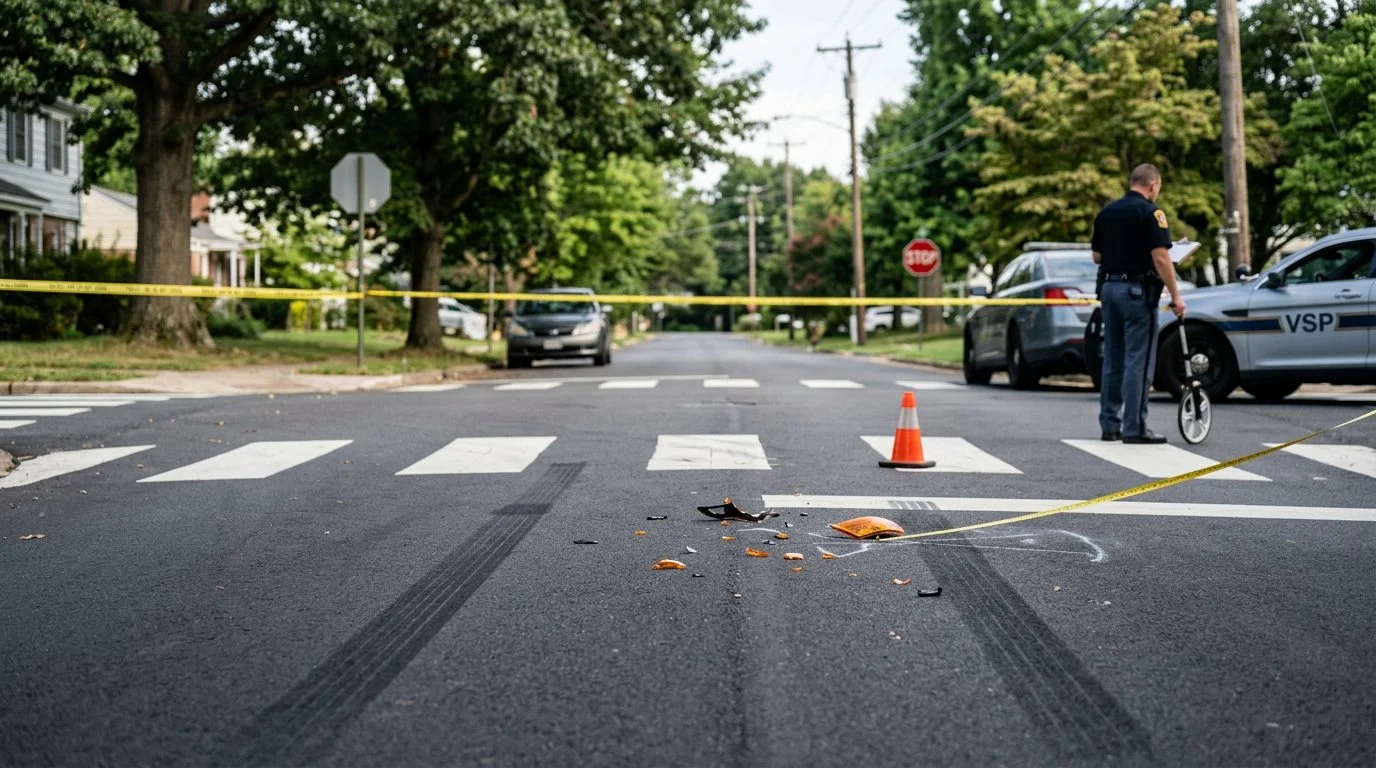
Useful evidence often includes the police report, photographs of the scene and vehicles, witness statements, and dashcam or traffic camera footage. Vehicle data, medical records that tie the injuries to the crash, and testimony from accident reconstruction professionals can test each side’s account.
Evidence can disappear quickly. Vehicles are repaired, and footage can be overwritten, so early preservation matters.
How the time limit fits with fault questions in a Virginia injury claim
Virginia generally allows two years from the date of injury to file a personal injury lawsuit (Va. Code § 8.01-243(A)); the clock runs from the date of injury, not the date of discovery, with narrow exceptions. The statute text is at Va. Code § 8.01-243.
The two-year period is the deadline to file a lawsuit, not the deadline to report a crash to police. A criminal case arising from the same facts can also affect the timing. While that prosecution is pending, its time is not counted toward the civil filing period (Va. Code § 8.01-229).
Some claims carry notice requirements that run out sooner, so don’t assume two years covers every claim. Fault disputes can take time to sort out, but the filing clock does not wait for them.

Why catastrophic injury cases raise the same fault questions
Traumatic brain injury and spinal cord injury cases often involve long medical records and disputed accounts of how the crash happened. That makes fault a central question.
The injured person’s own conduct is measured by the same proximate cause test.
Brain injury can affect a person’s memory of the crash. Spinal injury can make it hard to gather records and describe events. Witness accounts and physical evidence can matter more as a result.
For that reason, a person may wish to speak with a lawyer early, while the evidence is still fresh.