
Car Accidents | Virginia
Reading a Virginia Car Accident Police Report, Line by Line
A plain-language guide to the boxes, codes and diagrams in the report, and why they matter after a serious crash.
Published November 12, 2026
After a crash that left someone badly hurt, the police report is often the first written record of what happened.
It also covers what the report can and cannot tell you, and the mistakes readers often make with it.
What a Virginia Police Crash Report Is
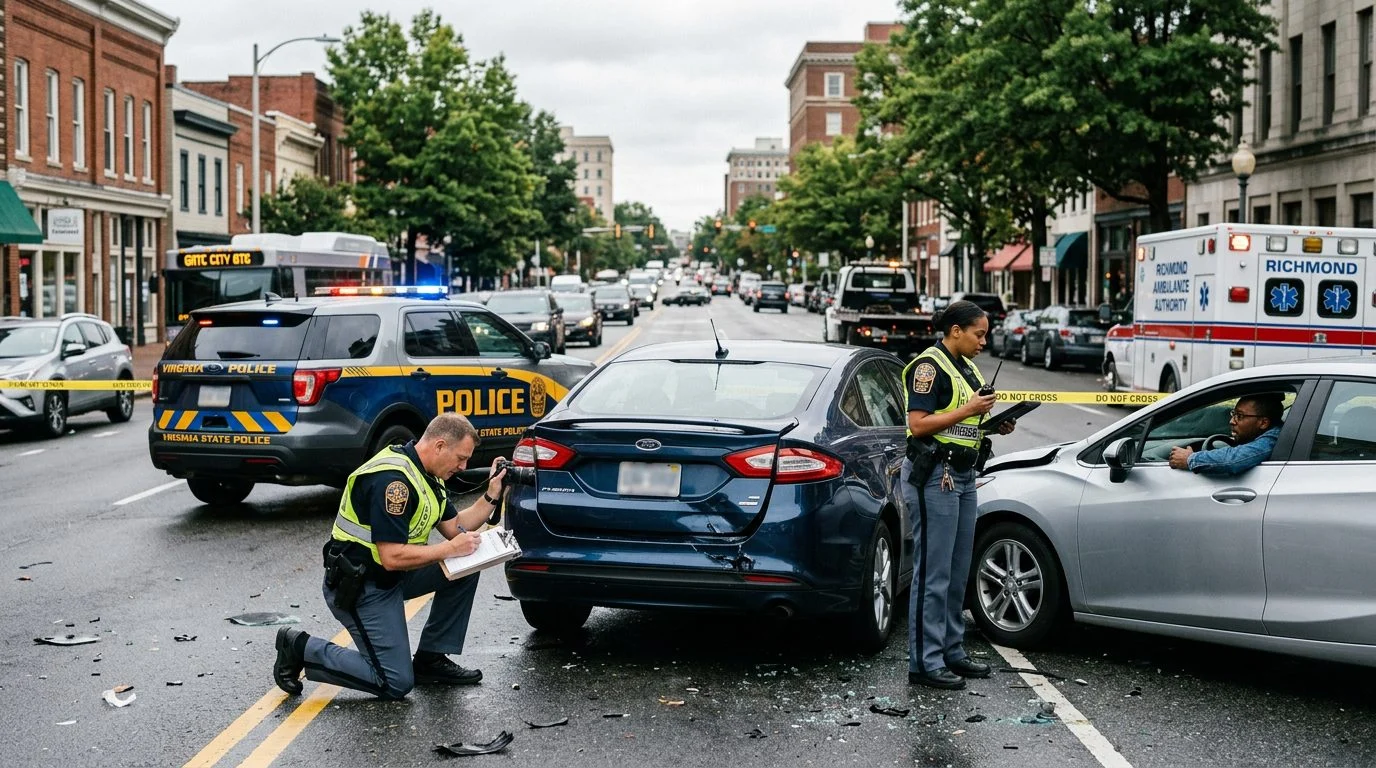
A Virginia police crash report is the official record an investigating officer creates after a crash. It usually includes the facts the officer observed at the scene, information about each vehicle and person involved, and the officer’s notes and diagram.
Virginia requires a driver involved in a crash with injury or death to stop and report it to police immediately (Va. Code §§ 46.2-371, 46.2-894).
The report is a record of what the officer documented. It is not a final ruling on who caused the crash or on any legal claim. For background on brain injuries after a crash, read about traumatic brain injury after a car or truck crash.
Not sure what your next step is?
Talk it through with Correll Law Firm — we can walk you through how a situation like yours is usually handled and what your options are.
Which Agency Keeps the Report
The law enforcement agency that responded to the crash keeps the report. That is either the Virginia State Police or a local law-enforcement agency.
Under the reporting statute, a driver involved in a crash in which a person is killed or injured, or in which an attended vehicle or other attended property is damaged, is required to immediately stop as close to the scene as possible without obstructing traffic and report his name, address, driver’s license number and vehicle registration number forthwith to the State Police or a local law-enforcement agency, to the person struck and injured if that person appears to be capable of understanding and retaining the information, or to the other driver or occupant, or the custodian of the damaged property, as the statute provides (Va. Code § 46.2-894).
To identify the agency, check any business card or citation the officer gave you. Look for a report or case number written on your paperwork from the scene. Those details point to the right office.
How to Request a Copy of the Crash Report
To get a copy, ask the agency that responded to the crash for its report. Start as soon as you can, because the report is the record the officer made at the time.
Have these details ready: the date, time and location of the crash, the names of the drivers involved, and the report or case number if you have one.
Each agency sets its own steps for releasing reports, and those steps can change. Ask the agency how it currently handles requests. Keep a note of who you spoke with and when, and keep copies of anything you send.
How Long Crash Reports Take to Become Available
The wait for a crash report depends on the agency’s workload and on whether the investigation is still open. A crash that involves death or serious injury can take longer, because the investigation may stay open.
Check the agency’s current status information when you request the report. The agency sets the timing, so ask it directly about where your report stands.
While you wait, write down what you remember about the crash. Include the weather, the road, the lighting and any witnesses you spoke with. Memories fade, and your notes will help you check the report’s facts against what you saw.
How to Read a Virginia Car Accident Police Report
Read the report in its usual order: crash information, vehicle information, driver and passenger information, then general information and the narrative. Each section answers a different question, so read them one at a time.
Crash information covers the date, time, location, road conditions, weather and light. Vehicle information lists each vehicle involved and what the officer recorded about it.
Driver and passenger information lists each person and the details the officer wrote down for them. The general information and narrative section holds the officer’s written account of what happened.
The diagram shows where each vehicle was and where the points of impact were. Look at the arrows and positions, then compare them with your own memory of the crash.
Many entries use numeric or letter codes. Use the code key published with the official form to decode them rather than guessing.
Read each part as its own category. The officer’s recorded observations are one thing. Statements from drivers and witnesses are another. The officer’s opinion or conclusion is a third, and it deserves the closest check.
Look for missing or incorrect information, such as a wrong plate number, a misspelled name or the wrong vehicle description. Ask the responding agency how it handles corrections.
Common Mistakes When Reading the Report
The most common mistake is treating the officer’s conclusion as the final answer on fault. More than one driver can share responsibility for a crash.
Another mistake is assuming the report lists every injury. Brain and spinal cord injuries are often diagnosed later, so keep your own medical records alongside the report.
Virginia generally allows two years from the date of injury to file a personal injury lawsuit (Va. Code § 8.01-243(A)); the clock runs from the date of injury, not the date of discovery, with narrow exceptions.
For personal injury claims and claims for damages resulting from fraud, the deadline to file a lawsuit is generally two years after the cause of action accrues, unless another statute or a special rule in the section applies (Va. Code § 8.01-243). It is not the deadline to report a crash or to request a copy of the report.
Some claims carry shorter notice requirements.
Not sure what your next step is?
Talk it through with Correll Law Firm — we can walk you through how a situation like yours is usually handled and what your options are.
Reports After a Fatal Crash and Next Steps for Families
A fatal crash report leads to a different legal path, one set by the wrongful death statute. Families should know who files and who shares in any recovery.
A Virginia wrongful death action is filed by the decedent’s personal representative within two years of the death (Va. Code §§ 8.01-50(C), 8.01-244(B)), on behalf of the family members the statute protects.
Under Va. Code § 8.01-53, damages are distributed to classes of beneficiaries set by the statute; the first class is the surviving spouse, the children of the deceased and children of any deceased child, along with parents who, in the 12 months before the death, regularly received support or services from the decedent for necessaries, such as living expenses, food, shelter, health care expenses, or in-home assistance or care.
Keep the crash report with other records from the crash, including the agency’s case number and any letters from insurers. Those papers help build an accurate timeline.
If you were a passenger rather than a driver, see passenger injured in a Virginia car accident. Readers in Richmond and Henrico County can read the firm’s pages for those areas.
Frequently Asked Questions
Is a crash report the same as a lawsuit?
No. A crash report is a record made at the scene, while a lawsuit is a court case filed within the deadlines Virginia law sets.
Do I need the report to understand my injuries?
The report helps with the crash facts, but your medical records show what doctors found and when.