
Crash Claims in Virginia | Winchester, Harrisonburg and Richmond Area
Understanding Fault in a Virginia Crash Claim
Plain-language answers to the fault questions injured people ask most after a collision, from a firm that represents people hurt in car and truck crashes.
Published November 9, 2026
Is Virginia an At-Fault State? Crash Claim Fault Rules
After a crash leaves you hurt, you may wonder whether you can bring a claim at all. Is Virginia an at-fault state? Yes. Injury claims in Virginia generally turn on whether another party’s negligence caused the harm.
Here is how those rules work in practice.
If you were hurt in a crash and fault is unclear, you may have a claim, and the firm is glad to talk through the facts with you. Talk it through with Correll Law Firm — we can walk you through how a situation like yours is usually handled and what your options are.

What “at-fault” means for a Virginia crash claim
Did someone act carelessly, and did that carelessness cause the injury?
An efficient intervening cause can break that sequence. In plain terms, the careless act must connect to the harm.
Whether a particular crash meets that test depends on the facts.
Crashes also involve different parties. A car crash may involve only two drivers. A truck crash may involve the driver, the trucking company, and sometimes the owner of the truck. Passengers and pedestrians ask the same basic questions. Each person’s role is part of the review.
How partial fault can affect a Virginia claim
Even a small share of fault by the injured person may be enough to bar recovery in Virginia.
Virginia follows contributory negligence: if you are found even partly at fault, you may be barred from recovering, with limited exceptions. Talk to a lawyer about your facts.
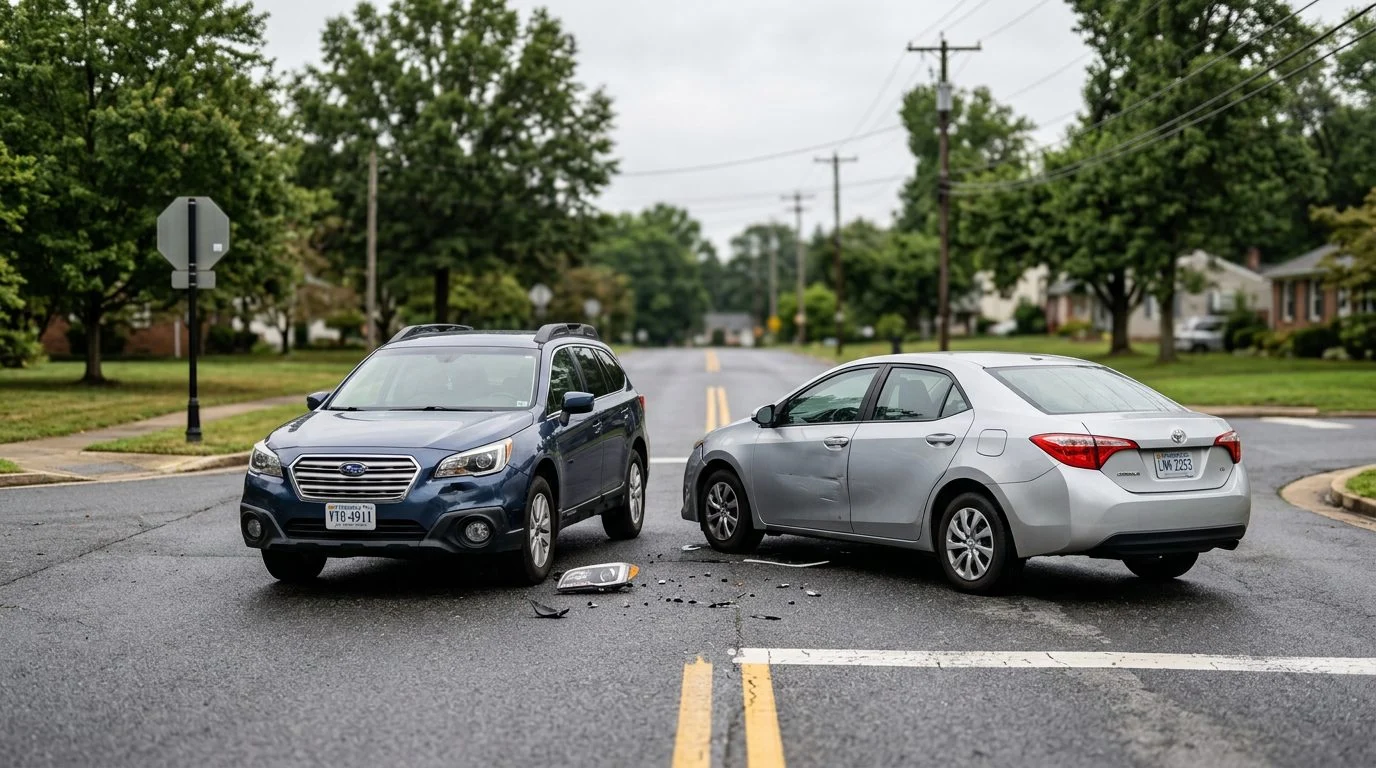
Consider a hypothetical. A driver believes another driver ran a red light and caused a side-impact crash. That same driver was also speeding on a wet road. The other side may argue that the speed contributed to the crash. Under the rule above, that argument could matter a great deal.
Opposing parties may look for any share of responsibility. That is why early evidence from the scene can matter. Photos of the vehicles, skid marks, traffic signals and witness names can show how the crash unfolded. Written notes made while memories are fresh can help too.
Reporting the crash and building the record
Virginia requires a driver involved in a crash with injury or death to stop and report it to police immediately (Va. Code §§ 46.2-371, 46.2-894). That duty is about reporting the crash. It is separate from the deadline to file a lawsuit.
The Virginia Department of Motor Vehicles provides crash-report records, so the police report number is a useful place to start. Other helpful records include photos, witness names and contact details, and medical visit summaries.
After a serious injury, keep every visit summary and discharge paper. Tell your medical providers about every symptom, even small ones, so the records are complete.
Truck crashes can produce more paper. Federal rules require a motor carrier to require each driver to record duty status for each 24-hour period (49 C.F.R. § 395.8). Carriers must also keep a driver qualification file for each driver they employ (49 C.F.R. § 391.51). A lawyer may ask for these records when reviewing a truck claim.
Deadlines: when the filing clock starts
Virginia generally allows two years from the date of injury to file a personal injury lawsuit (Va. Code § 8.01-243(A)); the clock runs from the date of injury, not the date of discovery, with narrow exceptions.
Some claims carry notice requirements that run out sooner.
Many people wait while they recover, and the clock keeps running. Early steps give more time to gather evidence and records. Exceptions exist, and the facts of each claim decide which rules apply.

Brain injuries, spinal cord injuries and wrongful death cases
A Virginia wrongful death action is filed by the decedent’s personal representative within two years of the death (Va. Code §§ 8.01-50(C), 8.01-244(B)), on behalf of the family members the statute protects.
The statute names who shares, including a surviving spouse and children, and in some cases parents (Va. Code § 8.01-53).
Traumatic brain injury and spinal cord injury claims often involve long medical records and recovery that unfolds over time. The records that matter vary from one injury to another.
The firm handles car accidents, truck accidents, commercial vehicle accidents, catastrophic injuries, traumatic brain injury, spinal cord injury and wrongful death claims. It has an office in Winchester and an office in Harrisonburg, and serves people across the Shenandoah Valley, Richmond and Henrico County.