
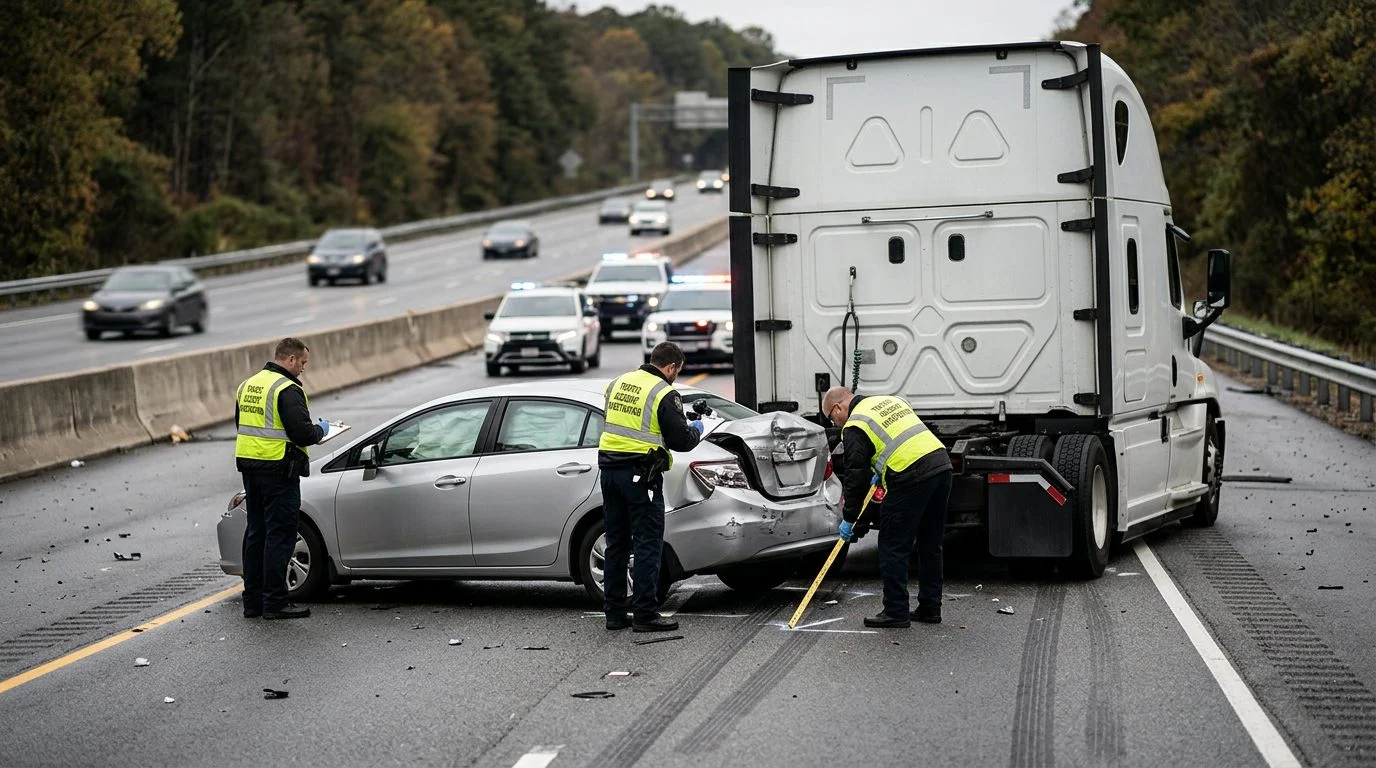
Commercial Truck Accidents | Richmond, Henrico County and Virginia
Spinal Cord Injury Truck Accident Claims: Clear Information for Richmond and Henrico County Readers
A spinal cord injury after a truck crash can change daily life in an instant. Here is a plain-language guide to the questions that often come next.
Published November 8, 2026
Richmond Spinal Cord Injury Truck Accident Lawyer
If you are reading about spinal cord injury claims after a truck crash in the Richmond area, you may be facing medical bills, time away from work, and hard questions about what comes next. A spinal cord injury from a truck crash may support a personal injury claim against the people or companies responsible. Virginia sets firm deadlines, so early steps can matter.
This page explains what these injuries are, why truck crashes differ from car crashes, what a claim may cover, and which Virginia rules apply.
Not sure what your next step is?
Talk it through with Correll Law Firm — we can walk you through how a situation like yours is usually handled and what your options are.

What a Spinal Cord Injury From a Truck Crash Means
A spinal cord injury damages the nerves that carry signals between the brain and the rest of the body. When those signals are interrupted, movement, feeling, and some bodily functions below the injury can change.
Doctors describe these injuries by level. The cord runs through the neck (cervical), the upper back (thoracic), and the lower back (lumbar). A higher injury often affects more of the body than a lower one.
Doctors also describe whether an injury is complete or incomplete. A complete injury means the cord has lost all function below the injury. An incomplete injury means some function remains.
Many people need help with bathing, dressing, moving between surfaces, and getting around. Those needs can change over time, in either direction.
The effects can change over time. Rehabilitation teams track progress, and recovery may be slow or limited. Correll Law Firm handles spinal cord injury matters within its work on catastrophic injuries and truck crashes.
Why Truck Crashes Often Cause Severe Spinal Injuries
A loaded tractor-trailer weighs far more than a passenger car. In a collision, that weight and speed transfer much more force to the people around it.
A sudden stop or violent impact can strain or break bones in the neck and back, even when a person’s body looks unharmed at first.
Common crash patterns involving commercial trucks include:
- Rear-end impacts, when a car strikes a slowing truck
- Lane changes into a truck’s blind spot
- Jackknifing, when the trailer swings out of line with the cab
- Rollovers on curves and highway ramps
Interstate 95 and Interstate 64 both run through Richmond and carry trucks, so these patterns can happen on either route.
Commercial carriers operate under federal safety rules. Federal law allows the Secretary of Transportation to set requirements for the qualifications, hours of service, and equipment of motor carriers (49 U.S.C. § 31502). The Federal Motor Carrier Safety Administration also publishes large truck crash facts.
Who May Be Responsible After a Truck Crash
More than one person or company may share responsibility after a truck crash. Who may be responsible depends on the facts of each crash.
Possible parties include the truck driver, the company that employs or leases the driver, a repair or maintenance provider, whoever loaded the cargo, and a parts maker if a defect played a role.
Several records may matter:
- Driver logs. Motor carriers must require drivers to record duty status for each 24-hour period (49 C.F.R. § 395.8).
- Electronic logging device data. An ELD automatically records items such as date, time, location, engine hours, and vehicle miles (49 C.F.R. § 395.26).
- Inspection reports. Carriers must keep periodic inspection reports for fourteen months from the report date (49 C.F.R. § 396.21).
- The police crash report. It records the scene, the parties, and the officer’s observations.
Crash scene details fade, and damaged trucks are often repaired or sent to salvage. Early requests help keep evidence in place.
What a Claim May Cover
A claim may seek money for the losses an injured person suffered because of the crash. Categories often include:
- Past and future medical care, including surgery, hospital stays, and rehabilitation
- Assistive equipment and changes to a home or vehicle
- Lost income and reduced ability to earn in the future
- Pain, suffering, and loss of enjoyment of life
Virginia allows punitive damages for actual malice, or for willful or wanton conduct or recklessness showing a conscious disregard for the safety of others, capped at $350,000 (Va. Code § 8.01-38.1).
Deadlines and Duties to Report the Crash in Virginia
Virginia requires a driver involved in a crash with injury or death to stop and report it to police immediately (Va. Code §§ 46.2-371, 46.2-894).
The two-year period is the deadline to file a lawsuit, not the period to report a crash: the driver of any vehicle in an accident resulting in injury or death must immediately give notice of the accident to a law-enforcement officer (Va. Code § 8.01-244). Virginia generally allows two years from the date of injury to file a personal injury lawsuit (Va. Code § 8.01-243(A)); the clock runs from the date of injury, not the date of discovery, with narrow exceptions.
A written statement of the claim must be filed within six months after the cause of action accrued (Va. Code § 15.2-209). Failure to file it does not bar the claim if the locality’s attorney, chief executive, or mayor, or any insurer or entity providing coverage or indemnification of the claim, had actual knowledge of the claim, including its nature and the time and place at which the injury is alleged to have occurred, within that six months. Because some notice requirements run out sooner, timing matters from the start.
Medical records made soon after the crash help show how the injury began. Gaps in treatment are often questioned by insurers, so keeping every appointment record matters.
Not sure what your next step is?
Talk it through with Correll Law Firm — we can walk you through how a situation like yours is usually handled and what your options are.
How a Truck Crash Spinal Cord Injury Claim Typically Proceeds
A typical claim moves through an early review, evidence requests, medical documentation, negotiation, and, if needed, a lawsuit.
- Initial review. The crash facts, the injury, and the treatment so far are reviewed.
- Evidence requests. Letters ask the trucking company to keep the driver logs, maintenance, inspection, and dispatch records described above.
- Medical documentation. Hospital, rehabilitation, and treating doctor records are gathered, along with proof of lost income.
- Settlement talks. Negotiations with insurers may or may not resolve the claim.
- Lawsuit. If a fair resolution is not reached, a lawsuit is filed within Virginia’s deadlines, and the case is prepared for trial.
Each step builds on the one before it, so early information shapes later steps. Timelines vary widely with the medical picture, the evidence, and court schedules. No single timeline fits every case.
About Correll Law Firm
Correll Law Firm is a Virginia personal injury firm with offices in Winchester and Harrisonburg. It represents people from the Shenandoah Valley to Richmond and Henrico County.
The firm handles:
- Car accidents
- Truck and commercial vehicle accidents
- Catastrophic injuries
- Traumatic brain injury
- Spinal cord injury
- Wrongful death
The firm focuses on serious injury and commercial vehicle matters and is experienced in those areas. Families often have questions about medical care, work, and their rights at the same time. The firm explains the process in plain terms and starts with the questions that cannot wait.

Frequently Asked Questions About Spinal Cord Injury Truck Claims in Virginia
Below are direct answers to common questions about these claims.
What if I was partly at fault for the crash?
Virginia follows contributory negligence: if you are found even partly at fault, you may be barred from recovering, with limited exceptions. Talk to a lawyer about your facts.
Can a claim name more than one party?
A claim may name more than one party.
Do I need a lawyer to file a truck crash claim?
You may wish to talk with a lawyer about your facts. The choice is yours.
What should I do if the trucking company’s insurer contacts me?
Keep a written record of every call and letter. You may wish to get legal advice before giving a recorded statement or signing anything.