
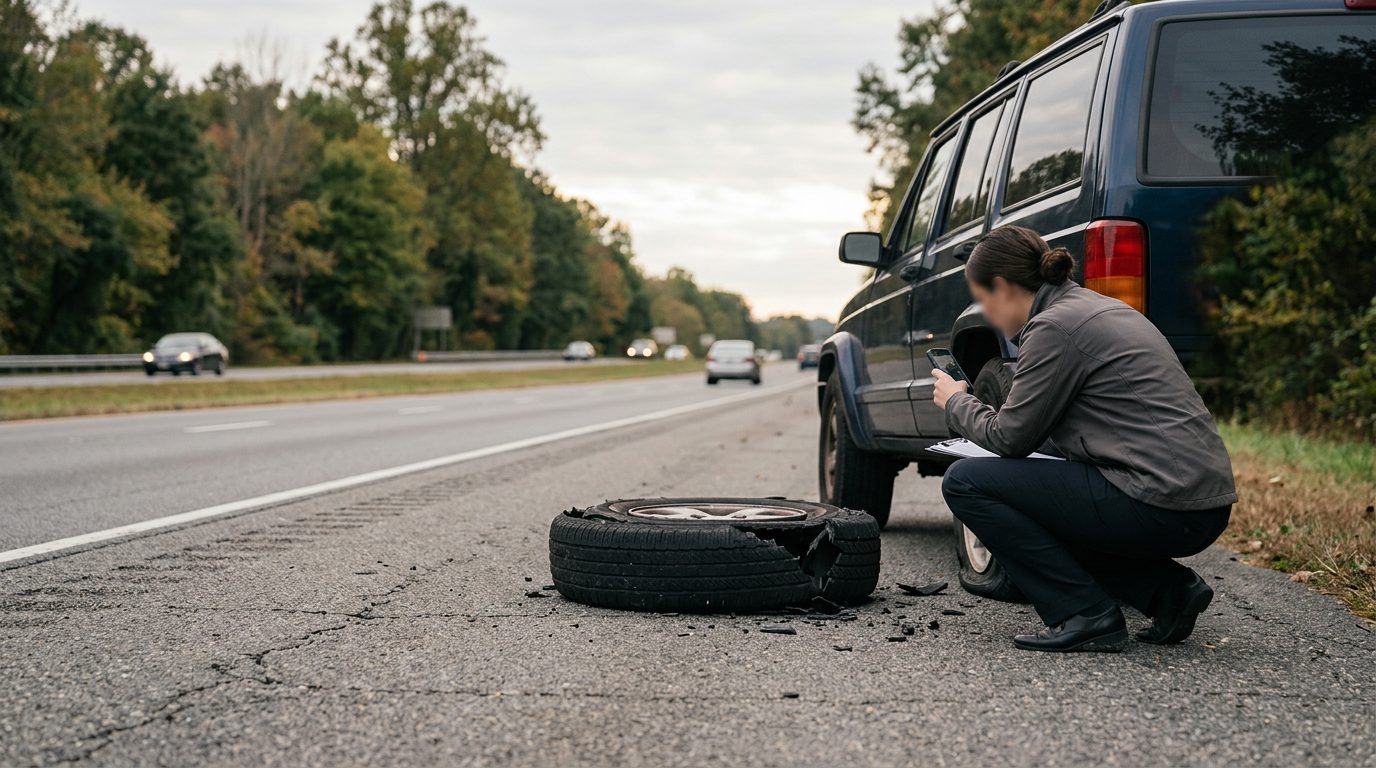
Car and Truck Accidents | Virginia
Hurt in a Tire Blowout Crash? Here's What to Know in Virginia
A plain-language guide to how tire failures happen, what evidence matters, and when a crash may lead to a claim.
Published October 21, 2026
In many cases, you may be able to sue after a tire blowout crash, but the answer depends on what caused the tire to fail. A blowout alone does not decide a lawsuit. The real question is whether someone’s carelessness, a defect or poor maintenance played a part. Correll Law Firm handles car and truck crash claims and is based in Winchester, with an office in Harrisonburg. This guide explains how Virginia law looks at these questions for people across the northern Shenandoah Valley, Richmond and Henrico County.
Is a tire blowout considered an accident?
Yes, a tire blowout crash is an accident in the everyday sense. The blowout itself, however, does not decide who is legally responsible. A tire can fail suddenly, even on a vehicle that was well kept. The legal question is whether a person’s conduct, a bad repair or a product defect caused the failure or made the crash worse. Virginia courts look at proximate cause, which is the act or omission that, in natural and continuous sequence, produces the event. That means a blowout and a driver’s choices can both matter.
If a tire failure left you or someone you love hurt, the firm can talk with you about whether someone may be responsible for the crash. Talk it through with Correll Law Firm — we can walk you through how a situation like yours is usually handled and what your options are.
Who may be liable for a crash involving a tire blowout?
Liability may fall on the driver, a trucking company, a tire maker, a repair shop or another driver. The right party depends on what went wrong.
- The driver whose tire failed. A driver who ignored worn tread, low air pressure or visible damage may have been careless.
- A trucking company. Federal rules require motor carriers to inspect, repair and maintain every vehicle under their control, including wheels and rims. 49 CFR 396.3
- A tire maker. If a manufacturing defect caused tread separation or early failure, a claim may be possible. Virginia law says lack of privity between the parties is no defense in a negligence case seeking damages for injury. Va. Code § 8.01-223
- A repair shop or installer. Virginia law says an independent contractor cannot avoid a negligence claim because the work was completed or accepted. Va. Code § 8.01-39
- Another driver. A driver who forced your vehicle off the road or dropped debris that caused the blowout may share responsibility.
What evidence is needed to prove a tire blowout claim?
The failed tire and the vehicle’s maintenance history often show what caused the blowout. Preserving them early matters, because a discarded tire cannot be examined later. Useful evidence includes:
- Photos and video of the tire and the scene, taken as soon as it is safe.
- The tire itself, kept in its current condition.
- Maintenance and inspection records showing when tires were checked, rotated or replaced.
- Service history, including earlier complaints or repairs involving the tire or suspension.
- Names and statements from witnesses who saw the blowout or the crash.
- The police report and crash documentation.
- Medical records and bills showing your injuries and treatment.
In a defective tire claim, an engineer may need to examine the tire. That examination can separate a manufacturing defect from normal wear or driver error.
Common causes of tire blowout crashes
Most blowouts trace back to tire condition, air pressure, load, road hazards or installation. The National Highway Traffic Safety Administration notes that inadequate tire maintenance can contribute to blowouts. NHTSA tire safety overview Common factors include:
- Worn tread with too little depth to grip the road.
- Underinflated tires, which run hot and weaken the sidewall.
- Overloaded vehicles that put extra stress on each tire.
- Potholes, road debris or sharp objects.
- Manufacturing defects such as tread separation or sidewall weakness.
- Improper tire repair, or failure to rotate or balance tires.
The National Transportation Safety Board has said that deteriorated tires and inadequate maintenance can be contributing factors. Under 49 C.F.R. § 393.75, no motor vehicle shall be operated on a tire that has body ply or belt material exposed through the tread or sidewall, has any tread or sidewall separation, is flat or has an audible leak, or has a cut to the extent that the ply or belt material is exposed. The same section provides that any tire on the front wheels of a bus, truck, or truck tractor shall have a tread groove pattern depth of at least 4/32 of an inch when measured at any point on a major tread groove. The measurements shall not be made where tie bars, humps, or fillets are located. Other tires need at least 2/32 of an inch.
What damages can you recover after a tire blowout crash?
Damages usually cover the losses the injury caused, such as medical bills, lost income and property damage. Virginia law says lost income from an injury is not reduced because another source reimbursed it. Va. Code § 8.01-35 In a suit for personal injury or death, provable damages for loss of income due to such injury or death shall not be diminished because of reimbursement of income from another source, and the fact of that reimbursement cannot be admitted into evidence. Dominion Resources, Inc. v. Alstom Power, Inc. Injured people often also describe physical pain, emotional distress and changes in daily life.
When a crash causes a death, the claim is different. A Virginia wrongful death action is filed by the decedent’s personal representative within two years of the death (Va. Code §§ 8.01-50(C), 8.01-244(B)), on behalf of the family members the statute protects. Family members do not file; they share in the recovery. Virginia wrongful death damages cover the family’s sorrow, mental anguish and loss of the decedent’s companionship, guidance and care; lost income and services; medical expenses from the injury; funeral expenses; and, for willful or wanton conduct, punitive damages (Va. Code § 8.01-52).
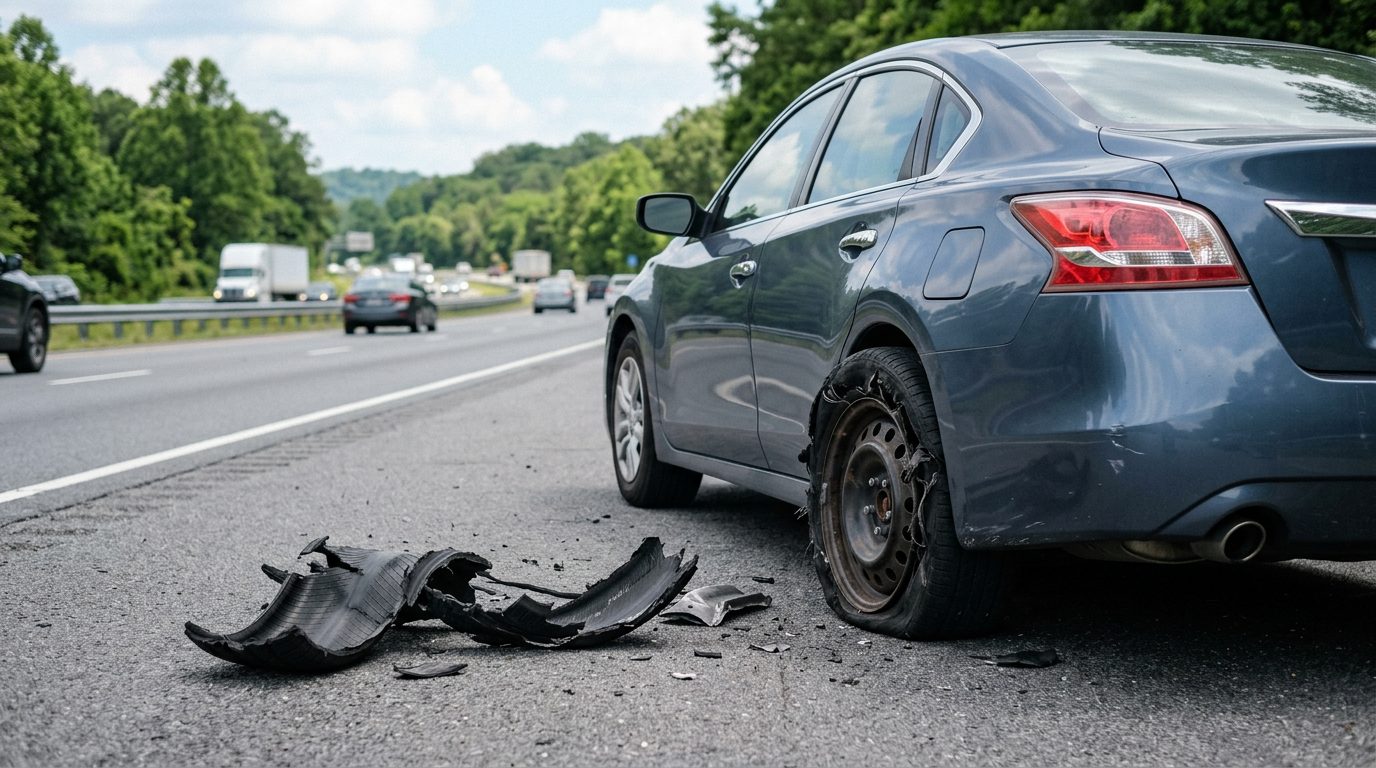
Is it worth suing after a tire blowout crash?
Whether a lawsuit makes sense depends on the facts, including the injuries, who may be responsible and the insurance involved. Serious harm, such as a traumatic brain injury, a spinal cord injury or a permanent disability, can change how a claim is viewed. Clear fault, such as a documented maintenance failure or a defective tire, can also shape the case.
Virginia follows contributory negligence: if you are found even partly at fault, you may be barred from recovering, with limited exceptions. Talk to a lawyer about your facts. The Virginia Court of Appeals has described this defense as one that can completely bar recovery. Hazelwood v. Lawyer Garage, LLC
Drivers sometimes say a blowout was a sudden emergency. Under Herr v. Wheeler, an emergency is a sudden, unexpected and unforeseen happening that calls for immediate action. That defense does not excuse a driver whose own negligence helped create the emergency.
Not sure what your next step is?
Talk it through with Correll Law Firm — we can walk you through how a situation like yours is usually handled and what your options are.
What should you do after a tire blowout crash?
Stop safely, report the crash and keep whatever evidence you can. Virginia requires a driver involved in a crash with injury or death to stop and report it to police immediately (Va. Code §§ 46.2-371, 46.2-894). The two-year period is the deadline to file a lawsuit, not the deadline to report a crash.
- Turn on your hazard lights and move to safety if you can.
- Photograph the tire, the scene, vehicle damage and road conditions.
- Get names, phone numbers, insurance details and witness contact information.
- Seek medical care even if you feel fine, because some injuries appear later.
- Keep medical records, repair estimates and receipts.
- Report the crash to your own insurer. Sign only police and medical forms until you understand what you are signing.
- You may wish to talk with a lawyer before giving a recorded statement to another insurer.
Tire blowout claims in truck accidents
A truck tire claim often turns on whether the motor carrier followed federal inspection and maintenance rules. Motor carriers, except for a private motor carrier of passengers (nonbusiness), must keep records of inspections, repairs and maintenance for each vehicle they control. They must keep those records for one year, and for six months after the vehicle leaves their control. 49 CFR 396.3
Interstate 81 carries heavy truck traffic through the Shenandoah Valley, including past Winchester and Harrisonburg. A truck claim may involve the company’s own maintenance failures, the driver’s conduct, or both.
Next steps if you’ve been injured in a tire blowout crash
Preserve evidence, document your recovery and watch the filing deadline. Virginia generally allows two years from the date of injury to file a personal injury lawsuit (Va. Code § 8.01-243(A)); the clock runs from the date of injury, not the date of discovery, with narrow exceptions. Some claims carry notice requirements that run out sooner.
Keep a log of medical appointments, medications and time away from work. Do not settle with an insurance company until you understand the full extent of your injuries and losses.
Frequently asked questions
Can you sue the other driver if a tire blowout caused the crash?
You may be able to, if that driver’s negligence caused or contributed to the blowout or the crash.
What if the tire was thrown away after the crash?
Photos, maintenance records, witness names and medical records can still help show what happened.
Does a blowout always mean someone is at fault?
No. Virginia courts look at maintenance, defects, road conditions and driver conduct to decide who, if anyone, was responsible.