
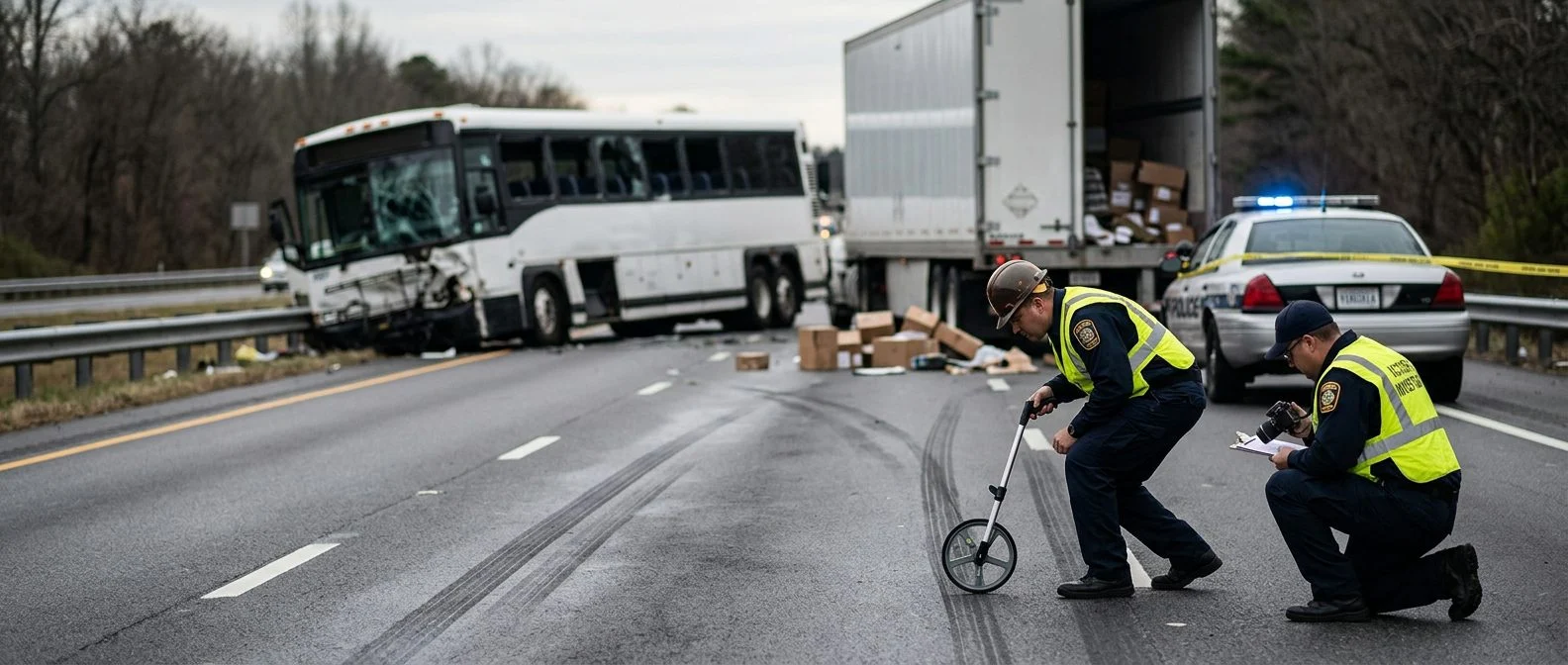
Commercial bus crashes | Virginia
Commercial Bus Crash Fault: How Federal Safety Rules Fit Your Claim
Federal driver, vehicle and hours-of-service rules can matter when a commercial bus crash raises questions about who is responsible. Here is how they work and where their limits lie.
Published November 9, 2026
If you were hurt in a commercial bus crash, or you lost someone in one, you may be wondering how federal rules fit into your claim. Here is how they work.
How do federal FMCSA safety and hours-of-service rules affect proving fault in a commercial bus crash claim?
A violation is not automatic proof of liability, because a court still looks at what happened in that crash. The rules are one part of the proof.
The Federal Motor Carrier Safety Administration rules cover driver qualifications, driving and duty hours, vehicle maintenance and safe operation. They reach both the bus company and the driver. Under 49 CFR § 390.11, a motor carrier must require observance of the duties placed on its drivers. That can make the company’s own records and instructions relevant, not only the driver’s conduct.
A rule violation can help show a pattern of unsafe operation. The real question is whether it played a part in the crash that injured someone.

Which records can show whether a bus company or driver followed federal safety rules?
The most relevant records are usually driver qualification files, duty-status logs, vehicle maintenance records and trip or dispatch records. Each one can show whether the rules were followed in the period before a crash.
A motor carrier must keep a driver qualification file for each driver it employs. Federal rules generally require carriers that operate commercial motor vehicles to have drivers record duty status with an electronic logging device, but a carrier may allow manual records in listed cases, such as a vehicle made before model year 2000, and private motor carriers of passengers (nonbusiness) are excepted. For passenger-carrying vehicles, federal driving limits allow no more than 10 hours of driving following 8 consecutive hours off duty. They also bar driving after 15 hours on duty following 8 consecutive hours off, and after 60 hours on duty in any 7 consecutive days (or 70 hours in any 8 consecutive days where the carrier operates every day of the week).
Logs and dispatch times can show whether a driver stayed within those limits on the day of the crash. Trip records can also show when a driver was scheduled to start and where the bus was headed.
Maintenance records matter too. A carrier must keep records showing the date and nature of inspections and repairs (49 CFR § 396.3). These records are usually obtained through the lawsuit process, and the company controls them. Federal rules set minimum retention periods for maintenance records, so early requests help make sure key records still exist: under 49 C.F.R. § 396.3(c), records must be kept for 1 year and for 6 months after the vehicle leaves the carrier’s control.
How do a crash report and the police investigation fit into proving fault?
A police report records what officers saw and what people said at the scene, so it can be one piece of evidence about fault. It is not the final word on who was at fault.
Virginia requires a driver involved in a crash with injury or death to stop and report it to police immediately (Va. Code §§ 46.2-371, 46.2-894). The two-year period discussed later is the deadline to file a lawsuit, not the deadline to report a crash.
Federal investigations work differently. So a federal accident report is not a shortcut to proving fault.
Why does each commercial bus crash turn on its own facts when federal rules are involved?
A federal rule violation does not automatically cause a crash or an injury. The link between the violation and the harm has to be shown with evidence in that case. Whether a particular rule matters depends on the facts of the crash.
In practice, the key question is often whether a rule violation changed what the driver did at the moment that mattered. Records help answer that, but they do not answer it alone.
Virginia follows contributory negligence: if you are found even partly at fault, you may be barred from recovering, with limited exceptions. Talk to a lawyer about your facts.

What should a reader take away about FMCSA fault in a Virginia bus crash?
Records, the crash report and proof of what caused the injury all shape the claim.
Virginia generally allows two years from the date of injury to file a personal injury lawsuit (Va. Code § 8.01-243(A)); the clock runs from the date of injury, not the date of discovery, with narrow exceptions.