
Truck Accidents | Virginia
Truck Crash Claims in Virginia: Why Early Evidence Matters
Commercial trucks generate a large trail of records. Learn which evidence often matters most after a serious truck crash and why acting early can help protect it.
Published November 2, 2026
A truck accident claim in Virginia turns on two questions: how the crash happened, and who is responsible for the harm. Crashes involving tractor-trailers and box trucks often leave more records behind and involve more parties than a typical car crash. This guide explains the evidence that tends to matter, the duty to report a crash, the deadlines Virginia sets, and the damages a family may pursue after a death. Correll Law Firm, with locations in Winchester and Harrisonburg, handles truck accident claims for people across the Shenandoah Valley, Richmond and Henrico County. The facts of each crash decide which rules apply and how they fit together.
Why a Truck Accident Claim Often Involves More Evidence
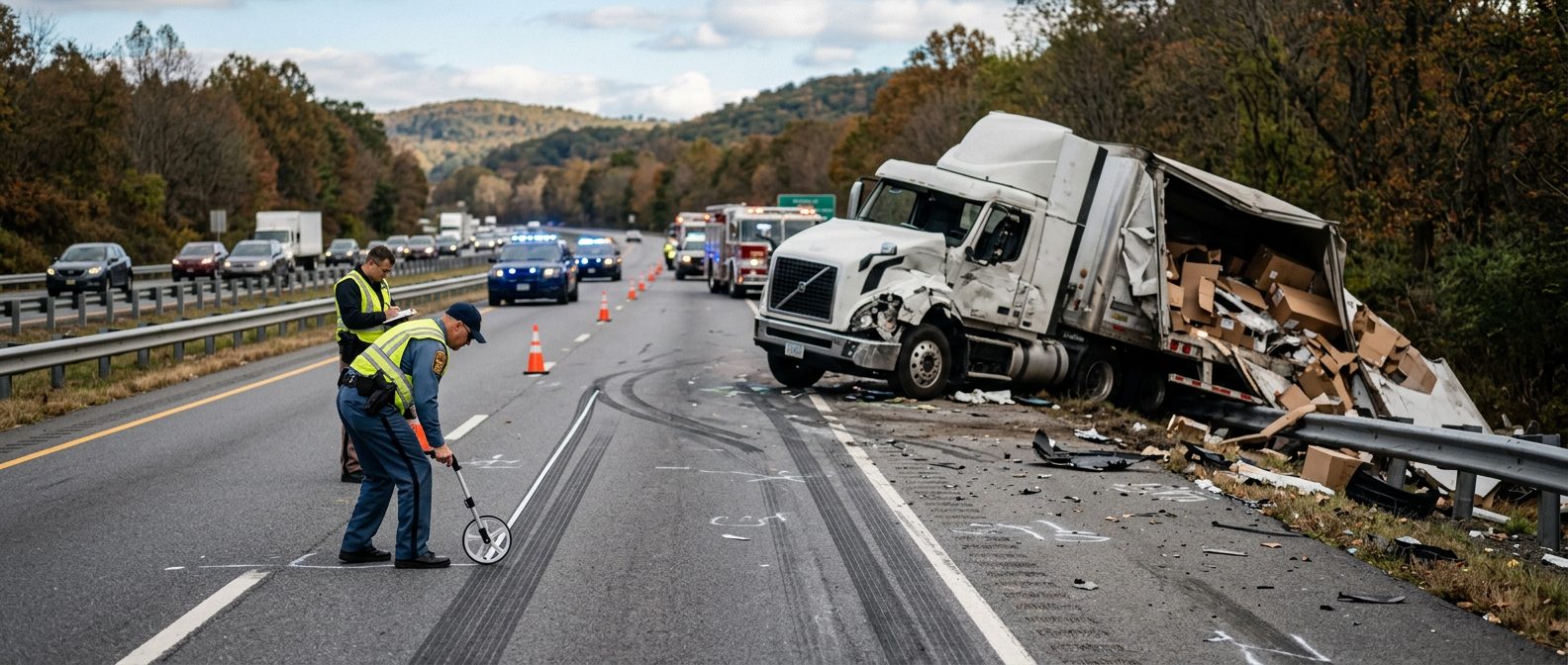
A truck crash usually leaves more records than a car crash, and the review often reaches more than one company.
Commercial trucks are regulated vehicles. Federal motor carrier safety rules, which the Federal Motor Carrier Safety Administration oversees, set how carriers track driving time and maintain their trucks. Two sets of records often matter most.
The first is the driver’s record of duty status. It tracks hours on duty for each 24-hour period, often through an electronic logging device. Federal rules also bar false reports about that status (49 C.F.R. § 395.8).
The second is maintenance. Motor carriers must systematically inspect, repair and maintain their vehicles, and they must keep records of that work (49 C.F.R. § 396.3). Cargo paperwork, dispatch messages, and the truck’s company name and unit number can also show who operated the truck.
A crash may also involve more than one party. That is why a truck claim may look at the driver, the company, and others.
If a truck crash hurt you or someone you love, you may have a claim, and you don't have to sort out the next steps alone. Talk it through with Correll Law Firm — we can walk you through how a situation like yours is usually handled and what your options are.

Reporting the Crash and Preserving Information
Virginia requires a driver involved in a crash with injury or death to stop and report it to police immediately (Va. Code §§ 46.2-371, 46.2-894). The two-year period discussed below is the deadline to file a lawsuit, not the deadline to report a crash (Va. Code § 8.01-243).
The driver statute also requires reasonable help for anyone who is hurt. That includes taking the injured person to a physician or hospital when medical treatment is needed (Va. Code § 46.2-894). A person convicted of failing to stop after a crash that injures or kills someone is guilty of a Class 5 felony.
Information fades fast after a crash, so write down what you remember while the details are fresh. If you can do so safely, take photos of the scene and both vehicles. Note the truck’s company name, unit number and the driver’s name. Get witness names and contact details. Keep every medical record tied to the injury, and keep a simple journal of symptoms and missed work.
Evidence That Often Matters in Truck Cases
Video, phone records and the truck’s own data often matter most, and they are the easiest to lose.
Dashcam footage and video from nearby businesses can be overwritten as storage fills. Cell phone records can show what was happening on a device at the time of the crash. Maintenance files can show whether brakes, tires and lights were checked before the crash. Periodic inspection reports must be kept for fourteen months (49 C.F.R. § 396.21), which is one reason to ask for them early.
Accident reconstruction analysts are sometimes used to explain how a crash happened. Their findings are one part of a claim, not the whole claim.
How Partial Fault Can Affect a Claim
Virginia follows contributory negligence: if you are found even partly at fault, you may be barred from recovering, with limited exceptions. Talk to a lawyer about your facts.
The details of how each driver acted shape what the evidence shows. A truck’s speed, lane position and braking time can all matter.
Time Limits for Filing a Truck Accident Lawsuit
Virginia generally allows two years from the date of injury to file a personal injury lawsuit (Va. Code § 8.01-243(A)); the clock runs from the date of injury, not the date of discovery, with narrow exceptions.
That rule appears in Va. Code § 8.01-243, which covers every action for personal injuries unless otherwise provided in that section or by other statute. The two years run from when the cause of action accrues, so it is not a date you can count from the day you feel ready.
Some claims carry notice requirements that run out sooner. A claim against a county, city or town for negligence is barred unless a written statement is filed within six months after the cause of action accrued, subject to a limited exception (Va. Code § 15.2-209). A truck crash involving a government vehicle can raise this issue.
Records take time to gather. Starting early leaves more room to request reports, preserve video and build the file.
When a Truck Crash Results in a Death
A Virginia wrongful death action is filed by the decedent’s personal representative within two years of the death (Va. Code §§ 8.01-50(C), 8.01-244(B)), on behalf of the family members the statute protects.
Family members do not file the action themselves; under § 8.01-50 it is brought by and in the name of the personal representative of the deceased person, and for a fetal death by the natural mother. The action itself comes from Va. Code § 8.01-50, which allows a claim against the person or company whose wrongful act, neglect or default caused the death, if the injured person could have sued had the death not occurred.
Virginia wrongful death damages cover the family’s sorrow, mental anguish and loss of the decedent’s companionship, guidance and care; lost income and services; medical expenses from the injury; funeral expenses; and, for willful or wanton conduct, punitive damages (Va. Code § 8.01-52).
Families often face these questions while also grieving. Keeping records of medical care, funeral arrangements and the decedent’s work history helps the review.
Not sure what your next step is?
Talk it through with Correll Law Firm — we can walk you through how a situation like yours is usually handled and what your options are.
Punitive Damages in Truck Accident Cases
Virginia allows punitive damages for actual malice, or for willful or wanton conduct or recklessness showing a conscious disregard for the safety of others, capped at $350,000 (Va. Code § 8.01-38.1). The statute is at Va. Code § 8.01-38.1, and the jury is not told of the limit.
For example, imagine a truck driver who keeps driving after knowing that alcohol or fatigue has impaired his ability to drive. The jury must find that the conduct met this standard before punitive damages can be awarded. Whether it does depends on the facts.

Frequently Asked Questions
Short answers to three common questions follow.
Is it hard to prove a hit and run involving a truck?
It can be harder, because the driver may not stop and the truck may be hard to identify. Paint transfer, camera footage, witness accounts and nearby traffic records are often the key sources.
What should I tell a lawyer early on?
Share complete, honest details about the crash, your treatment and any earlier injuries. Bring any photos, medical papers or reports you already have.
Is it better to hire a lawyer or an attorney?
In everyday speech, people use lawyer and attorney to mean the same kind of professional. What matters more is whether you feel comfortable discussing the facts of your own crash.