
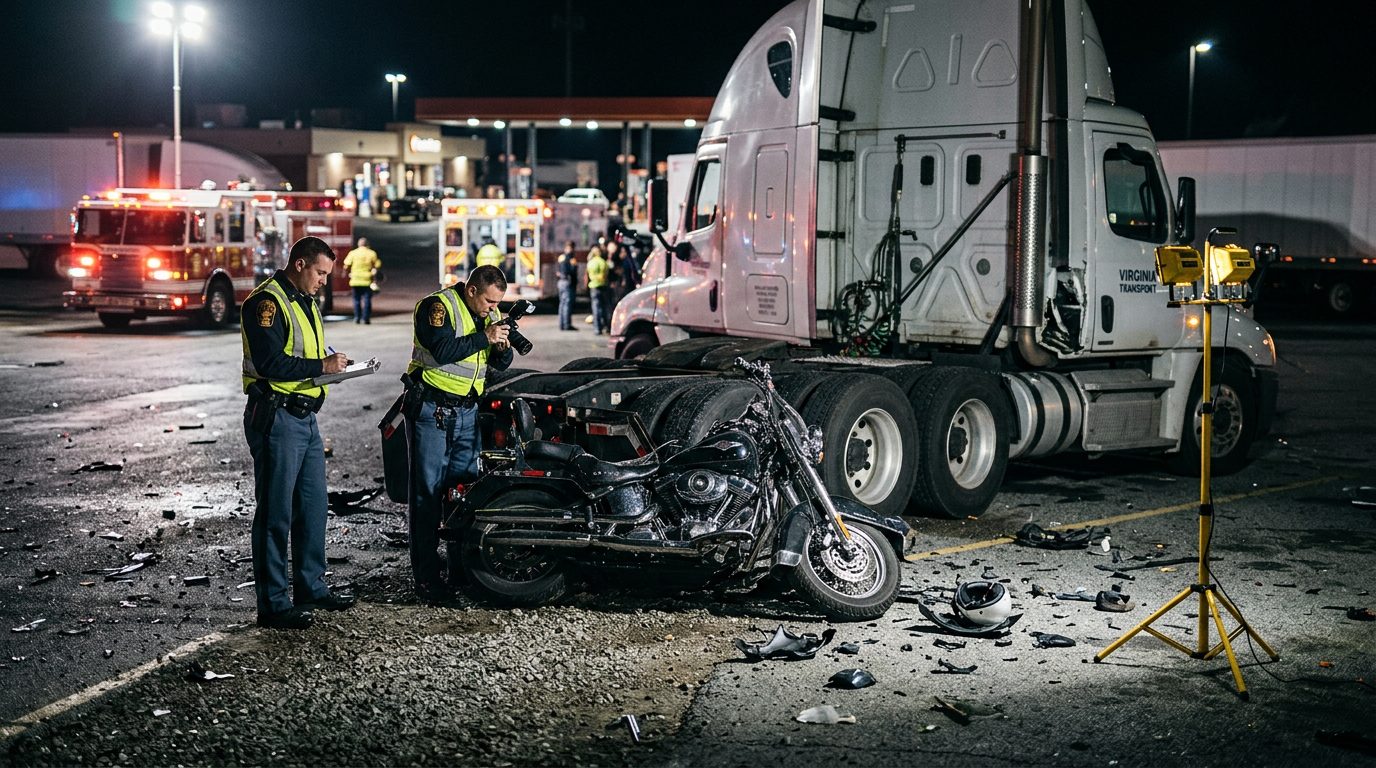
Hit by a Truck on a Motorcycle? Get Clear Answers Before You Decide Next Steps
Correll Law Firm represents motorcyclists injured in crashes with trucks and commercial vehicles, from the Shenandoah Valley to Richmond and Henrico County.
Published October 28, 2026
Correll Law Firm represents motorcycle riders, passengers and families after a truck or commercial vehicle hits a motorcycle in Virginia. Hit by a truck while riding a motorcycle in Virginia? Many people in that position face serious injuries, medical bills and missed work. This page explains how these claims work, what evidence matters and which deadlines may apply.
Who This Service Is For and What the Firm Handles
The firm represents injured riders, passengers and surviving family members when a truck or commercial vehicle collides with a motorcycle. It handles car accidents, truck accidents, commercial vehicle accidents, catastrophic injuries, traumatic brain injury, spinal cord injury and wrongful death. A single crash can involve more than one of these areas.
This service is for people who:
- were riding a motorcycle when a truck or commercial vehicle hit them
- were a passenger on a motorcycle that was struck
- lost a family member who died after a truck struck the motorcycle they were riding
Riders often face questions about medical care, missed work and who may be responsible for the crash. The firm’s offices are in Winchester and Harrisonburg. It represents people from communities across the northern Shenandoah Valley, Richmond and Henrico County.
For the broader picture of truck crash claims, read the truck accident claims guide.
If a truck hit you or someone you love on a motorcycle in Virginia, you may have a claim, and you do not have to face the insurers alone. Talk it through with Correll Law Firm — we can walk you through how a situation like yours is usually handled and what your options are.

Why Truck Crashes With Motorcycles Often Cause Serious Injuries
A motorcycle has no frame or body around the rider, so the head, spine and limbs take the force of impact and the road. A truck is far heavier than a motorcycle. Its wide blind spots and long stopping distance can make a rider hard to see or hard to avoid.
Common crash patterns include:
- a truck changing lanes into a motorcycle
- a turning truck that does not see a rider alongside it
- a truck striking a motorcycle from behind
Some riders suffer traumatic brain injury or spinal cord injury. These injuries can require long periods of medical care and rehabilitation, and they can change work and family life.
What a Motorcycle Injury Claim Can Include
A claim can seek damages for the losses an injured rider or passenger has suffered. Those losses may include:
- emergency care, hospital stays and ongoing medical treatment
- rehabilitation and future medical needs
- lost wages and reduced ability to earn in the future
- damage to the motorcycle, helmet, riding gear and personal items
- pain, suffering and a lower quality of life for the injured person
The value of a claim turns on medical records, the evidence and the injuries themselves. No one can predict or promise a result. Medical bills, treatment notes and a record of missed work help document each category. Records of time off and changed job duties show how the injury affected earning ability.
Wrongful Death When a Motorcyclist Dies
When a rider dies in a truck crash, the family may have a claim under Virginia wrongful death law, but the action must be brought by and in the name of the personal representative of the deceased rider.
A Virginia wrongful death action is filed by the decedent’s personal representative within two years of the death (Va. Code §§ 8.01-50(C), 8.01-244(B)), on behalf of the family members the statute protects.
Virginia wrongful death damages cover the family’s sorrow, mental anguish and loss of the decedent’s companionship, guidance and care; lost income and services; medical expenses from the injury; funeral expenses; and, for willful or wanton conduct, punitive damages (Va. Code § 8.01-52).
Family members do not file the action themselves. They share in any recovery, and the statute names beneficiaries such as a surviving spouse and children (Va. Code § 8.01-53). Because a filing deadline applies and evidence can be lost, a family may wish to speak with a lawyer early.
Steps and Evidence to Protect in the First Days After the Crash
The first days after a crash matter most for proof, and the first step is reporting the crash. Virginia requires a driver involved in a crash with injury or death to stop and report it to police immediately (Va. Code §§ 46.2-371, 46.2-894). The two-year period is the deadline to file a lawsuit, not the deadline to report a crash (Va. Code § 8.01-243).
Riders and passengers can help by collecting:
- photos of the scene, the motorcycle, the helmet and riding gear
- names and contact details of witnesses
- the police report number
- a simple daily log of symptoms, appointments and limits on work and daily activity
Commercial carriers keep records that can show what happened. Federal rules require a motor carrier to keep records of duty status and supporting documents for not less than 6 months from the date of receipt (49 C.F.R. § 395.8). Periodic inspection reports must be kept for fourteen months from the date of the inspection report (49 C.F.R. § 396.21) where the vehicle is housed or maintained, and must be available on demand to authorized federal, state or local officials. Requesting these records early matters, since the retention periods are limited. A fuller list is in the evidence to preserve checklist.
Insurance Adjusters, Fault Disputes and How the Claim Moves Forward
A trucking company’s insurer may contact a rider quickly. A rider may wish to speak with a lawyer before giving a recorded statement or signing a release.
The truck driver may say the motorcyclist caused the crash. Evidence such as the scene, vehicle damage, witness accounts and records can help show how a crash happened.
For those situations, see the insurance adjuster call guide and the page on a driver blaming the rider.
A claim usually moves through these steps:
- a case evaluation with the firm, where the facts are reviewed
- investigation and evidence gathering
- documentation of medical treatment
- a settlement demand to the insurer
- negotiation
- a lawsuit, if needed
Virginia generally allows two years from the date of injury to file a personal injury lawsuit (Va. Code § 8.01-243(A)); the clock runs from the date of injury, not the date of discovery, with narrow exceptions. Some claims carry notice requirements that run out sooner, so timing depends on the facts.
Not sure what your next step is?
Talk it through with Correll Law Firm — we can walk you through how a situation like yours is usually handled and what your options are.
How Correll Law Firm Handles These Cases
Correll Law Firm handles car, truck and commercial vehicle crash claims, catastrophic injury cases and wrongful death matters, and its offices are located in Winchester and Harrisonburg. In these cases, the firm gathers medical and crash records, requests commercial truck evidence, communicates with insurers and keeps clients informed at each step.
Support staff help with records, scheduling and communication. When the facts call for it, the firm may bring in outside accident reconstruction professionals or medical providers to review the crash and the injuries. The firm’s work covers the injured person’s claim and, when a rider dies, the family’s wrongful death claim.

Frequently Asked Questions
Can I still recover if I was partly at fault?
Virginia follows contributory negligence: if you are found even partly at fault, you may be barred from recovering, with limited exceptions. Talk to a lawyer about your facts.
Does a truck driver’s citation prove fault?
A citation is one piece of evidence, not the whole picture. The full record, including photos, reports and witness accounts, is reviewed.
What if my injuries seem minor at first?
Early medical records create a clear timeline of what was found and when. Keep every appointment and follow the treatment plan you are given.
Do I need to file a lawsuit to make a claim?
Some claims are resolved without a lawsuit, while others need one. Either way, the filing deadline still applies, so timing matters.
What if the insurer calls before I have spoken with anyone?
There is no need to answer questions on the spot. Write down the caller’s name, the company and the time of the call.
Can the firm help if the crash happened outside Winchester or Harrisonburg?
Yes, the firm represents people beyond its office towns, including Richmond and Henrico County. Its offices are in Winchester and Harrisonburg.