
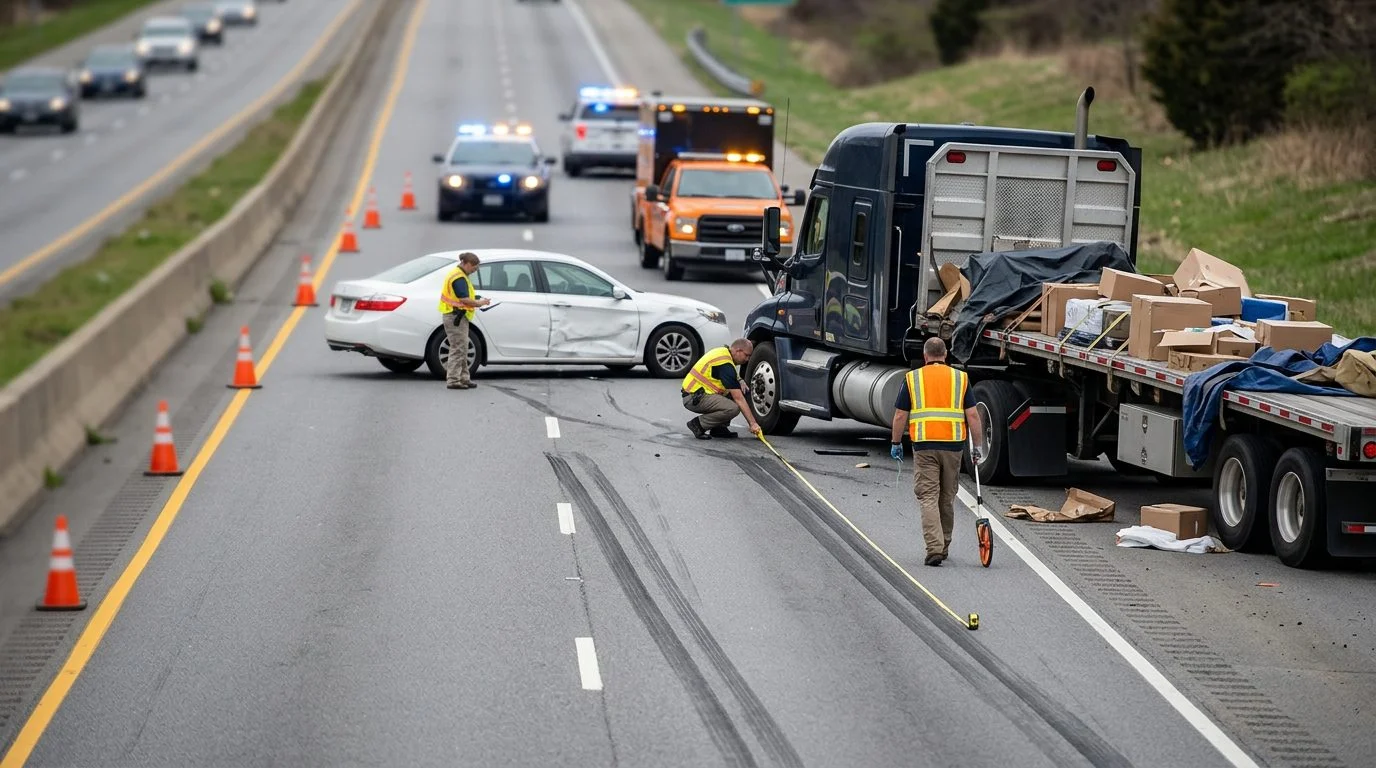
Virginia Injury Law | Car and Truck Crashes
Truck Crash or Car Crash: Why the Difference Matters Under Virginia Law
A truck crash can involve federal trucking rules, more parties and more records than a typical car crash. Here is how the two kinds of claims differ, and what to know early.
Published October 28, 2026
How do commercial truck accidents differ from regular car accidents in Virginia law?
A crash involving a commercial truck can involve different parties, records and questions than a crash between passenger cars. The real differences come from the facts. Truck crashes usually involve more parties, more records and more federal rules.
What changes is who may be involved. A car crash often involves two drivers and their insurers. A truck crash can also involve a motor carrier, a vehicle owner, a maintenance company or a cargo company. The sections below cover vehicle size, causes, responsible parties, crash data, deadlines and fatal crashes.
Correll Law Firm focuses on car accidents, truck accidents and commercial vehicle accidents. The firm has offices in Winchester and Harrisonburg and serves people across the Shenandoah Valley, Richmond and Henrico County.
If a crash with a commercial truck left you or someone you love hurt, the firm can talk with you about whether you may have a claim. Talk it through with Correll Law Firm — we can walk you through how a situation like yours is usually handled and what your options are.

Why do truck crashes tend to produce more severe injuries?
Truck crashes can cause more serious injuries because a loaded commercial truck weighs far more than a passenger car. The people in the smaller vehicle take much of that force.
Weight drives how hard an impact hits. A heavy truck also takes longer to stop, so a driver may have less time to react. Height matters too. A car that strikes the side or rear of a trailer can slide beneath it, a crash pattern called underride. That puts the car’s occupants in a different place in the impact than they would be in a car-to-car crash.
Those injuries can need long medical care, and they can change daily life for years.
Here is a hypothetical example. A driver on a highway brakes hard in heavy traffic. A sedan following too closely strikes the back of a loaded trailer. The sedan’s driver may need ongoing care for head and neck injuries. This example is not about any real person or case.
What causes large truck accidents?
Large truck crashes often trace back to a few common problems. These include driver fatigue, poor maintenance, unsecured cargo, distraction and impairment. Federal safety rules address several of these directly.
Fatigue comes first. 49 C.F.R. § 392.3 says no driver may operate a commercial motor vehicle when ability or alertness is so impaired, or so likely to become impaired, through fatigue, illness, or any other cause, that it is unsafe. A motor carrier may not require or permit that either.
Maintenance matters just as much. 49 C.F.R. § 396.3 requires every motor carrier to inspect, repair and maintain its vehicles systematically. Parts such as steering systems, brakes and wheels must be in safe operating condition at all times.
Cargo must stay put. 49 C.F.R. § 393.100 requires cargo to be secured so it does not spill, blow or fall, and so it does not shift enough to affect the vehicle’s stability.
These rules also create records. Carriers must keep inspection and repair records for set periods. Those records are one reason truck cases often involve more paperwork than car cases.
Who can be responsible when a commercial truck is involved in a crash?
More than one party can share responsibility in a truck crash. Depending on the facts, that may include the driver, the motor carrier, the vehicle owner, a maintenance company or a cargo loader.
This matters because each party may hold different records and carry different insurance. A crash report is only one piece of the picture. The truck’s electronic data, maintenance files and driver records may sit with the carrier, not the driver.
Accident reconstruction experts can study the scene, speed, braking and vehicle data. Their work can help show how the crash happened. Who is responsible depends on the facts of each crash.
What do Virginia crash statistics show about trucks and cars?
When people compare truck accidents vs car accidents in Virginia, the numbers need care. The Virginia DMV reports large truck crashes in its Virginia DMV 2022 Traffic Crash Facts report as a separate group.
The 30-day window matters. A death that happens weeks after a crash still counts.
Three kinds of counts often get mixed up. A crash count counts crashes, not people. An injury count tracks people who were hurt. A fatality count tracks people who died. Comparing one kind of count to another can mislead.
Before you draw a conclusion from any truck or car figure, check which count it uses. Then check whether the figures cover the same years and the same type of vehicle.
What deadlines and duties apply after either kind of crash?
After a crash involving injury or death, Virginia requires the driver to act right away. A lawsuit has its own, later deadline. The two are different.
The duty to report comes first. Virginia requires a driver involved in a crash with injury or death to stop and report it to police immediately (Va. Code §§ 46.2-371, 46.2-894). The statute also requires reasonable help for anyone hurt, as Va. Code § 46.2-894 sets out.
The two-year period is the deadline to file a lawsuit, not to report a crash (Va. Code § 8.01-243). Virginia generally allows two years from the date of injury to file a personal injury lawsuit (Va. Code § 8.01-243(A)); the clock runs from the date of injury, not the date of discovery, with narrow exceptions.
Some claims carry notice requirements that run out sooner, so timing deserves early attention.
Fault also matters. Virginia follows contributory negligence: if you are found even partly at fault, you may be barred from recovering, with limited exceptions. Talk to a lawyer about your facts.
Not sure what your next step is?
Talk it through with Correll Law Firm — we can walk you through how a situation like yours is usually handled and what your options are.
How does a fatal truck crash change the claim in Virginia?
When a crash causes a death, the claim becomes a wrongful death action. Virginia law controls who files it and what it can cover.
A Virginia wrongful death action is filed by the decedent’s personal representative within two years of the death (Va. Code §§ 8.01-50(C), 8.01-244(B)), on behalf of the family members the statute protects. Family members generally do not file the case; it is brought by the decedent’s personal representative, except that an action for fetal death is brought by and in the name of the natural mother, or, if the natural mother dies or is under a disability as defined in § 8.01-2, by the administrator of her estate, her guardian, or her personal representative qualified to bring such action. They share in the recovery, and Va. Code § 8.01-53 sets out who shares.
Virginia wrongful death damages cover the family’s sorrow, mental anguish and loss of the decedent’s companionship, guidance and care; lost income and services; medical expenses from the injury; funeral expenses; and, for willful or wanton conduct, punitive damages (Va. Code § 8.01-52). The damages list is in Va. Code § 8.01-52.
Virginia allows punitive damages for actual malice, or for willful or wanton conduct or recklessness showing a conscious disregard for the safety of others, capped at $350,000 (Va. Code § 8.01-38.1). Under Va. Code § 8.01-38.1, the trier of fact determines the total amount of any punitive damages award. The cap is in Va. Code § 8.01-38.1.
Evidence about a driver’s fatigue or a carrier’s known maintenance problems may bear on that question. Whether the facts meet that standard depends on the evidence in each case.
Does Virginia treat truck crash claims under different rules?
Federal trucking rules and extra parties add layers that shape how the claim is built.
Why do truck crash records matter so much?
Maintenance, inspection and repair records can show the truck’s condition before the crash. Some of those records must be kept only for a set time, so early attention helps.