
Virginia Car Accident Claims
Which Virginia Car Crashes May Qualify for a Claim?
Plain-language guidance from Correll Law Firm on common crash types, how injuries and fault are reviewed, and what to keep after a collision in the Shenandoah Valley, Richmond and Henrico County.
Published October 28, 2026
What types of car accidents qualify for personal injury claims in Virginia? A crash may support a personal injury claim when another person’s negligence helps cause injury or death. No single crash type decides the question. What matters most is how the crash happened, who was involved, and what injuries followed.
This guide walks through the crash patterns that come up most often in Virginia. It explains the rules that shape each one and the evidence worth keeping. The firm’s offices are in Winchester and Harrisonburg. It represents people hurt in car and truck crashes across the Shenandoah Valley, Richmond and Henrico County.
Which car crashes can lead to a personal injury claim in Virginia
A claim generally asks whether someone’s careless conduct helped cause the crash and the harm that followed. The breach is what a driver did or failed to do. The damage is the injury.
That framework is why the type of crash matters less than the facts. Two rear-end collisions can look alike and still have very different causes. A crash with little visible damage can still cause a serious neck or head injury. A crash on a quiet road can involve a driver who was impaired or distracted.
Keep three things in view: the cause of the crash, the link between that cause and the injury, and the injuries that followed. No crash type leads to a claim or a particular result automatically. Each case turns on its own facts.
Not sure what your next step is?
Talk it through with Correll Law Firm — we can walk you through how a situation like yours is usually handled and what your options are.
Fault and Virginia’s contributory negligence rule
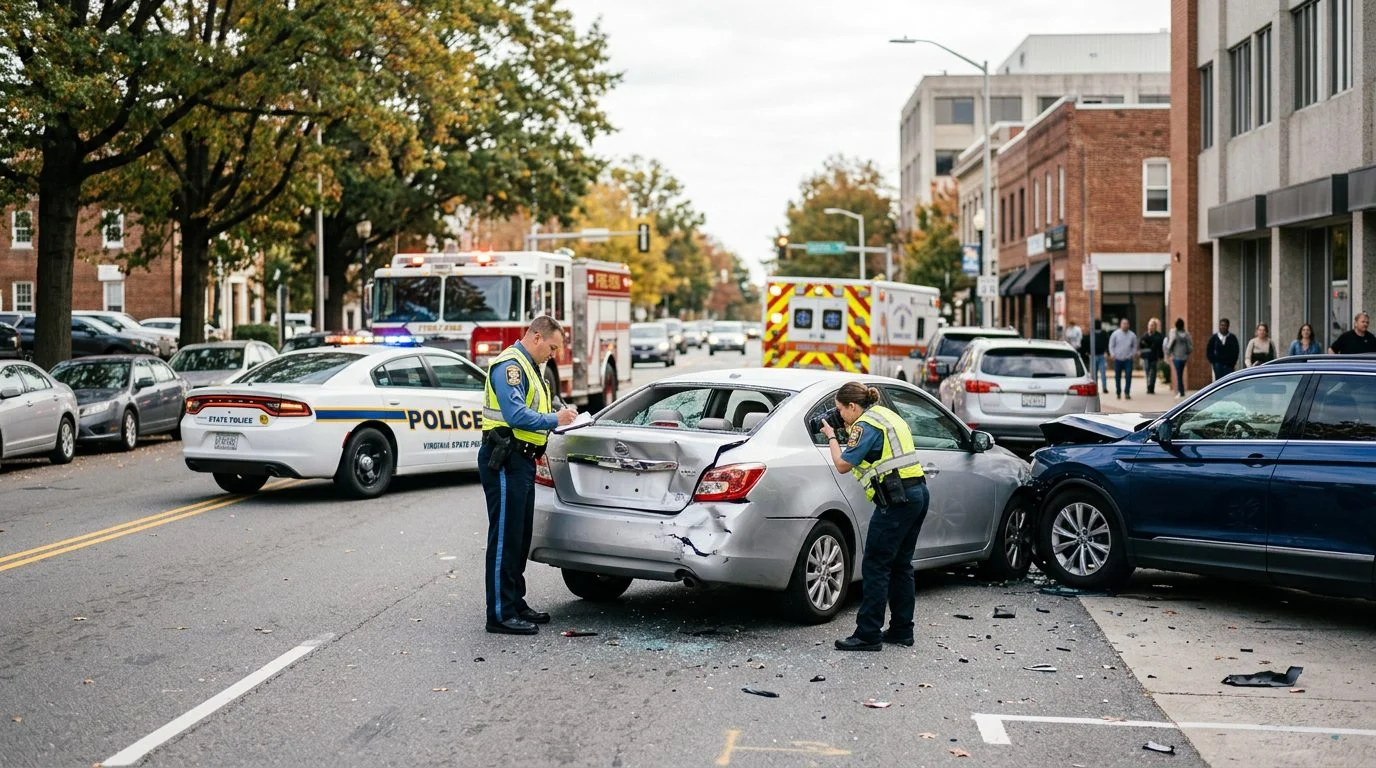
Fault is the central question in nearly every crash claim. The question is who did what, and when. Useful evidence usually comes from several sources at once. These include the police report, photos of the scene and vehicles, the damage pattern on each car, witness statements, and dashcam or traffic camera video when it exists.
Virginia follows contributory negligence: if you are found even partly at fault, you may be barred from recovering, with limited exceptions. Talk to a lawyer about your facts.
This is the rule that matters most in a fault dispute. That is why careful handling of the facts from the start matters.
A common mistake is guessing at speed or distance in the days after a crash. Write down what you remember soon after it happens. Mark anything you are unsure about, rather than filling in gaps.
Rear-end and sudden-stop collisions
A rear-end crash may support a claim when the following driver’s conduct helped cause the impact. These crashes are common in heavy traffic and on busy Virginia highways where traffic slows suddenly.
Common causes include following too closely, distraction from a phone or passenger, and braking too late for slowed traffic. Sometimes the front driver shares responsibility, such as when a sudden stop was not needed. The facts of the stop matter as much as the facts of the impact.
People in the front car also get hurt. A hard rear impact can push a car into the vehicle ahead, so one crash can involve three or more vehicles. Chain-reaction crashes are covered in the pileup section below.
Injuries deserve prompt attention. Neck and back injuries from a rear impact can take time to show up. Symptoms sometimes appear hours or days later. A medical evaluation soon after any crash is commonly recommended, and it creates a record of how you felt at the start. Keep the visit notes and any referral papers.
Side-impact, intersection and head-on crashes
Side-impact crashes at intersections, often called T-bone crashes, usually involve a driver who failed to yield. Other common facts include running a red light or stop sign, or turning left across oncoming traffic. These are the facts a claim tends to examine first.
Head-on collisions usually happen when a vehicle crosses the center line, drifts out of its lane, or travels the wrong way on a road or ramp. The closing speed of two vehicles coming toward each other is high. That is one reason these crashes often cause serious injuries.
Road design, weather and traffic signal timing also matter. A claim may look at whether a signal worked as it should, whether a sightline was blocked, or whether the road was wet or poorly marked. These facts help show how the crash happened.
Virginia looks at causation in a specific way. In plain terms, the injury must follow from the conduct, with no separate event breaking that chain.
Multi-vehicle pileups and hit-and-run crashes
A multi-vehicle pileup can involve several drivers, and one first impact may set off the rest. Investigators often need to sort out the order of impacts. A later collision may trace back to the first one, or to a separate act by another driver.
Hit-and-run crashes are different. The driver who caused the harm leaves the scene, which makes identifying them harder. Witness descriptions, partial plate numbers, traffic camera footage and damage to other vehicles can all help. Gather what you can, and write down what you saw.
Virginia requires a driver involved in a crash with injury or death to stop and report it to police immediately (Va. Code §§ 46.2-371, 46.2-894). The stop-and-report duty is set out in Va. Code § 46.2-894. It also requires reasonable help for an injured person, including a ride to a doctor or hospital when treatment appears necessary or is requested. If injuries keep a driver from reporting right away, the report must be made as soon as reasonably possible.
That reporting duty is separate from the deadline to file a lawsuit. A report is due right after the crash. A lawsuit has its own timeline, covered below.
Crashes involving commercial vehicles and trucks
Crashes involving tractor-trailers and other commercial vehicles often involve more than one party who may be responsible. The driver is one. The company that employed or dispatched the driver, the vehicle’s owner, or a business that arranged the trip may also be involved. Which parties can be named depends on how the work and the vehicle were set up.
Federal and state safety rules apply to many commercial vehicles. Records kept under those rules can matter after a crash. Trucks are heavier than passenger vehicles and need more distance to stop, so a truck crash often involves a larger impact.
Scene details matter in these cases. Photos of the trailer, the truck’s final position, and any company name and number on the cab can help identify the parties. Keep the names and contact details of anyone who saw the crash. The firm represents people hurt in car and truck crashes, and these cases often involve more evidence than a typical car crash.
Not sure what your next step is?
Talk it through with Correll Law Firm — we can walk you through how a situation like yours is usually handled and what your options are.
Injuries that commonly come from these crashes
Car crashes can cause fractures, soft-tissue injuries, traumatic brain injuries and spinal cord injuries. The injury type shapes the claim, because it affects the medical records, the treatment timeline and the effects on daily life.
Fractures and orthopedic injuries are often easiest to document with imaging. Soft-tissue injuries, such as sprains, strains and whiplash, can be harder to see on a scan but still cause real pain and limits. Traumatic brain injury can affect memory, mood and concentration, and symptoms may take time to show. Spinal cord injuries can affect movement and sensation and can lead to long-term needs.
A serious injury can have lasting effects on work, daily activities and family life. Records of missed work, changes to hobbies and household tasks, and what family members notice all help show those effects. Medical records and treatment history are central evidence. Keep every bill, prescription and referral.
Some people also struggle with anxiety, sleep problems or fear of driving after a crash. These effects are real. Describe them honestly to a doctor, and note when they started.
Fatal crashes and wrongful death claims
A fatal crash can lead to a wrongful death claim. That is a separate action from an injury claim, and the time limit and the people involved are different. The approved sentence below sets out who files and when.
A Virginia wrongful death action is filed by the decedent’s personal representative within two years of the death (Va. Code §§ 8.01-50(C), 8.01-244(B)), on behalf of the family members the statute protects. The time limit is set in Va. Code § 8.01-244.
Family members do not file the action themselves. They share in what is recovered. Va. Code § 8.01-53 sets out who shares in the damages and in what order.
Virginia wrongful death damages cover the family’s sorrow, mental anguish and loss of the decedent’s companionship, guidance and care; lost income and services; medical expenses from the injury; funeral expenses; and, for willful or wanton conduct, punitive damages (Va. Code § 8.01-52).
When punitive damages may be available
Punitive damages are available in Virginia only for conduct that goes well beyond ordinary carelessness. The statute is at Va. Code § 8.01-38.1.
Virginia allows punitive damages for actual malice, or for willful or wanton conduct or recklessness showing a conscious disregard for the safety of others, capped at $350,000 (Va. Code § 8.01-38.1).
Racing through a crowded intersection while aware of the danger is the kind of conduct a court may examine under this standard.
A jury must find that the conduct met this standard before punitive damages can be awarded. Ordinary carelessness alone does not meet it. The facts of each crash decide whether the standard applies.

Filing deadlines and evidence to preserve
Virginia generally allows two years from the date of injury to file a personal injury lawsuit (Va. Code § 8.01-243(A)); the clock runs from the date of injury, not the date of discovery, with narrow exceptions. The two-year rule is set out in Va. Code § 8.01-243.
Some claims carry notice requirements that run out sooner, so timing matters early on. It is not the deadline to report a crash, which happens right away.
Frequently asked questions
What types of car accidents qualify for personal injury claims in Virginia?
Crashes where another driver’s negligence helped cause injury, such as rear-end, side-impact, head-on, pileup and hit-and-run crashes, may support a claim. The facts of each crash decide the outcome.
Does a rear-end collision qualify for a personal injury claim in Virginia?
A rear-end collision may support a claim when the following driver’s conduct helped cause the injury. Fault and the specific facts still decide the question.
How long do I have to file a Virginia car accident lawsuit?
Virginia generally allows two years from the date of injury to file a personal injury lawsuit. Some claims have shorter notice requirements.
Evidence worth keeping after any crash
Keeping good records early makes every type of claim easier to document. Consider keeping the following:
- Photos of the scene, the vehicles and the road, taken as soon as it is safe.
- The police report number and the name of the responding agency.
- Names and contact details of witnesses.
- Insurance information for each driver and each vehicle owner.
- Medical records, bills, prescriptions and referral notes.
- Receipts for medicine, rides and repairs.
- A simple daily journal of symptoms, sleep, missed work and activities you can no longer do.