
Getting the Police Report After a Fatal Crash in Virginia
A plain-language guide to requesting the crash report, what it can contain, and how a family can start the process while grieving.
Published October 29, 2026
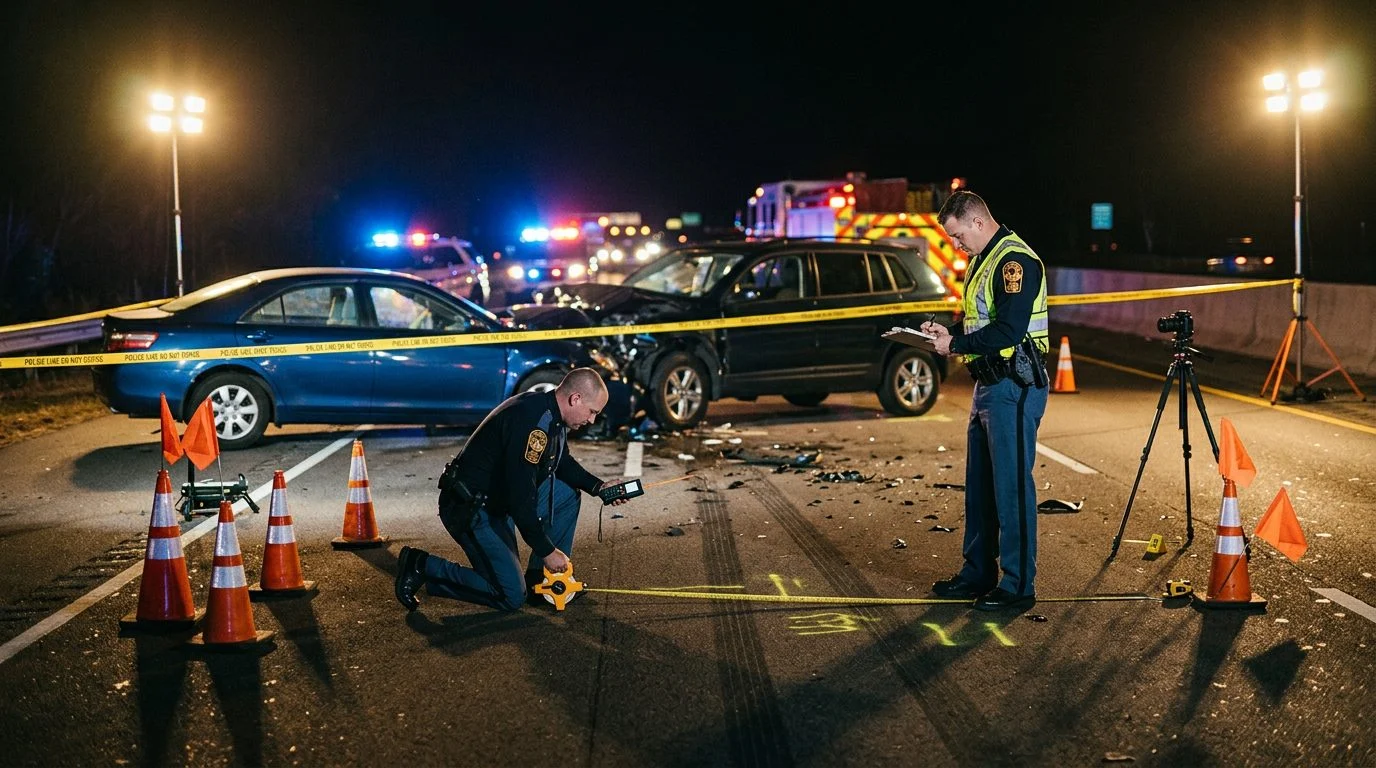
To get a police report after a fatal crash in Virginia, contact the agency that investigated the crash and ask how it accepts requests. The investigating agency holds the file, so finding it is the first step. The steps below show how to find that agency, what to gather first and what the report contains.
Losing a loved one in a crash is painful. Many families need the official record early, while they are still making hard decisions. This guide is written for families in Winchester, Harrisonburg, the Shenandoah Valley, Richmond and Henrico County. The steps are the same across Virginia, although each agency sets its own request methods.
Who Investigates a Fatal Crash and What the Report Is
The agency that responded to the scene usually investigates and writes the crash report. That may be the Virginia State Police, a county sheriff’s office, or a city or town police department. Where the crash happened decides which agency it is.
A crash report is a written record of the investigation so far. The officer usually records the date, time and location, the vehicles and drivers, any passengers and witnesses, a written narrative and a diagram. Many reports also include coded contributing factors. These are short labels the officer assigns to conditions noted at the scene.
Families often ask for the report early because it is the first official written account of what happened. It is not always the final word. An investigation can continue after the first report is written. The Virginia State Police crash report guidance explains how official crash records are kept and obtained.
If a fatal crash has left your family with hard questions, you may have a claim, and the firm is glad to talk through your options with you. Talk it through with Correll Law Firm — we can walk you through how a situation like yours is usually handled and what your options are.

Gather the Details Before You Request the Report
The agency needs enough information to find the right file. The most useful details are the full date and time of the crash, the exact location or nearest intersection, and the full names of the people involved.
If the officer gave you a card or paperwork, look for a report or incident number. A family member may not have that number. In that case, the date, the location and the names are often enough for the agency to search its records. Write down everything you have before you call or visit.
Be ready to show identification. Expect the agency to ask how you are related to the person who died. Having that relationship clear helps the request move forward. Keep copies of anything you send.
Many families wait weeks to start because they are grieving. Starting early, even with partial details, can prevent a long gap before the report reaches you.
How to Find and Request a Fatal Crash Report in Virginia
Learning how to get police report after fatal crash Virginia requests follow starts with one call or visit to the investigating agency’s records office. Ask which request methods it accepts. Some agencies take requests in person, some by mail, and some through an online portal. Ask rather than assuming one method applies.
The Virginia Department of Motor Vehicles’ police crash report request page explains who may obtain a Virginia police crash report and how requests may be submitted. Read it before you start, then confirm the details with the agency that holds the file.
Ask the agency which family members or representatives it accepts requests from. Keep a written record of the date you asked, the name of the person you spoke with and any reference number they gave you. A short log makes follow-up easier.
Getting a Copy of a Report Involving a Loved One
The agency decides how it processes each request. That is why a family should check eligibility before sending paperwork.
When the report names a loved one who was killed, the family member asking should explain the relationship clearly. Ask the agency what proof it needs. Find out whether it wants a written request, a specific form or identification. Send copies unless the agency asks for originals.
Keep everything in one folder. Store each request, each reply, each receipt and each reference number together. A single folder makes it easier to answer questions later, whether they come from an insurer, the agency or a lawyer the family may wish to speak with.
What Happens After the Report Is Filed and What It Shows
The report is the start of the investigation record. Supplemental reports, reconstruction findings or other records may follow. Ask the agency whether a supplement exists before you assume the first report is complete.
Read the report in parts. The narrative describes what the officer believed happened. The diagram shows where vehicles stopped or came to rest. The vehicle and occupant sections list details about each vehicle and person. The witness list names people who may have seen the crash.
Contributing-factor codes are short labels. Read each code alongside the narrative and diagram, not by itself. A code can look clear on its own but mean something different in context.
Compare the report with your own notes, photos and witness accounts. If something does not match, write it down early. Early notes are easier to check while memories and records are fresh.
Common Delays and Problems When Requesting a Report
A report can take time. It may wait while the crash is still under investigation, while toxicology or reconstruction results are pending, or when more than one agency was involved. Ask the agency what stage the file is in and when it expects to finish.
Errors happen. A name, vehicle detail or location may be wrong. Point out the error in writing to the agency. Include the report number and the correct information, and keep a copy of your letter.
If a request is denied or delayed, ask the agency for the reason in writing. Also confirm the correct contact person at that agency. Note dates and names each time you call. A dated log makes it easier to follow up on a stalled request.
Not sure what your next step is?
Talk it through with Correll Law Firm — we can walk you through how a situation like yours is usually handled and what your options are.
Virginia Reporting Duties and Filing Deadlines to Keep in View
Virginia requires a driver involved in a crash with injury or death to stop and report it to police immediately (Va. Code §§ 46.2-371, 46.2-894).
Keep these two clocks separate so the dates do not get mixed up.
A Virginia wrongful death action is filed by the decedent’s personal representative within two years of the death (Va. Code §§ 8.01-50(C), 8.01-244(B)), on behalf of the family members the statute protects. The action under subsection A is brought by the decedent’s personal representative (Va. Code § 8.01-50(C)); actions for fetal death under subsection B are brought by the natural mother, or, if she dies or is under a disability as defined in § 8.01-2, by the administrator of her estate, her guardian, or her personal representative qualified to bring such action. The beneficiary classes are set out in Va. Code § 8.01-53, which lists first the surviving spouse, children of the deceased and children of any deceased child of the deceased. If any of them survive, this first group also includes a parent who, within 12 months before the death, regularly received support or services from the decedent for necessaries; but if the decedent left a surviving spouse and a parent or parents and no child or grandchild, the award goes to the spouse and the parent or parents.
Can I file a police crash report online in Virginia?
Online options depend on the agency that investigated the crash. The Virginia DMV request page explains how requests may be submitted, so check there and with the agency.
Does the two-year period apply to reporting a crash?
Reporting a crash to police is a separate duty that applies immediately.
Related Resources for Families After a Catastrophic Injury or Death
For a general overview of the subject, read the catastrophic injuries page, which covers these injuries and the families affected by them. The firm handles wrongful death cases and catastrophic injury matters, and that page is a good starting point.
Families caring for a relative with a catastrophic injury may also want to read about life care planning to understand long-term planning. If a relative has a spinal cord injury and home changes are under consideration, the home modifications page covers that topic. For a traumatic brain injury, the return-to-work page covers work and recovery timelines.