
Virginia Personal Injury | Winchester, Harrisonburg and the Shenandoah Valley
Catastrophic Injury Claims in Virginia: How They Work
A plain-language guide for families facing a serious brain, spinal cord or crash injury, and what the claim process can involve.
Published November 2, 2026
A catastrophic injury claim in Virginia seeks compensation for serious harm that may last for years or never fully heal. Many of these claims begin with a serious car or truck crash. This guide walks through how the process generally works, from crash reporting and filing deadlines to fault, wrongful death and punitive damages. Serious injuries differ from minor ones in how long they take to understand. The sections below explain that difference, what a catastrophic injury attorney may do during a case, and which steps matter most early on.
What a catastrophic injury claim covers in Virginia
A catastrophic injury claim covers serious harm that may change a person’s health, work and family life for years or permanently. Two injuries are common in this group: traumatic brain injury and spinal cord injury.
A brain injury can affect memory, speech, balance, mood and the ability to work. A spinal cord injury can cause paralysis or loss of feeling and movement below the injury. Both can require long-term medical care, therapy and daily help at home.
The first weeks after a serious crash matter. Emergency room records, imaging results and notes from each treating doctor build the timeline of the injury. If treatment is delayed, the records may show a gap, and insurers often look closely at gaps. Keep every appointment, every medication list and every note about symptoms.
For a wider overview, read the firm’s catastrophic injuries page.
If someone you love was seriously hurt or killed in a crash, you do not have to face the questions alone, and the firm is ready to talk about what happened. Talk it through with Correll Law Firm — we can walk you through how a situation like yours is usually handled and what your options are.
Why serious injury claims take more work than minor ones
Serious injury claims take more work because the full effect of the injury often shows up over time. Past medical bills are the easy part to measure. Future care is harder.
Future medical care, rehabilitation and long-term help at home may be needed for years. Estimating those needs usually takes detailed medical records and input from treating doctors. The loss of an ability to work, and the value of help a family member once gave, can also be hard to show with simple numbers.
Medical records from emergency care, specialists and rehabilitation providers form the core of the proof. Medical experts may be needed to explain the injury and its long-term effects to an insurer or a jury. In truck and commercial vehicle crashes, accident reconstruction and crash data can show how the collision happened.
What the lawyer does during the case
A lawyer’s main job in these cases is to build the proof and handle the insurance side. That work lets the injured person focus on recovery.
In a truck crash, the work may include gathering police reports, vehicle data and driver logs. Early requests to keep those records can prevent important proof from being lost. Organizing medical records and working with treating providers keeps the file complete.
Communication with insurance companies is another part of the work. An injured person does not have to handle those calls alone. Throughout the case, a lawyer explains each step and the options the injured person may consider. No lawyer can promise a particular result, because each case depends on its own facts and evidence.
Deadlines and the duty to report a crash in Virginia
Most Virginia injury lawsuits have a filing deadline, and the clock starts early. Virginia generally allows two years from the date of injury to file a personal injury lawsuit (Va. Code § 8.01-243(A)); the clock runs from the date of injury, not the date of discovery, with narrow exceptions.
Crash reporting is a separate duty with its own rule. Virginia requires a driver involved in a crash with injury or death to stop and report it to police immediately (Va. Code §§ 46.2-371, 46.2-894). The two-year period is the deadline to file a lawsuit, not to report a crash.
Some claims carry notice requirements that run out sooner than the lawsuit deadline.
How fault works in a Virginia injury claim
Fault decides whether an injured person can recover, so it is one of the first questions in any claim. Virginia follows contributory negligence: if you are found even partly at fault, you may be barred from recovering, with limited exceptions. Talk to a lawyer about your facts.
More than one driver can share responsibility for a crash.
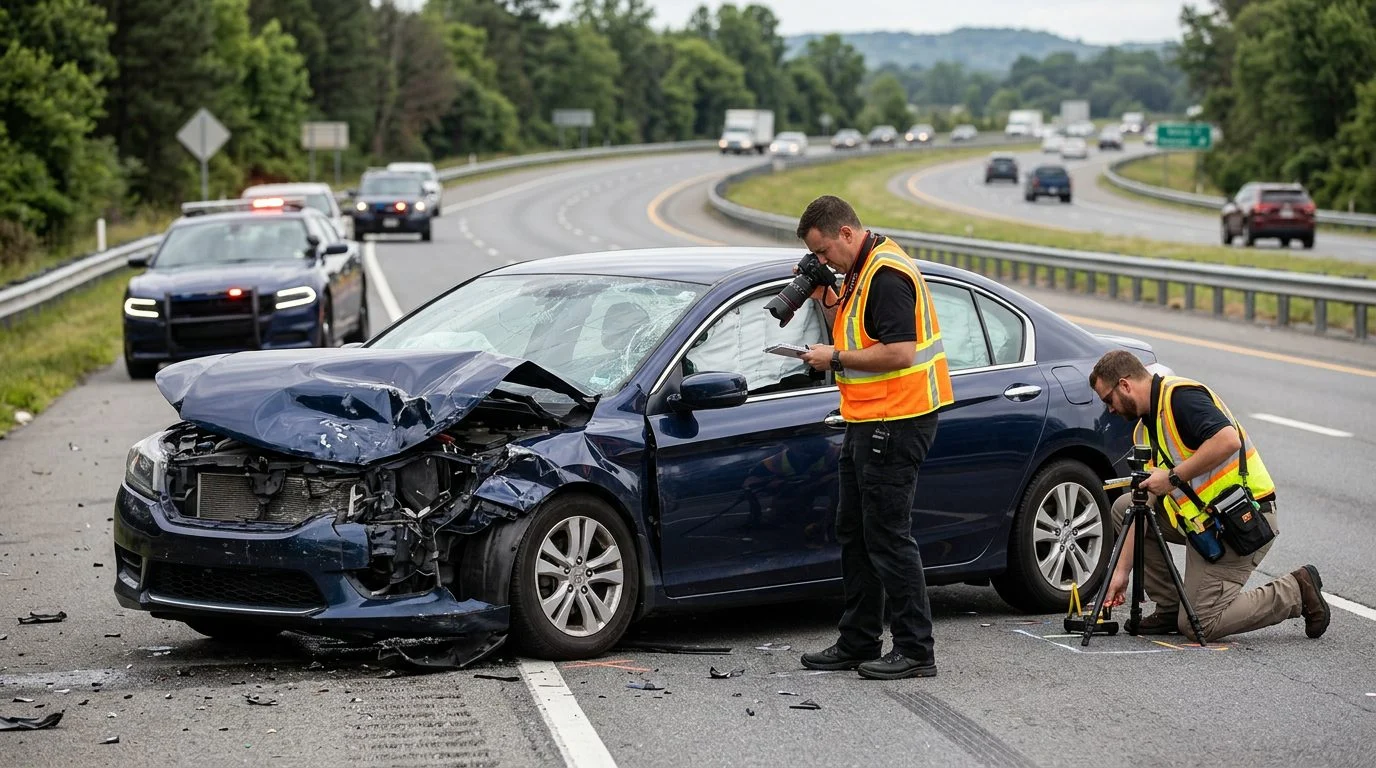
Imagine a crash at an intersection involving a car, a delivery van and a tractor-trailer. Police reports, traffic camera footage, skid marks and witness statements can each show a different part of the sequence. Investigators then try to match that evidence to a single timeline.
Evidence can disappear quickly. Vehicles are repaired, video is overwritten and witnesses move on. Acting early helps preserve the proof that shows who was at fault.
Wrongful death claims after a fatal crash or injury
A Virginia wrongful death claim is brought by the decedent’s personal representative for the benefit of certain family members. Virginia wrongful death actions are filed by the decedent’s personal representative within two years of the death (Va. Code §§ 8.01-50(C), 8.01-244(B)), on behalf of the family members the statute protects.
Virginia wrongful death damages cover the family’s sorrow, mental anguish and loss of the decedent’s companionship, guidance and care; lost income and services; medical expenses from the injury; funeral expenses; and, for willful or wanton conduct, punitive damages (Va. Code § 8.01-52).
The statute directs the award to beneficiaries in a set order, beginning with the surviving spouse and children of the deceased (Va. Code § 8.01-53).
Not sure what your next step is?
Talk it through with Correll Law Firm — we can walk you through how a situation like yours is usually handled and what your options are.
Punitive damages: when Virginia law allows them
Virginia allows punitive damages for actual malice, or for willful or wanton conduct or recklessness showing a conscious disregard for the safety of others, capped at $350,000 (Va. Code § 8.01-38.1). Each claim turns on its own facts. The total punitive damages awarded against all defendants found to be liable cannot exceed $350,000 in actions accruing on or after July 1, 1988 (Va. Code § 8.01-38.1).
The jury must find that the conduct met this standard before punitive damages are awarded. Imagine a driver who knew about a serious brake problem and kept driving anyway. Whether that conduct meets the standard depends on the proof of what the driver knew.

Where the firm works and who it serves
Correll Law Firm’s offices are located in Winchester and Harrisonburg. The firm represents people from the Shenandoah Valley to Richmond and Henrico County.
The firm handles car accidents, truck accidents, commercial vehicle accidents, catastrophic injuries, traumatic brain injury, spinal cord injury and wrongful death. Readers can learn more on the firm’s catastrophic injuries page.
Frequently asked questions
What is a catastrophic injury in Virginia?
It is a serious injury, such as a traumatic brain injury or spinal cord injury, that can cause long-term or permanent loss.
Can a family share in a wrongful death recovery?
Yes. The statute directs the award to beneficiaries in a set order, starting with the surviving spouse and children.
Do punitive damages apply to every crash?
No. Virginia requires actual malice or willful or wanton conduct, and the jury must find that standard met.
Does a truck crash case always need accident reconstruction?
No. Crash data and physical evidence often matter in truck and commercial vehicle cases, but the need depends on the facts.