
Catastrophic Injuries | Virginia
Hit and Run Catastrophic Injury in Virginia: What to Do Next
Practical steps after a driver leaves the scene, and the Virginia rules that may affect an injured person's claim.
Where the firm works
Winchester
Office
Harrisonburg
Office
Published November 3, 2026
After a driver leaves the scene of a serious crash, people often ask the same first questions: what to do, what to keep, and what deadlines apply. If a driver hit you and left, report the crash to police as soon as you can, get medical care, and preserve evidence. A person seriously hurt in that kind of crash may still be able to bring a claim, even if the driver is never found.
The Short Answer: Report the Crash, Preserve Evidence, and Understand Your Options
Report the crash, get medical care, and start keeping records right away. Virginia requires a driver involved in a crash with injury or death to stop and report it to police immediately (Va. Code §§ 46.2-371, 46.2-894). The duty to stop is set out in Va. Code § 46.2-894.
If you cannot make the report yourself, ask a witness or passerby to contact police for you. Reporting a crash and filing a lawsuit are separate steps with separate clocks. The two-year period covered later is generally the deadline to file a personal injury lawsuit, unless another statute provides otherwise, and it is not the deadline to report a crash (Va. Code § 8.01-243). Many people focus on the other driver and forget their own records. Your photos, medical file and notes often form the foundation of any claim.
If a driver who left the scene caused a serious injury to you or someone you love, the firm is glad to talk through your options and whether you may have a claim. Talk it through with Correll Law Firm — we can walk you through how a situation like yours is usually handled and what your options are.

What Counts as a Hit and Run Crash in Virginia
A hit and run happens when a driver leaves the scene instead of stopping and giving their information. Under Va. Code § 46.2-894, a driver involved in an accident in which a person is killed or injured, or in which an attended vehicle or other attended property is damaged, must immediately stop as close to the scene as possible without obstructing traffic. The driver must also report a name, address, driver’s license number and vehicle registration number to State Police or local police, to the injured person if able to understand it, or to the other vehicle’s driver or occupant or the custodian of damaged property.
The same statute requires reasonable help for anyone hurt. That includes taking the injured person to a physician, surgeon or hospital when medical treatment is apparent or requested. A person convicted of a violation involving injury or death is guilty of a Class 5 felony under that statute.
The driver may be unknown at first. The crash can still be reported and documented even if the vehicle is never found.
Steps to Take If You Were Seriously Hurt
Get medical evaluation as soon as possible, even if your injuries seem minor. A medical record made close to the crash helps connect your injuries to it. Gaps in treatment can make that connection harder to show, so follow the treatment plan your providers give you.
Tell each provider about the crash, and describe every new symptom, even small ones. Providers can only record what they are told. Ask for copies of visit notes and test results as they become available.
Start a written log the same week. Note symptoms, appointments, medications, missed work and any limits on daily tasks. Keep medical records, insurance letters and receipts together in one folder, paper or digital. A log written close to the events is easier to rely on than memory months later.
Evidence That Matters in a Hit and Run Crash
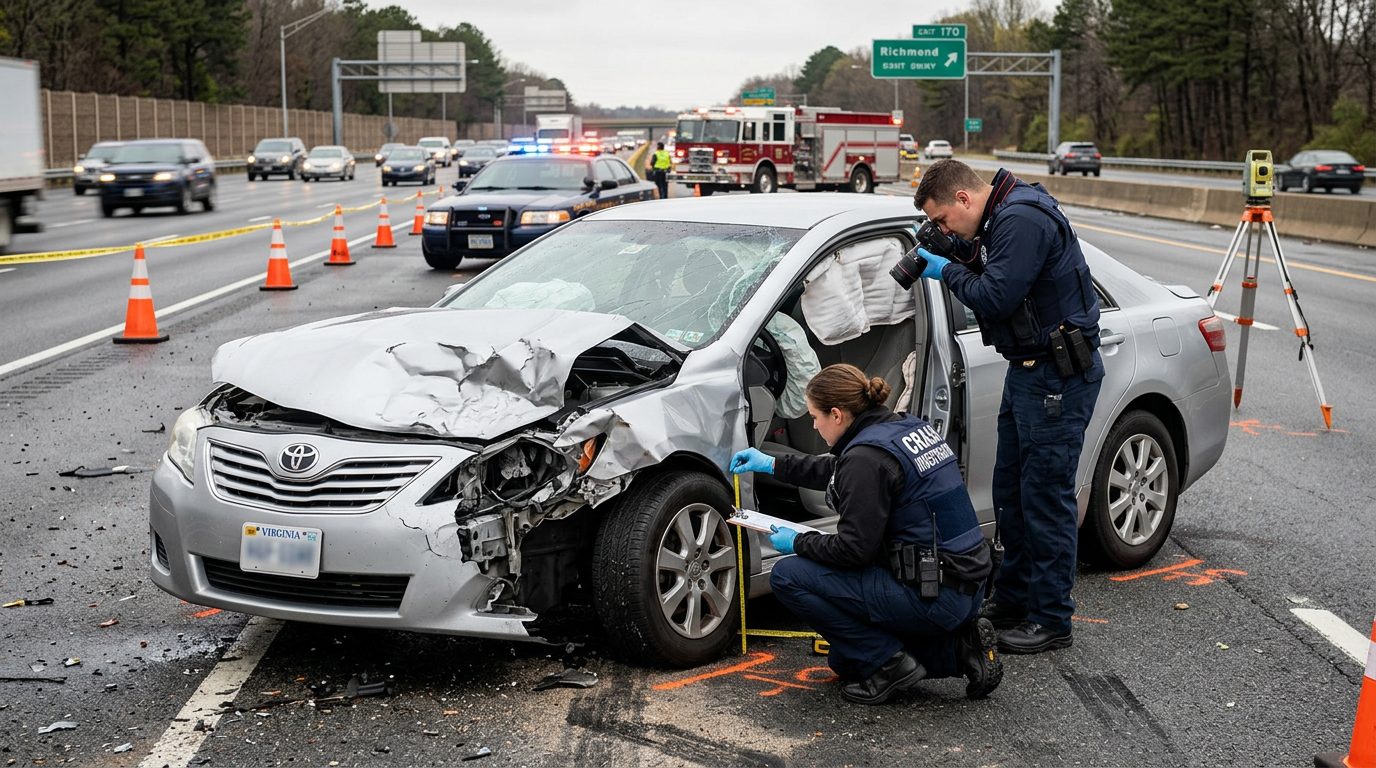
The most useful evidence is the police report, the scene itself, and the people who saw what happened. Write down the report number, the responding officer’s name and agency, and the exact time and location of the crash.
Take photos of the scene, roadway markings, debris, skid marks and your vehicle’s damage as soon as it is safe. Collect names and contact details of witnesses. Ask what they saw of the other vehicle, including make, model, color, partial plate or direction of travel. Witnesses’ memories fade, so write down what each person said soon after the crash.
Nearby surveillance or dashcam footage can be overwritten quickly. Note where cameras were located, and ask how long footage is kept as early as possible. Keep damaged clothing, helmets and personal items. Do not repair or sell your vehicle until its condition has been documented.
Insurance and Uninsured Motorist Coverage Questions
Your own auto insurer may matter most when the other driver is unknown. Under Va. Code § 38.2-2206, when the owner or operator of the vehicle is unknown and there was no contact between the vehicles, the accident must be reported promptly for the insured to recover under the endorsement required by subsection A. For the insured to recover under that endorsement, the report must go to the insurer or to a law-enforcement officer having jurisdiction in the county or city in which the accident occurred. If prompt reporting is not reasonably practicable, it must be made as soon as reasonably practicable.
Whether that coverage applies depends on the facts and the terms of your own policy, so read the policy language closely. Virginia law also allows an action against an unknown driver named as “John Doe” (Va. Code § 38.2-2206(E)). Statements to insurers can affect a claim. Keep a record of every conversation, including dates, names and what was said.
Deadlines: The Two-Year Limit and Notice Requirements
Virginia generally allows two years from the date of injury to file a personal injury lawsuit (Va. Code § 8.01-243(A)); the clock runs from the date of injury, not the date of discovery, with narrow exceptions. Va. Code § 8.01-243(A) provides that, unless otherwise provided in this section or by other statute, every action for personal injuries, whatever the theory of recovery, shall be brought within two years after the cause of action accrues (Va. Code § 8.01-243).
Some claims carry notice requirements that run out sooner. Under that statute, a claim filed after the deadline may be barred.
A pending criminal case can also affect the clock. Under Va. Code § 8.01-229, if a criminal prosecution arising out of the same facts is commenced, the time that prosecution is pending is not counted toward the period for a personal action for damages or an action for death by wrongful act under § 8.01-50, and the civil action may then be brought within the remaining period of the statute or within one year, whichever is longer. Do not treat that pause as a reason to wait.
Not sure what your next step is?
Talk it through with Correll Law Firm — we can walk you through how a situation like yours is usually handled and what your options are.
Catastrophic Injury Claims When the At-Fault Driver Is Unknown or Leaves
A hit and run catastrophic injury Virginia matter often involves an unknown driver, a serious injury and an insurance policy that needs close review. The firm handles catastrophic injury matters, including traumatic brain injury and spinal cord injury. Those matters can involve a driver who is unknown or who left the scene. An overview is on the catastrophic injuries page.
Because the other driver cannot be questioned, records from the scene and your own medical file carry more weight. Early steps often shape what can be shown later. The police report, the first medical records and the first notice to your insurer are good places to start.
The firm’s offices are in Winchester and Harrisonburg. It serves people from the Shenandoah Valley to Richmond and Henrico County.

Frequently Asked Questions About Hit and Run Crashes in Virginia
Can I still bring a hit and run catastrophic injury Virginia claim if the driver was never identified?
Possibly. The facts and the insurance available decide it, and early documentation matters.
Does the driver’s arrest affect my civil claim?
A criminal case is separate from a civil claim. The timing rules for each are covered above.
Who can bring a wrongful death claim after a hit and run death?
A Virginia wrongful death action is filed by the decedent’s personal representative within two years of the death (Va. Code §§ 8.01-50(C), 8.01-244(B)), on behalf of the family members the statute protects.
What if I can’t remember the crash?
Witness statements, the police report and medical records can help reconstruct the crash when memory is incomplete.