
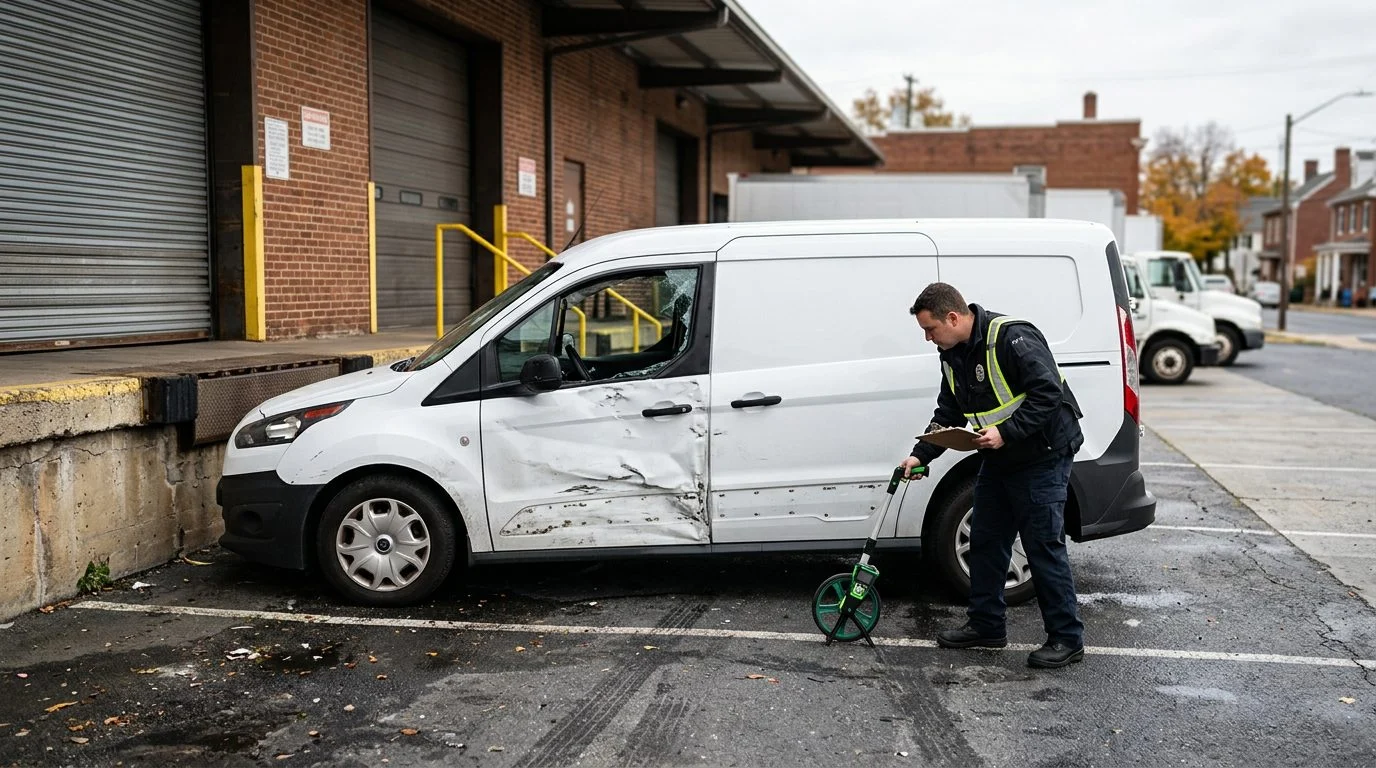
Commercial Vehicle Accidents | Winchester, VA
Injured in a Commercial Vehicle Crash? The Firm Can Help You Understand Your Options
Crashes involving box trucks, tractor-trailers, buses and other commercial vehicles can raise questions that ordinary car crashes do not. Here is how the firm approaches them.
Published November 12, 2026
If a commercial truck or bus crash left you or someone you love seriously hurt, you likely have many questions. A commercial vehicle accident claim asks the people responsible for a crash to pay for the losses it caused. This guide explains how these claims work in Virginia, which deadlines apply, and what the process usually looks like.
What Is a Commercial Vehicle Accident Claim?
A commercial vehicle accident claim arises when a vehicle used for business is involved in a crash that injures or kills someone. Commercial vehicles include tractor-trailers and other large trucks, buses, delivery and box trucks, and work vehicles used in a business. Because they are heavy, these crashes often cause more serious injuries than crashes between passenger cars.
A claim may involve a commercial vehicle that hits a passenger car, a pickup, a motorcycle or a pedestrian. It may also involve a single-vehicle rollover. Drivers and passengers alike may have questions about their injuries after a crash.
Not sure what your next step is?
Talk it through with Correll Law Firm — we can walk you through how a situation like yours is usually handled and what your options are.

What Crashes Does the Firm Handle?
The firm handles serious car and truck crashes, catastrophic brain and spinal cord injuries, and wrongful death claims. Its matters include:
- Truck crashes on interstate and rural roads, such as rear-end, lane-change, jackknife and rollover crashes.
- Crashes involving buses, delivery vehicles and other commercial vehicles used in business.
- Car crashes in which the other driver was operating a commercial vehicle.
- Traumatic brain injury and spinal cord injury. These injuries often need long-term medical care and careful planning for the future.
- Wrongful death claims that arise from commercial vehicle crashes.
Who May Be Responsible in a Commercial Vehicle Crash?
More than one party may be responsible for a commercial vehicle crash, not only the driver. Many different parties can be involved in a commercial truck crash, and each crash has its own set of facts.
Federal rules put a duty on the motor carrier to make sure drivers follow the driving rules. 49 C.F.R. § 390.11 states that when a regulation in part 325 of subchapter A or in this subchapter imposes a duty or prohibition on a driver, it is the carrier’s duty to require that the duty or prohibition be observed. If the motor carrier is a driver, the driver is likewise bound.
Insurers often become involved in more than one policy. Identifying each party early helps the claim move forward.
What Evidence Matters in a Truck Crash Case?
The most useful evidence often comes from records the carrier must keep, plus what the crash scene shows. Key items include:
- Electronic logging device data and duty status records. Federal rules require a motor carrier to have each driver record duty status for each 24-hour period (49 C.F.R. § 395.8).
- Post-accident testing records. In defined circumstances, employers must test surviving drivers for alcohol and controlled substances as soon as practicable (49 C.F.R. § 382.303).
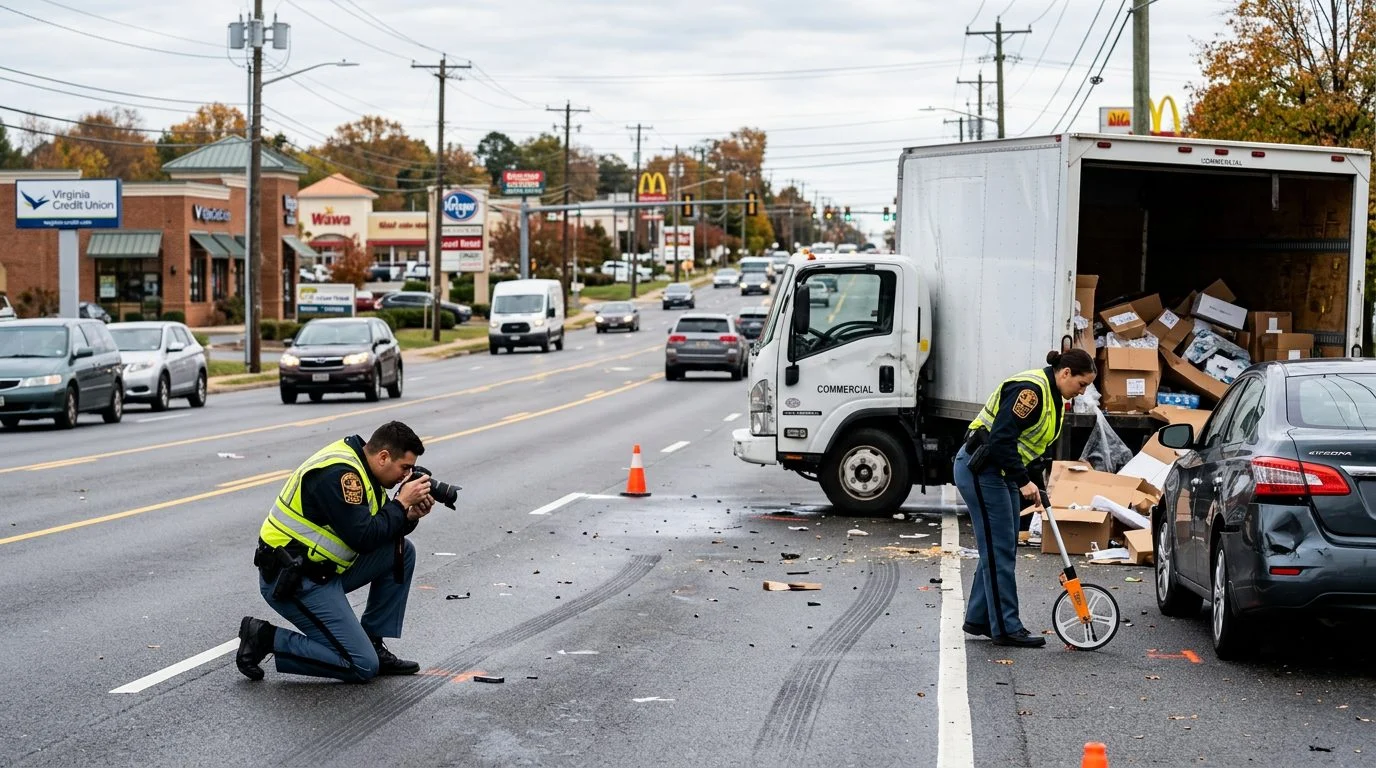
- Crash reports and photos. Scene photos, vehicle damage photos and witness contact information matter.
- Video. Dash camera footage and nearby traffic or business video can be recorded over quickly.
- Medical records. Records and imaging that connect the injury to the crash are central to any claim.
When the cause of a crash is disputed, outside accident reconstruction professionals can analyze how it happened.
Reporting the Crash and Protecting Your Claim Early
Virginia requires drivers to report injury crashes to police right away. Virginia requires a driver involved in a crash with injury or death to stop and report it to police immediately (Va. Code §§ 46.2-371, 46.2-894).
The two-year lawsuit period is a deadline to file suit (Va. Code § 8.01-243). It is not a deadline to report a crash.
Prompt medical evaluation and keeping follow-up appointments create a clear record of injuries and how they affect daily life.
Be careful with social media. Posts and photos about activities can be used later. Recorded statements to an insurer or trucking company can also be used later, so think before speaking.
What Are the Deadlines and Legal Standards in Virginia?
Virginia generally allows two years from the date of injury to file a personal injury lawsuit (Va. Code § 8.01-243(A)); the clock runs from the date of injury, not the date of discovery, with narrow exceptions.
Some claims carry notice requirements that run out sooner. For example, a negligence claim against a county, city or town requires a written statement of the nature of the claim, including the time and place of the injury, within six months after the claim accrues; failure to file it does not bar the claim if the attorney, chief executive, or mayor of the locality, or any insurer or entity providing coverage or indemnification of the claim, had actual knowledge of the claim within that period, and if the claimant was under a disability when the claim accrued, the tolling provisions of § 8.01-229 apply (Va. Code § 15.2-209).
Wrongful Death Claims
A Virginia wrongful death action is filed by the decedent’s personal representative within two years of the death (Va. Code §§ 8.01-50(C), 8.01-244(B)), on behalf of the family members the statute protects.
Virginia wrongful death damages cover the family’s sorrow, mental anguish and loss of the decedent’s companionship, guidance and care; lost income and services; medical expenses from the injury; funeral expenses; and, for willful or wanton conduct, punitive damages (Va. Code § 8.01-52).
Fault and Punitive Damages
Virginia follows contributory negligence: if you are found even partly at fault, you may be barred from recovering, with limited exceptions. Talk to a lawyer about your facts.
Not sure what your next step is?
Talk it through with Correll Law Firm — we can walk you through how a situation like yours is usually handled and what your options are.
How a Commercial Vehicle Claim Usually Proceeds
A claim usually moves through review, evidence gathering, documentation, negotiation and, if needed, a lawsuit. The steps generally look like this:
- Review. The firm looks at what happened, the injuries and the records already available.
- Preservation. The firm may send letters asking carriers and insurers to keep key records, such as logs and dispatch communications.
- Documentation. Medical records show how the injury affects work, daily life and future care.
- Demand and negotiation. A written demand goes to the responsible parties and their insurers, followed by negotiation.
- Lawsuit. If a fair resolution is not reached, a lawsuit may be filed within Virginia’s deadlines, and trial is possible.
Timing varies from case to case, and each stage can take a different amount of time.
How Correll Law Firm Approaches These Cases
The firm focuses on serious car and truck crashes, catastrophic injuries and wrongful death. It has offices in Winchester and Harrisonburg.
The firm serves people from across the Shenandoah Valley, Richmond and Henrico County. Support staff help with records requests and scheduling, and the firm keeps clients informed as the claim moves forward.
Common Questions About Commercial Vehicle Accident Claims
Do I need a lawyer after a truck crash?
A person may wish to speak with a lawyer about their situation after a commercial vehicle crash. The choice is theirs.
What if an insurance adjuster calls me directly?
The adjuster works for the insurer, not for you. Statements given early can affect a claim later.
Does the firm handle wrongful death cases from commercial vehicle crashes?
Yes, the firm focuses on wrongful death cases, including those that arise from commercial vehicle crashes.
Can someone hurt in Winchester or Richmond bring a claim?
Residents of the Shenandoah Valley, Richmond and Henrico County may be among those the firm represents. Each crash is reviewed on its own facts.