
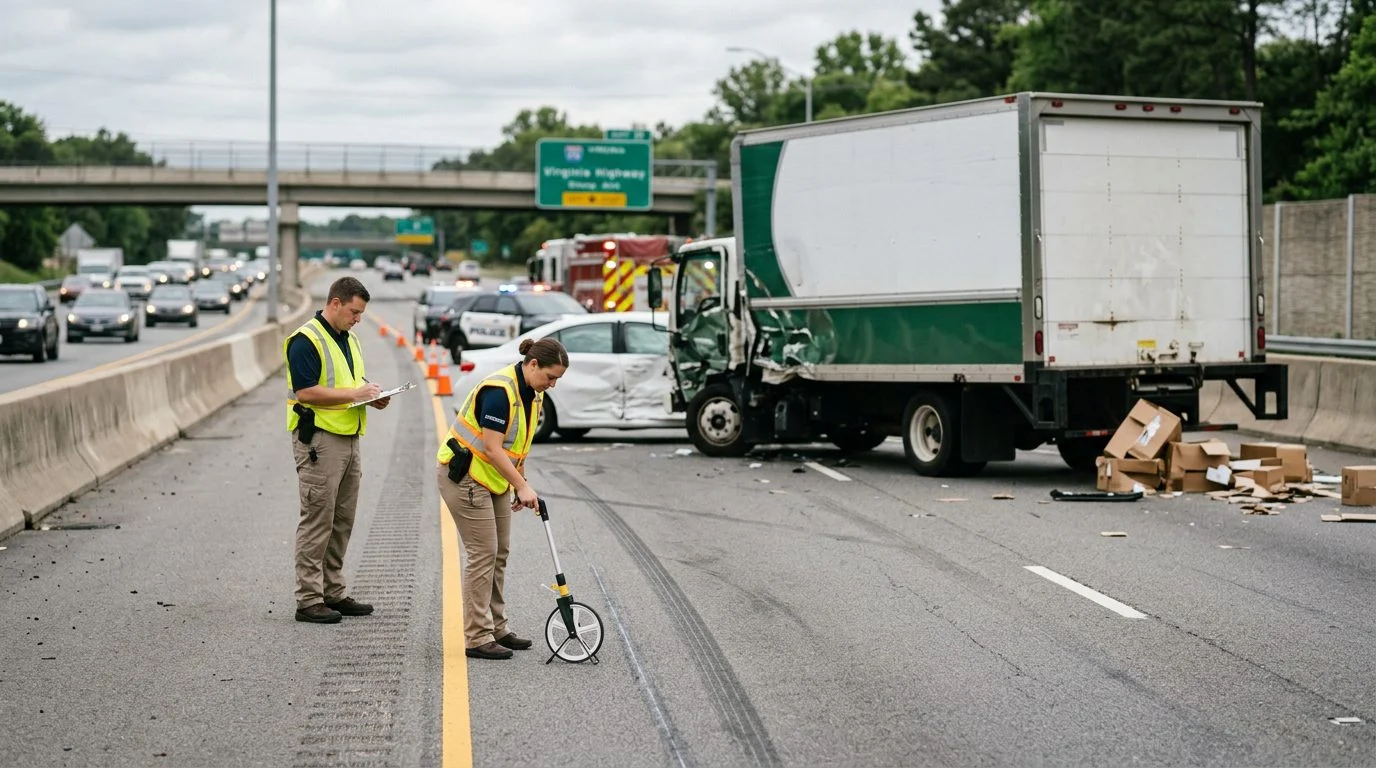
Commercial Vehicle Accidents | Richmond and Henrico County
Hurt in a Delivery Truck Crash in Richmond or Henrico County?
Correll Law Firm represents people seriously injured in car and commercial vehicle crashes, from Richmond and Henrico County to the Shenandoah Valley.
Published October 28, 2026
A delivery truck accident can leave a person with serious injuries or leave a family without a loved one. If you are looking for a delivery truck accident lawyer in Richmond or Henrico County, this guide explains how these claims work. It covers common crash patterns, who may be responsible, what a claim may cover, and the Virginia deadlines that matter.
What Delivery Truck and Box Truck Accidents Involve
A delivery truck accident is a crash involving a commercial vehicle that makes repeated stops to drop off goods. Several vehicle types fall into this group:
- Delivery truck: a larger truck that carries freight or packages along a route.
- Box truck: a truck with an enclosed cargo box behind the cab.
- Step van: a walk-in delivery vehicle with a high cab and a rear door.
- Delivery van: a smaller van used for parcel and store deliveries.
This page serves injured drivers, passengers, pedestrians and cyclists, as well as families dealing with a death. These crashes often differ from passenger car crashes. The vehicles are heavier, have larger blind spots, carry cargo that can shift, and run on tight schedules. More companies and individuals can also be involved. For broader background, see the commercial vehicle accidents guide.
If a delivery truck left you or someone you love injured, you may have a claim, and the firm is glad to talk through the facts with you. Talk it through with Correll Law Firm — we can walk you through how a situation like yours is usually handled and what your options are.

Common Crash Patterns on Richmond and Henrico County Roads
Most delivery vehicle crashes fall into a few patterns. Each one tends to happen during routine work on the road.
- Rear-end collisions at traffic signals and in stop-and-go traffic on busy commercial corridors.
- Lane changes into the blind spot beside or behind the truck.
- Turns across oncoming traffic at intersections and driveways.
- Backing collisions in driveways, loading areas and parking lots.
- Vehicles struck while parked at a delivery stop.
- Pedestrians and cyclists hit near homes, schools and businesses where deliveries are frequent.
Frequent stops add risk. A driver who starts and stops many times a shift has more chances to pull out, back up or cut across a lane. Heavy traffic in Richmond and Henrico County can make those moments harder to judge.
Who May Be Responsible After a Delivery Vehicle Crash
More than one party may be responsible after a delivery vehicle crash. Possible parties include:
- the driver;
- the company that employed or dispatched the driver;
- a contractor that operated the delivery route;
- anyone responsible for loading, securing or maintaining the vehicle.
Virginia law lets an injured person pursue more than one party. Finding the right parties often means reviewing the police crash report, who owns and operates the vehicle, and the delivery paperwork. Which parties apply depends on the facts of each crash.
What a Claim May Cover, Including Wrongful Death
An injury claim may address losses such as medical treatment, lost income, future care and damaged property. Serious injuries can last for years. A traumatic brain injury or spinal cord injury can require long-term medical care, therapy and changes to daily life. Spinal cord injuries high in the neck can affect breathing, according to the NINDS spinal cord injury overview.
When a crash causes a death, wrongful death claims arise under Va. Code § 8.01-50. A Virginia wrongful death action is filed by the decedent’s personal representative within two years of the death (Va. Code §§ 8.01-50(C), 8.01-244(B)), on behalf of the family members the statute protects. Virginia wrongful death damages cover the family’s sorrow, mental anguish and loss of the decedent’s companionship, guidance and care; lost income and services; medical expenses from the injury; funeral expenses; and, for willful or wanton conduct, punitive damages (Va. Code § 8.01-52).
Virginia allows punitive damages for actual malice, or for willful or wanton conduct or recklessness showing a conscious disregard for the safety of others, capped at $350,000 (Va. Code § 8.01-38.1).
Evidence and Steps Right After the Crash
The first steps after a delivery truck crash are getting medical care, reporting the crash and preserving evidence. Virginia requires a driver involved in a crash with injury or death to stop and report it to police immediately (Va. Code §§ 46.2-371, 46.2-894). The two-year period is the deadline to file a lawsuit, not to report a crash (Va. Code § 8.01-243).
Useful evidence includes:
- photos of the scene, the vehicles and any injuries;
- witness names and their accounts;
- the police report;
- medical records;
- the company name and unit number on the truck.
Some evidence changes quickly. GPS and telematics data, dashcam video, dispatch logs and delivery schedules may be overwritten or lost during routine business. The guide on commercial truck crash evidence explains why timing matters. An insurer’s adjuster may ask for a recorded statement. A person may wish to speak with a lawyer before giving one, as explained in this guide to trucking company adjusters.
Deadlines to Know After a Virginia Crash
The main filing deadline for personal injury claims comes from Va. Code § 8.01-243. Virginia generally allows two years from the date of injury to file a personal injury lawsuit (Va. Code § 8.01-243(A)); the clock runs from the date of injury, not the date of discovery, with narrow exceptions.
Some claims carry shorter notice rules. A negligence claim against a county, city or town, such as one involving a government-owned vehicle, is barred unless a written statement of the nature of the claim, including the time and place of the injury, is filed within six months after the claim accrued, under Va. Code § 15.2-209; however, if the claimant was under a disability when the claim accrued, the tolling provisions of § 8.01-229 apply. A limited exception applies when the attorney, chief executive or mayor of the locality, or any insurer or entity providing coverage or indemnification of the claim, had actual knowledge of the claim, including its nature and the time and place of injury, within six months after it accrued. A person may wish to ask a lawyer which deadlines apply to their facts.
Not sure what your next step is?
Talk it through with Correll Law Firm — we can walk you through how a situation like yours is usually handled and what your options are.
If You May Share Some of the Blame
Many people wonder whether their own actions, such as a sudden stop or a late merge, affect their claim. Virginia follows contributory negligence: if you are found even partly at fault, you may be barred from recovering, with limited exceptions. Talk to a lawyer about your facts. Your own role in the crash is one of the facts a claim examines.
How the Firm Handles Richmond and Henrico County Delivery Truck Cases
The firm is based in Winchester, has an office in Harrisonburg, and represents people from the Shenandoah Valley to Richmond and Henrico County. The firm handles car accidents, truck accidents, commercial vehicle accidents, catastrophic injuries, traumatic brain injury, spinal cord injury and wrongful death.
A typical process can include these steps:
- An initial discussion of the crash and the injuries.
- Gathering the police report and medical records.
- Requesting electronic and company records, such as dispatch logs and delivery schedules.
- Investigating the scene and the vehicles.
- Negotiating with insurers or filing suit when the facts support it.
The timeline varies with the injuries, the evidence and the number of parties involved.

Frequently Asked Questions
Here are short answers to common questions about delivery truck claims in Virginia.
Is a box truck crash handled differently from a car crash?
Often, yes. Commercial vehicle cases can involve more parties and company records, so the investigation may be broader.
Can a pedestrian or cyclist hit by a delivery van bring a claim?
They may. Whether a claim exists depends on how the crash happened and who was responsible.
Can a delivery truck accident lawyer help with a Henrico County crash?
Yes, the firm represents people from Richmond and Henrico County, though the firm is based in Winchester.
Do delivery truck cases always go to trial?
No. Some claims resolve without a trial, while others go to court. The path varies with each claim.
Related practice areas
- Catastrophic Injury Attorney in Virginia: A Guide
- Catastrophic Injury Claim Evidence in Virginia: A Guide