
Commercial Vehicle Accidents | Virginia
Hit by a Commercial Vehicle That Drove Away? Know Your Next Steps
A clear guide to the first steps after a crash with a company truck or other commercial vehicle, for drivers and families from the Shenandoah Valley to Richmond.
Published November 16, 2026
Being hit by a vehicle that drives away is frightening. It is harder when the vehicle is a truck, van or other company vehicle, and you may be hurt and unsure who to call.
In short, get to safety, call 911, report the crash to police right away, document the scene, get medical care, and tell your own insurer promptly. Then keep Virginia’s deadlines in view. Each step is explained below.
What a Hit-and-Run Involving a Commercial Vehicle Means
A hit-and-run is a crash where the other driver leaves the scene without stopping to exchange information or give aid.
A commercial or company vehicle can be a tractor-trailer, a box truck, a delivery van or another work vehicle. Several parties may be tied to one vehicle. The driver is the person behind the wheel. The owner is the person or company that holds the vehicle. The motor carrier is the business that operates it on the road. One person or company may fill more than one of these roles.
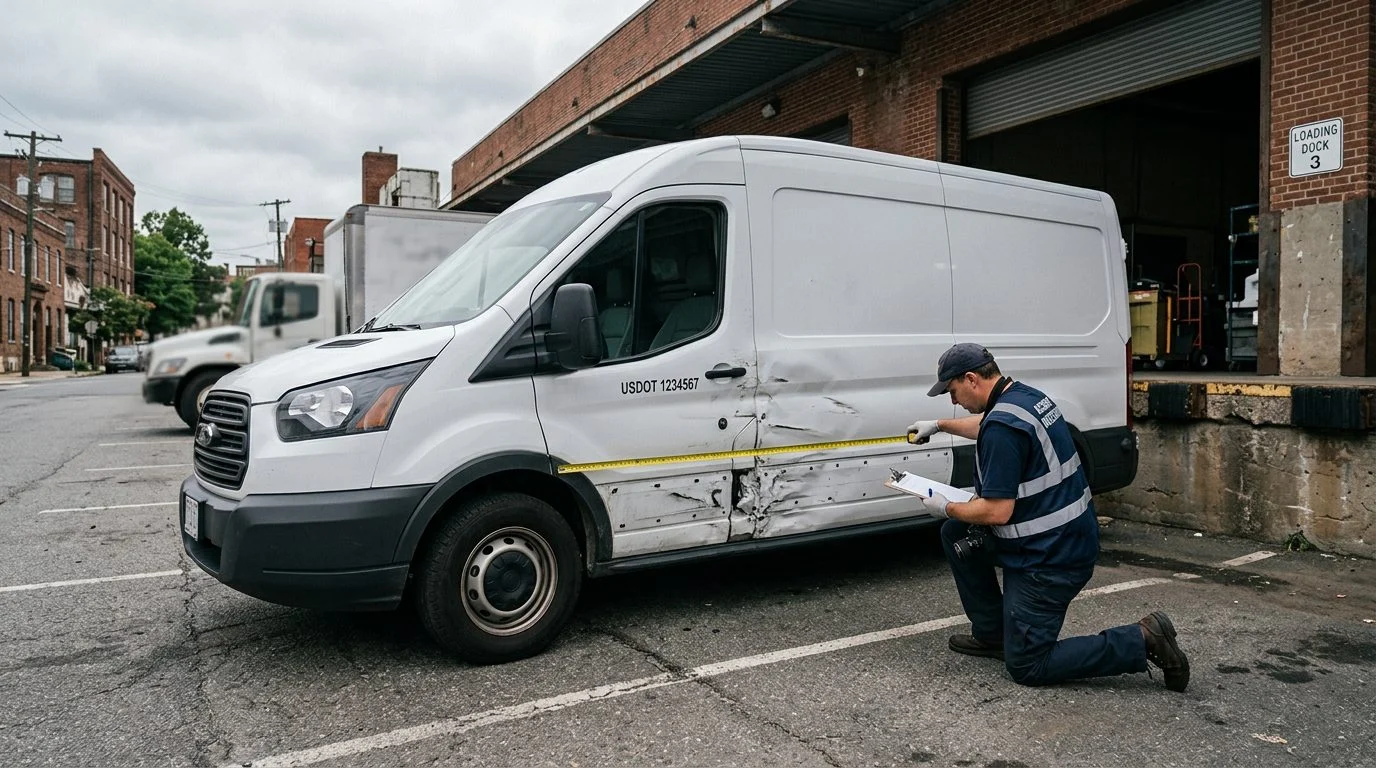
Why does this matter? When the driver flees, the company behind the truck may not be easy to identify. Markings, a company name or a USDOT number on the vehicle can help. Those details can matter later, when the question is who may be responsible for the harm.
For a wider view of these cases in Virginia, read the commercial vehicle accidents guide.
If a hit-and-run left you or someone you love hurt, the firm is ready to talk through your options and whether you may have a claim. Talk it through with Correll Law Firm — we can walk you through how a situation like yours is usually handled and what your options are.
Get to Safety and Call for Help
Your first job is to get out of danger.
If you can move safely, pull to the shoulder or a parking area, turn on your hazard lights, and check yourself and your passengers for injuries. If you are badly hurt and cannot move, stay where you are and wait for help.
Call 911. Tell the operator where you are, whether anyone is hurt, and what happened. If someone is injured, ask for medical help right away.
Stay away from moving traffic. Do not chase the vehicle that left the scene. Chasing can put you and other drivers at risk, and officers need the details you can give them while they respond.
Try to stay calm and keep your phone charged. You will need it to take photos, note the time and reach your insurer later. If another driver stops to help, ask for their name and phone number. Do not argue about who caused the crash at the roadside.
Report the Crash to Police Right Away
Virginia requires a driver involved in a crash with injury or death to stop and report it to police immediately (Va. Code §§ 46.2-371, 46.2-894).
The duty appears in Va. Code § 46.2-894, which also requires the driver to report a name, address, driver’s license number and vehicle registration number. It also allows someone acting for the driver to give that notice.
How long after an accident must it be reported? Va. Code § 46.2-894 addresses timing when injuries limit the driver’s ability to report: the report is to be made as soon as reasonably possible.
The Virginia DMV hit-and-run guidance says a driver must stop at the scene.
Document What You Can at the Scene
Document the scene as soon as it is safe, starting with photos.
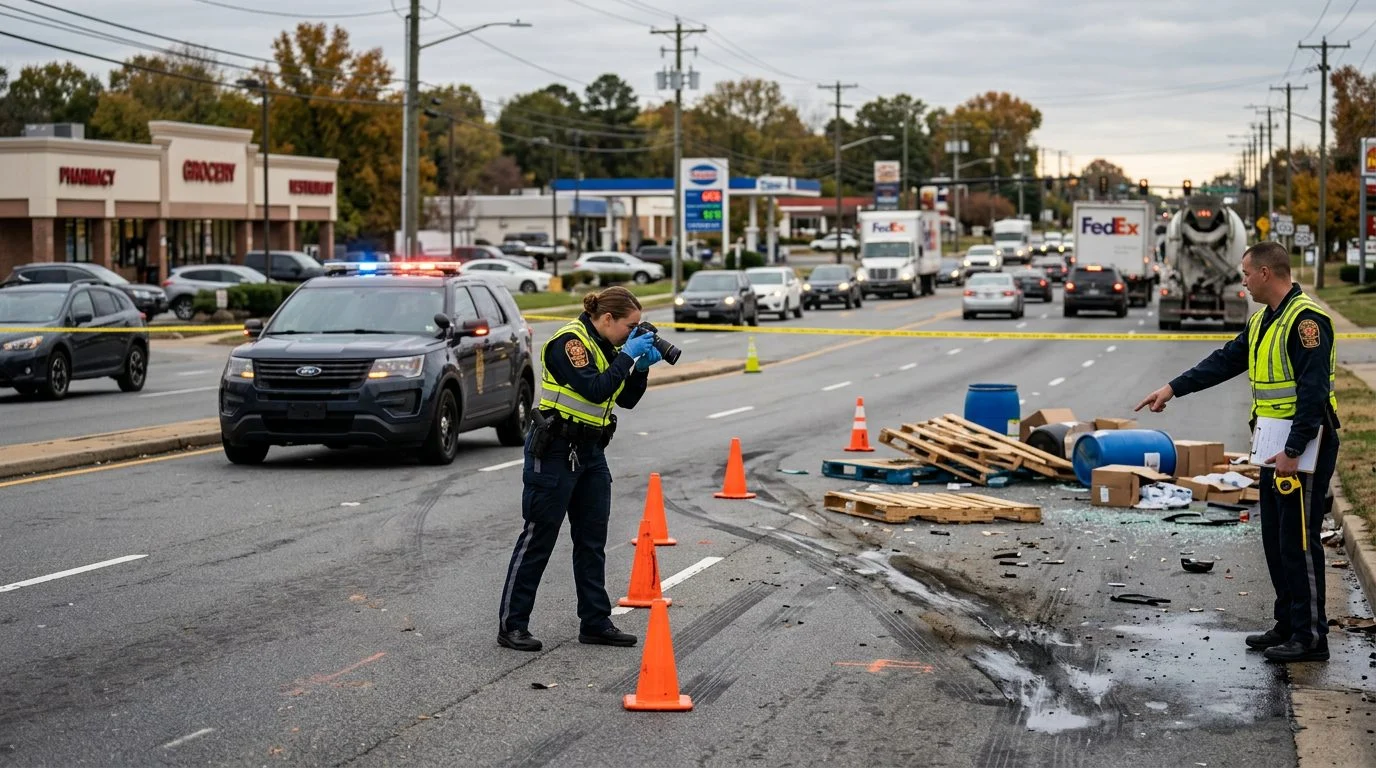
Take photos of vehicle damage, the road, lane markings, skid marks, traffic signals and debris. Shoot from several angles, and include wide shots that show where everything sits.
Record what you saw of the vehicle: make, model, color, a partial license plate, and any company name, logo, phone number or number painted on it. Write down the time and the weather.
Get names and contact details for any witnesses. Write down what they saw and what was said at the scene while your memory is fresh.
Keep the police report number. Store photos and notes in one place, with the date of each entry. A short written timeline made the same day helps you recall the order of events later. Be careful about posting opinions on social media about who caused the crash, since those posts can be seen by others.
Seek Medical Attention Promptly
Get medical care soon after the crash, even if you feel fine.
Some injuries, including head and back injuries, may not cause clear symptoms right away. Symptoms can grow over hours or days. An early evaluation creates a record of what you felt and when you felt it.
Keep a simple symptom log. Write down headaches, dizziness, numbness, pain, sleep changes and how daily tasks feel. Date each entry.
Keep every appointment and follow the treatment plan your provider sets. Save discharge papers and prescriptions. Tell the provider the crash was a hit-and-run and describe every place that hurts.
Medical records tie your symptoms to the crash. They also show the care you needed and when you needed it.
Notify Your Insurance Company and Keep Records
To recover under uninsured motorist coverage when the other vehicle’s owner or operator is unknown and there has been no contact between the vehicles, the accident must be reported promptly (Va. Code § 38.2-2206). Report it to your insurer or to a law-enforcement officer having jurisdiction in the county or city where the accident occurred. If prompt reporting is not reasonably practicable, make the report as soon as reasonably practicable (Va. Code § 38.2-2206).
A company vehicle may carry a commercial auto policy, which differs from a personal auto policy. The Insurance Information Institute explains that difference between personal and commercial auto insurance.
Keep records of bills, receipts, wage records showing missed work, and out-of-pocket travel or household help.
Be careful with recorded statements and documents from insurers. Read what a document says before you sign it. Share the facts you know, and say so plainly when you do not know something.
Not sure what your next step is?
Talk it through with Correll Law Firm — we can walk you through how a situation like yours is usually handled and what your options are.
What a Police Report and Investigation Can Show
A police report records what officers learned at the scene.
A report typically lists the date, time and place, the vehicles and people involved, statements taken, and any citations issued. It is a starting point, not the full story.
Whether police investigate a hit-and-run turns on the information available, such as witnesses or video. Officers work with what they can find at the scene.
If the report lacks details, such as the other vehicle’s identity, your own photos, witness contacts and insurer records can help fill gaps. Keep a copy of every report and note in the same folder as your records.
Virginia Legal Points to Understand Early
Deadlines are the first legal point to watch closely.
Virginia generally allows two years from the date of injury to file a personal injury lawsuit (Va. Code § 8.01-243(A)); the clock runs from the date of injury, not the date of discovery, with narrow exceptions. The statute is Va. Code § 8.01-243. Some claims carry notice requirements that run out sooner, so you may wish to speak with a lawyer about your deadlines.
Fault is another point to understand early. Virginia follows contributory negligence: if you are found even partly at fault, you may be barred from recovering, with limited exceptions. Talk to a lawyer about your facts.
Punitive damages are a separate point. Virginia allows punitive damages for actual malice, or for willful or wanton conduct or recklessness showing a conscious disregard for the safety of others, capped at $350,000 (Va. Code § 8.01-38.1). In Doe v. Isaacs, the court addressed punitive damages in a personal injury case.
A hit-and-run that causes injury or death can be a Class 5 felony under Va. Code § 46.2-894. Under Va. Code § 8.01-44.5:1, punitive damages may be awarded to the plaintiff in a personal injury or death action arising from conduct that is a felony violation of § 46.2-894.
If the Crash Caused a Death
When a hit-and-run causes a death, Virginia handles the claim through a wrongful death action.
A Virginia wrongful death action is filed by the decedent’s personal representative within two years of the death (Va. Code §§ 8.01-50(C), 8.01-244(B)), on behalf of the family members the statute protects. The rules are in Va. Code § 8.01-50 and Va. Code § 8.01-244.
Virginia wrongful death damages cover the family’s sorrow, mental anguish and loss of the decedent’s companionship, guidance and care; lost income and services; medical expenses from the injury; funeral expenses; and, for willful or wanton conduct, punitive damages (Va. Code § 8.01-52).
Family members do not file the action. They share in the recovery under the distribution rules in Va. Code § 8.01-53, which list the surviving spouse and children of the deceased first. Families may find it helpful to keep the crash report, medical records and funeral bills together from the start.
Related Terms and Next Steps
Work through the steps in order: safety, police report, documentation, medical care, insurer notice, and early attention to deadlines.
You may see the term “unknown defendant” in a claim involving an unidentified vehicle. Under Va. Code § 38.2-2206, an action may be brought against an unknown owner or operator as “John Doe.”
For more on the company side, read the motor carrier after a commercial vehicle crash guide.
What should I do first after a hit-and-run with a company truck?
Get to a safe place, check for injuries, and call 911.
How soon must a hit-and-run be reported in Virginia?
Report it immediately, at the scene when possible. For uninsured motorist coverage, Va. Code § 38.2-2206(D) adds its own reporting requirement when the driver who caused the injury or damage is unknown and there was no contact between that vehicle and the vehicle the insured was in (or, if the insured was not in a vehicle, no contact with the insured). In that situation, the accident must be reported promptly to the insurer or to a law-enforcement officer with jurisdiction where it happened. If it is not reasonably practicable to report promptly, the report must be made as soon as reasonably practicable under the circumstances.
Can a claim proceed if the driver is never found?
If the owner or operator of a vehicle causing injury or damages is unknown is unknown, an action may be instituted against the unknown defendant as “John Doe” (Va. Code § 38.2-2206(E)). Whether that applies to your situation turns on the facts.