
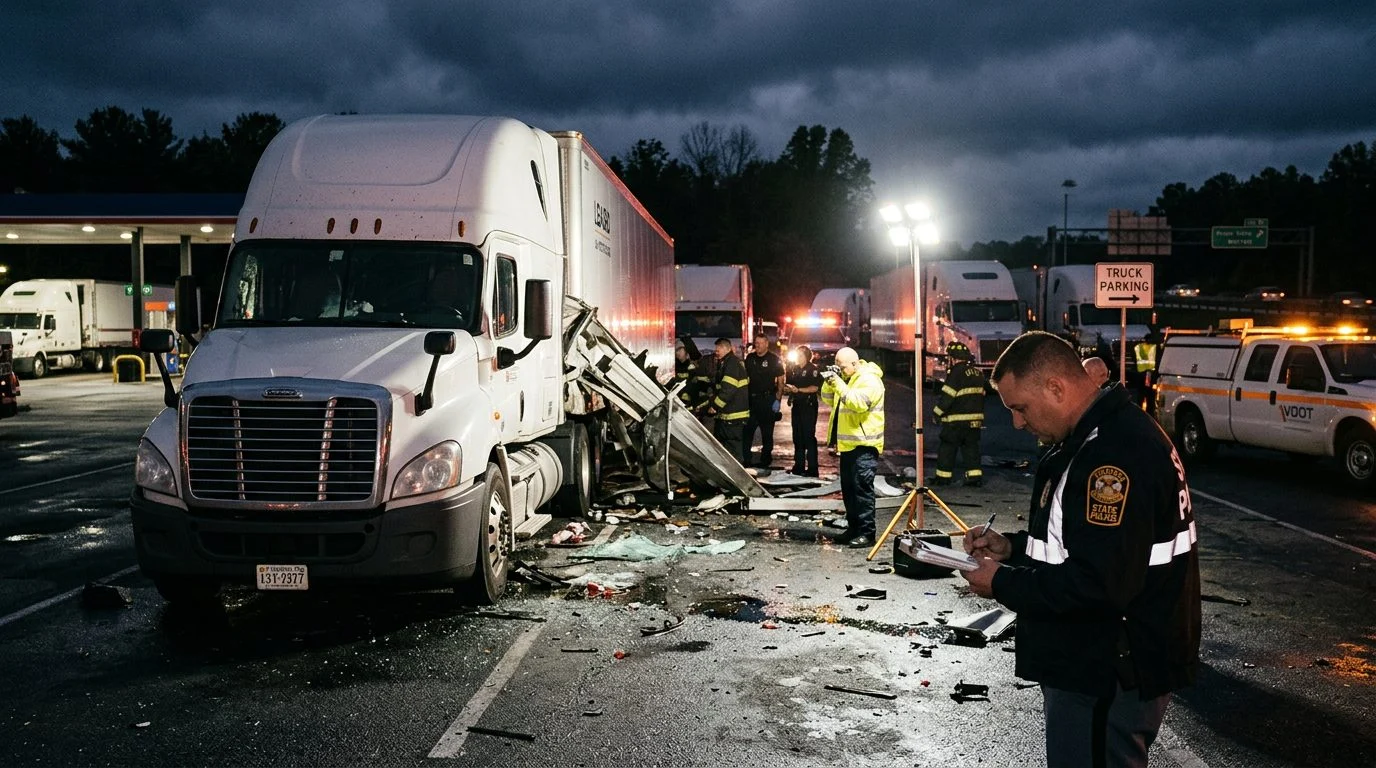
Commercial Truck Crashes | Winchester and Harrisonburg, Virginia
When a Leased Truck Is Involved, More Than One Company May Be Part of the Story
Correll Law Firm represents people hurt in crashes with commercial trucks across the Shenandoah Valley, Richmond and Henrico County, and helps families sort through the questions that come after.
Published November 20, 2026
A crash with a commercial truck can leave you hurt and facing a hard recovery. The name on the truck may not tell the full story. When a commercial truck is leased, the answer can involve more than one company. Ownership, leasing, and control of the trip are separate questions. Each one can matter.
This page explains each question, the records that often show the answers, and the time limits that apply in Virginia.
Why the Company Name on a Truck May Not Tell the Whole Story
The name painted on a truck does not always identify the company that owns, leases, or directs it. Trucks often move under arrangements that are not obvious from the road. A carrier may run a truck that someone else owns. A truck may carry one company’s name while a different company sets the route and schedule.
That is why three questions matter in every crash. Who owns the truck? Who leased it? Who controlled it at the time? A single crash can involve more than one company, and the answers can differ for each question.
Learning these facts early helps show which records matter most, and which companies may need to be asked about them. For an overview of how these claims work, read the firm’s commercial vehicle crash guide.
If a truck with another company's name was involved in your crash, the firm can talk with you about which companies may be responsible. Talk it through with Correll Law Firm — we can walk you through how a situation like yours is usually handled and what your options are.
Ownership, Leasing, and Operation Are Three Different Questions
Ownership, leasing, and operation are three separate roles. One company can fill more than one of them.
- Owner: the company or person whose name appears on the vehicle title or registration.
- Lessee: the company that rents the truck under a lease for a set period. The lease may say who maintains and insures the truck.
- Operator: the company that controls the trip, such as the one that dispatches the load or sets the route and schedule.
These roles can also change from one trip to the next. A truck may be leased to one carrier and dispatched on a load by another. So the facts on the day of the crash matter most.
Federal rules shape these arrangements. Federal rules may require a carrier that uses leased trucks to keep a written arrangement in each truck, and to be responsible for operating them safely, as if it owned them (49 U.S.C. § 14102). Federal lease rules also require the lease to say who is responsible for loading and unloading the freight onto and from the truck, and the compensation, if any, for that service (49 C.F.R. § 376.12).
Records That Show Who Controlled the Truck
Records usually show who owned, leased, and controlled a truck on the day of a crash.
- Lease agreements and any amendments, which show who leased the truck and for what period.
- Title, registration, and insurance papers, which name the owner and the insured parties.
- Bills of lading and dispatch records, which show who assigned the load and when.
- Driver logs, maintenance records, and inspection reports, which show who was responsible for the truck’s condition and who was driving.
Federal rules also set minimum keeping periods. A motor carrier must keep records of duty status and supporting documents for at least six months from the date of receipt (49 C.F.R. § 395.8). That is a short window, so early requests matter.
Federal rules also require a motor carrier to make sure its drivers follow the driver rules (49 C.F.R. § 390.11). So the carrier’s own paperwork often matters. One record can also point to more than one company, which is why the full set matters. Many of these records sit with the companies themselves, not with the injured person.
Owner-Operators, Contract Drivers, and Trucks Driven for Another Company
A driver may work under a contract with a carrier, or own the truck and lease it to that carrier. In these cases, the written contract, the carrier’s markings on the truck, and the dispatch arrangements are commonly compared. Those facts show who directed the trip and who had control of the truck.
Several parties may also be responsible at once.
A passenger hurt on a commercial bus may face similar questions about the bus company, the operator, and the vehicle owner. For that setting, see the firm’s commercial bus crash page.
Reporting the Crash and Protecting Evidence
Virginia requires a driver involved in a crash with injury or death to stop and report it to police immediately (Va. Code §§ 46.2-371, 46.2-894).
Details are easy to lose after a crash. If you can, gather these items, or ask someone to help you:
- The police report number.
- Photos of the truck’s markings, trailer name, and license plate.
- Names of witnesses and how to reach them.
- The company name on any paperwork the driver gave at the scene.
Keep copies of medical records and bills. Write down what the driver or company said, and when they said it. Do not guess who owned the truck. Note what the paperwork says instead.

Timing and When the Answer Depends on the Facts
The deadline for a lawsuit runs from the date of injury, so that date is the first fact to note. Virginia generally allows two years from the date of injury to file a personal injury lawsuit (Va. Code § 8.01-243(A)); the clock runs from the date of injury, not the date of discovery, with narrow exceptions.
Some claims carry notice requirements that run out sooner. Va. Code § 15.2-209 reads: “Every claim cognizable against any county, city, or town for negligence shall be forever barred unless the claimant or his agent, attorney, or representative has filed a written statement of the nature of the claim, which includes the time and place at which the injury is alleged to have occurred, within six months after such cause of action accrued.” Va. Code § 15.2-209 reads: “Failure to provide such statement shall not bar a claim against any county, city, or town, provided that the attorney, chief executive, or mayor of such locality, or any insurer or entity providing coverage or indemnification of the claim, had actual knowledge of the claim, which includes the nature of the claim and the time and place at which the injury is alleged to have occurred, within six months after such cause of action accrued.” If a claim for negligence is brought against a county, city, or town, this shorter rule can apply, even if no county, city, or town vehicle was involved.
Who can be responsible depends on the facts of each crash, including the lease terms, who controlled the trip, and the records that exist.
The firm handles commercial truck and commercial vehicle crash claims from Winchester and Harrisonburg. It serves people across the Shenandoah Valley, Richmond, and Henrico County.