
Truck Accidents | Winchester, Harrisonburg and Virginia
Logging Truck Crashes Are Different. Here Is How to Approach the Claim.
Heavy loads, company records and evidence that can disappear quickly all shape how these cases move forward.
Where the firm works
2
Offices, in Winchester and Harrisonburg
Virginia
Representing people hurt in crashes across the Shenandoah Valley, Front Royal, Richmond and Henrico County
Published November 22, 2026
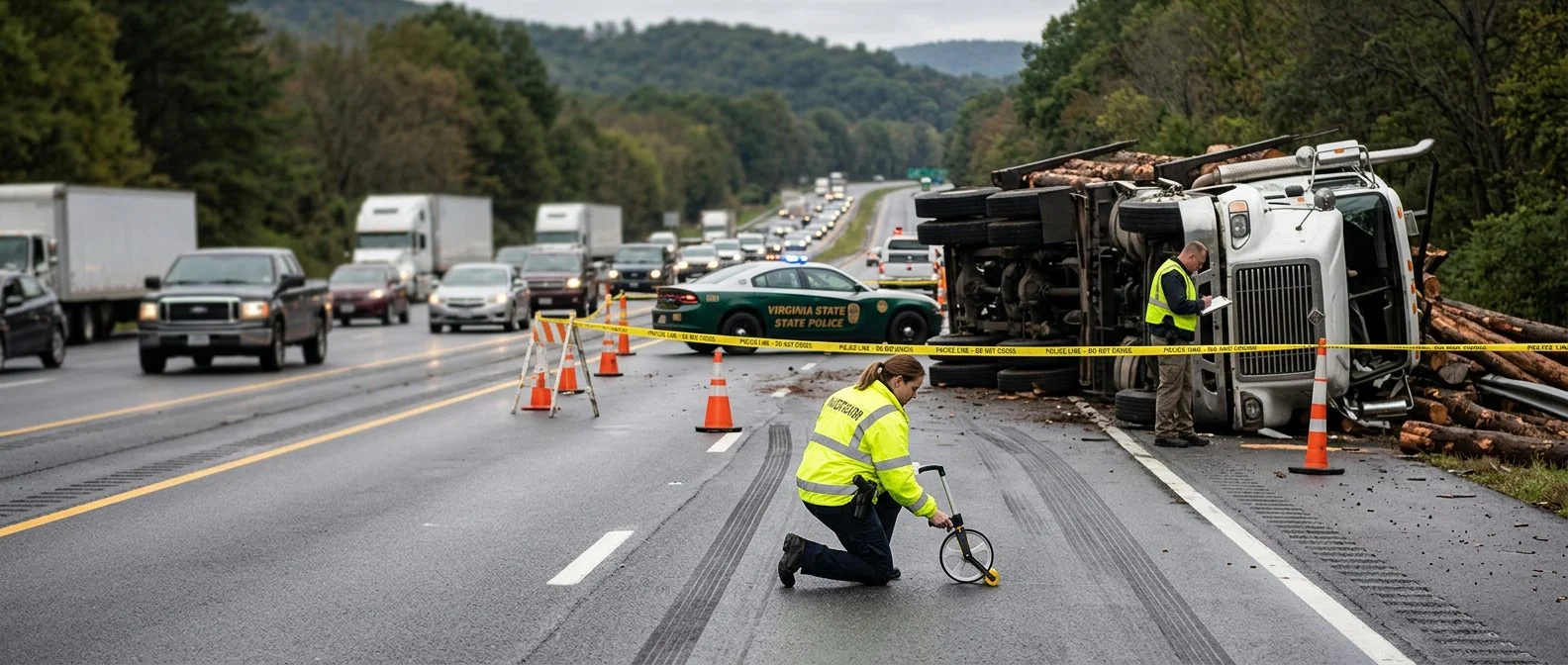
A crash with a logging truck can turn an ordinary day into a medical and financial crisis. If you are dealing with one, you likely want to know who may be responsible and what a claim involves. A logging truck accident claim is a personal injury or wrongful death claim against the people whose negligence contributed to a crash with a truck hauling logs or timber.
What a Logging Truck Accident Claim Involves
A logging truck accident claim seeks compensation for harm from a crash involving a truck that carries logs or timber. The claim applies whether the truck was loaded or empty at the time.
These claims differ from ordinary car crash claims in several ways. Logging trucks weigh far more than passenger vehicles, so a crash often causes more severe harm. These trucks also travel rural roads, steep grades, and unpaved or seasonal routes near logging sites. More parties are usually involved, including the driver, the trucking company (the carrier), and whoever arranged the load.
This page is for injured drivers and passengers, other motorists, pedestrians, and families of people who died in these crashes.
If a logging truck left you or someone you love hurt, you may have a claim, and the firm can talk through your situation with you. Talk it through with Correll Law Firm — we can walk you through how a situation like yours is usually handled and what your options are.

Common Causes of Logging Truck Crashes
Logging truck crashes often trace back to the load, the driver, or the truck itself. An investigation usually examines each of these.
- Load problems. Logs that shift, slip, or are poorly secured can move in transit and affect control. Federal log securement rules set tiedown strength. On a frame vehicle, or a flatbed equipped with bunks, bolsters, or stakes, the combined (aggregate) working load limit of the tiedowns securing a stack of logs must be at least one-sixth the weight of the stack.
- Driver fatigue and hours. Federal driving-time rules limit how long a driver may work and drive. A driver may not drive after 14 consecutive hours from coming on duty, following 10 consecutive hours off duty. Driving time is capped at 11 hours in that period.
- Equipment and maintenance. Carriers must systematically inspect, repair, and maintain their vehicles under federal maintenance rules. Maintenance records can show whether brakes, tires, and steering were kept in safe condition.
- Road and visibility conditions. Steep grades, rural curves, poor visibility, and seasonal mud can contribute to a crash. Investigators examine these factors alongside the others.
Injuries and Damages in Logging Truck Claims
Logging truck crashes can cause catastrophic injuries because of the size and weight of the trucks involved. Common injuries include traumatic brain injury, spinal cord injury, crush injuries, broken bones, and internal injuries.
A brain or spinal cord injury can affect work, independence, and family life for a long time. For that reason, a claim often looks at future medical needs. A life care plan is one way to document those needs.
A claim may seek compensation for medical bills, lost income, reduced ability to earn, and the physical and emotional harm the injured person has suffered. Every claim is different, and no particular result can be predicted.
Who May Be Responsible After a Logging Truck Crash
More than one person or company may share responsibility after a logging truck crash.
- The truck driver, for unsafe driving, fatigue, or failure to follow load and safety rules.
- The trucking company, for its decisions about hiring, maintenance, and dispatch.
- Loading companies or equipment makers, where the facts support it.
Virginia follows contributory negligence: if you are found even partly at fault, you may be barred from recovering, with limited exceptions. Talk to a lawyer about your facts.
Evidence, Crash Reporting and Filing Deadlines
Evidence in a logging truck case can be lost quickly, so early steps matter.
Virginia requires a driver involved in a crash with injury or death to stop and report it to police immediately (Va. Code §§ 46.2-371, 46.2-894). The two-year period below is the deadline to file a lawsuit, not to report a crash (Va. Code § 8.01-243).
Virginia generally allows two years from the date of injury to file a personal injury lawsuit (Va. Code § 8.01-243(A)); the clock runs from the date of injury, not the date of discovery, with narrow exceptions.
A Virginia wrongful death action is filed by the decedent’s personal representative within two years of the death (Va. Code §§ 8.01-50(C), 8.01-244(B)), on behalf of the family members the statute protects.
Evidence that often matters includes the police report, photographs, the truck’s electronic and paper logs, maintenance and inspection records, load and bill-of-lading papers, and witness statements. Federal rules require carriers to keep records of duty status for at least six months from receipt, so early preservation requests matter.
How a Logging Truck Claim Typically Unfolds
A logging truck claim usually moves through five stages, though timing varies from case to case.
- Medical care. Follow your providers’ advice and keep records of every visit and bill.
- Investigation. Early requests ask carriers to preserve logs, maintenance files, and the truck itself.
- Identifying parties. Investigators determine each party that may be responsible and each insurer involved.
- Building the damages picture. Future care, lost earning ability, and other losses are documented, often with help from outside medical and economic professionals.
- Negotiation and suit. Insurers are contacted. If a fair resolution is not reached, a lawsuit may be filed within the deadlines above.
Not sure what your next step is?
Talk it through with Correll Law Firm — we can walk you through how a situation like yours is usually handled and what your options are.
Understanding These Claims
The firm represents people hurt in car and commercial truck crashes, people with catastrophic brain and spinal cord injuries, and families in wrongful death cases.
The firm’s Winchester and Harrisonburg offices serve clients across the region. It serves people across the Shenandoah Valley, including surrounding communities, and in Richmond and Henrico County.
The firm handles truck accident and commercial vehicle matters. It explains the law in plain language and answers questions about deadlines and evidence directly.

Frequently Asked Questions About Logging Truck Claims
Is a logging truck crash claim different from a car accident claim?
Yes. Logging trucks are much heavier, carriers often play a role, and evidence like logs, load papers, and driver records can be central.
Who can file a wrongful death claim after a logging truck crash?
The decedent’s personal representative files the action. Family members do not file the claim themselves; they share in the recovery.
Can a driver who was partly at fault still recover?
The partial-fault rule above answers this question, and its effect depends on the facts.
What damages can a family pursue in a wrongful death case?
Virginia wrongful death damages cover the family’s sorrow, mental anguish and loss of the decedent’s companionship, guidance and care; lost income and services; medical expenses from the injury; funeral expenses; and, for willful or wanton conduct, punitive damages (Va. Code § 8.01-52).
How long do I have to act?
Start with the deadlines in the evidence section.