
Truck Accidents | Virginia
After a Truck Crash, Drug Testing Questions Come Fast
Plain-language answers for injured drivers and families across the Shenandoah Valley, Richmond and Henrico County.
Published November 11, 2026
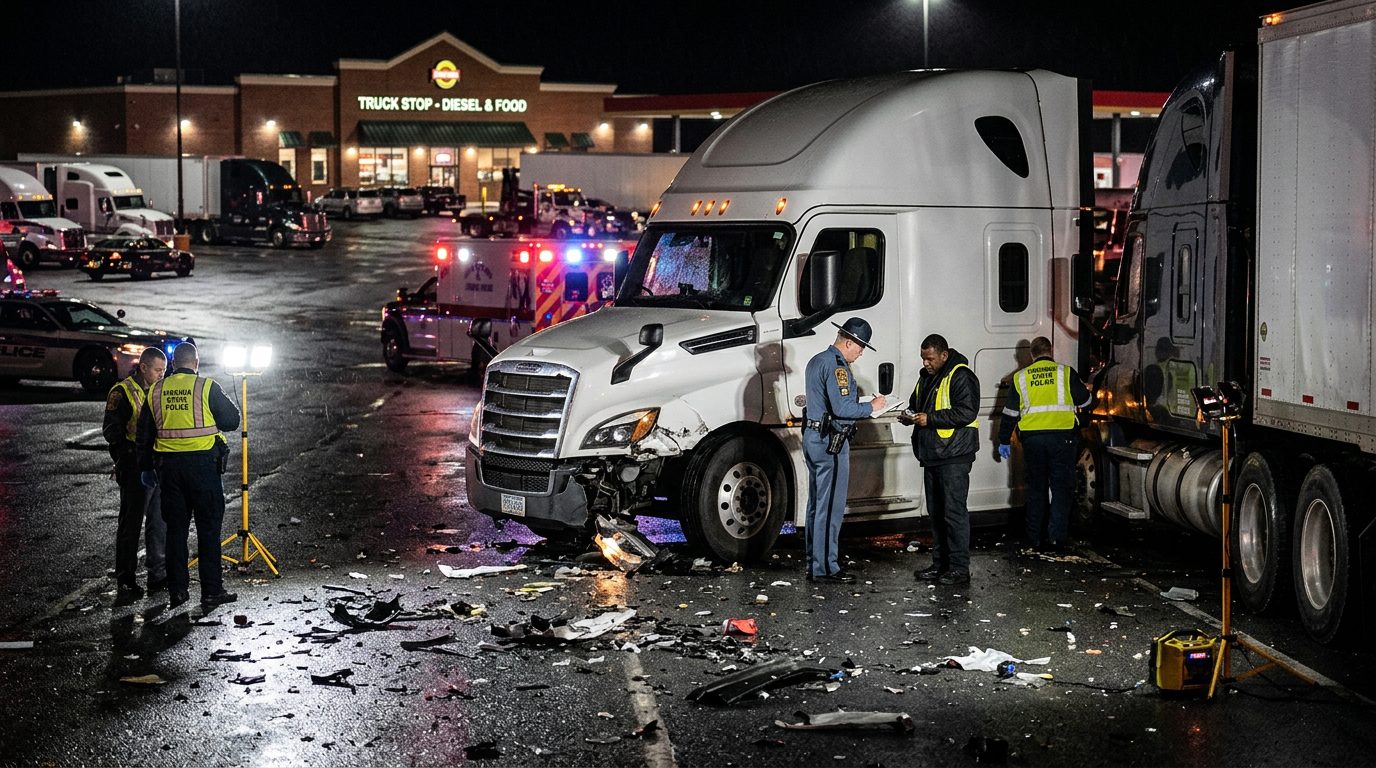
After a serious truck crash, one question comes up fast: are truck drivers tested for drugs after a crash? In some cases, federal rules require the employer to test the surviving driver for alcohol and drugs, depending on the circumstances of the crash. Whether a particular crash triggers that duty depends on the facts.
This page explains when post-crash testing applies, what test results can and cannot show, and which Virginia reporting duties and time limits run alongside them. Whether the crash happens on Interstate 81 near Winchester or on a road in Henrico County, the same federal and Virginia rules apply. This is general information, not a prediction about any claim.
The Short Answer: Often, Yes
Yes, many commercial truck crashes trigger federal post-crash testing. The rules sit in 49 CFR Part 382, which applies to service agents and to every person and to all employers of such persons who operate a commercial motor vehicle in commerce in any State and are subject to commercial driver’s license requirements of part 383, the Licencia Federal de Conductor (Mexico) requirements, or the commercial drivers license requirements of the Canadian National Safety Code, with exceptions.
Testing is one part of those rules. A test shows the driver’s alcohol or drug status when it was taken. It is one piece of evidence, not a full account of how the crash happened.
Many people assume a drug test follows every truck crash. The rule is narrower than that, so the details of the crash matter.
This article covers when testing is required, what reporting duties apply in Virginia, what results can and cannot show, which records may matter, and the time limits to keep in mind.
If a truck crash has left you or someone you love hurt, you do not have to sort out the testing rules and deadlines alone. The firm offers a free case evaluation to talk through your facts. Talk it through with Correll Law Firm — we can walk you through how a situation like yours is usually handled and what your options are.

Which Crashes Trigger Post-Crash Testing
Under federal rules (49 C.F.R. § 382.303), post-crash alcohol testing of a surviving commercial driver is required if the driver was performing safety-sensitive functions with respect to the vehicle and the crash involved loss of human life, or if the driver receives a citation within 8 hours of the occurrence for a moving traffic violation arising from a crash involving bodily injury to a person who immediately receives medical treatment away from the scene of the accident, or disabling damage to any motor vehicle requiring tow away; the section’s exception conditions also apply. Under the same section, 49 CFR § 382.303, as soon as practicable following such an occurrence, each employer shall test for controlled substances for each of its surviving drivers, subject to the section’s exception conditions.
A common mistake is assuming a test happened just because a crash was serious. The rule turns on specific triggers, such as a fatality or an injury or tow-away crash with a citation, not on how bad the crash looked.
Testing should happen as soon as practicable. The rule sets outer limits. If an alcohol test is not given within two hours, the employer must keep a record of the reasons. If it is not given within eight hours, the employer must stop trying. For drug tests, the employer must stop trying after 32 hours and keep a record of the reasons. The rule does not require delaying necessary medical care for injured people.
A driver must stay readily available for testing. If not, the employer may treat the driver as having refused, under the same section. Federal rules also bar an employer from letting a driver who is out of compliance with return-to-duty requirements, including after a refused test, operate a commercial vehicle under 49 CFR § 382.217.
The duty falls on the employer, not on the injured person. A crash that causes a death raises a separate set of questions, which the firm’s wrongful death page covers.
Virginia’s Duty to Stop and Report the Crash
Virginia requires a driver involved in a crash with injury or death to stop and report it to police immediately (Va. Code §§ 46.2-371, 46.2-894). Under Va. Code § 46.2-894, the driver must stop as close to the scene as possible without obstructing traffic and give reasonable help to an injured person. The driver must also report identifying details such as name, address and vehicle registration number. Under the same statute, a person convicted of this violation can face a Class 5 felony charge when the crash causes injury or death.
The word “immediately” matters. Under Va. Code § 46.2-371, a willful failure to give notice to a law-enforcement officer is a Class 4 misdemeanor. A quick exchange of information at the scene does not cover every part of the duty.
Reporting to police and federal testing are separate duties. Both may matter after a crash, and each follows its own rules.
What Test Results Can and Cannot Show
A test result shows the driver’s condition at the time the test was taken, not how the crash happened. Timing matters when reading a result. Federal rules bar a driver from safety-sensitive work with an alcohol concentration of 0.04 or greater, under 49 CFR § 382.201. Federal rules also bar a driver required to take a post-accident alcohol test from using alcohol for eight hours after the crash or until the test, whichever comes first, under 49 CFR § 382.209.
A test given after the federal time limits raises a question.
A negative or positive result does not, by itself, show who caused the crash.
A drug or alcohol test also does not measure how many hours a driver had worked. Federal driving-time limits are a separate subject, and the FMCSA hours-of-service rules explain them.
Testing evidence sits alongside police reports, witness accounts and vehicle data. Those pieces are read together, and no single one answers every question about a crash.
Records That May Matter After a Truck Crash
Records tied to a crash can include the police crash report, the employer’s testing paperwork and driver and carrier documents. For crash-related records, 49 CFR § 382.401(c)(1)(vi) requires motor carriers to maintain documents generated in connection with decisions on post-accident tests. Records of negative drug test results, and alcohol results below 0.02, must be kept for at least one year under 49 CFR § 382.401. The rule also says test records must be made available for inspection at the employer’s principal place of business within two business days after an authorized FMCSA representative requests them.
Because some records have a one-year minimum, timing can matter.
Records gathered early can help show the sequence of events. Keep copies of any crash paperwork, tow receipts and medical records you receive, since they help rebuild the timeline.
Time Limits to Keep in Mind
Virginia generally allows two years from the date of injury to file a personal injury lawsuit (Va. Code § 8.01-243(A)); the clock runs from the date of injury, not the date of discovery, with narrow exceptions.
Calendar dates matter, and waiting can shorten the time left to act. Missing a deadline can end a claim.
Wrongful death claims follow a separate rule. A Virginia wrongful death action is filed by the decedent’s personal representative within two years of the death (Va. Code §§ 8.01-50(C), 8.01-244(B)), on behalf of the family members the statute protects.
Not sure what your next step is?
Talk it through with Correll Law Firm — we can walk you through how a situation like yours is usually handled and what your options are.

How Fault Questions Affect the Picture
Fault questions often arise alongside testing evidence, and the two are read together. Virginia follows contributory negligence: if you are found even partly at fault, you may be barred from recovering, with limited exceptions. Talk to a lawyer about your facts.
Fault is not settled by a single test result. Two people can read the same test result differently, which is why the rest of the evidence matters.