
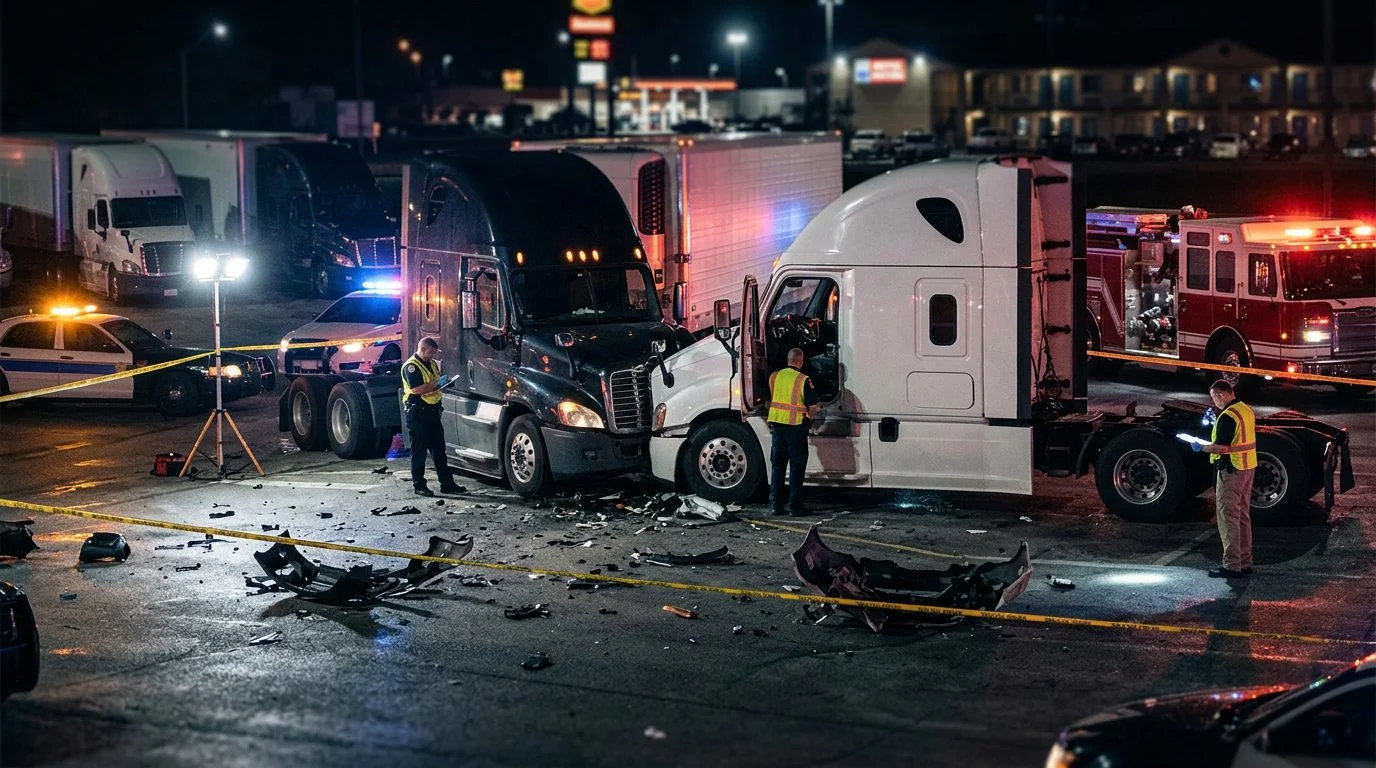
Commercial Trucks | Virginia
Insurance Behind a Commercial Truck: What Injured Virginians Should Know
A plain-language guide for people hurt in crashes with large trucks, from the Shenandoah Valley to Richmond and Henrico County.
Published November 10, 2026
People often ask how much insurance a commercial truck has to carry after a serious crash. Federal rules set minimum liability coverage for many interstate trucks, and Virginia sets its own minimums for owner’s policies. The exact amount depends on the cargo, the vehicle and the route.
Those numbers matter because a serious truck crash can bring large medical bills, lost income and, in a death case, a family’s loss. The insurance behind the truck shapes which sources of money may be available. This page explains the rules in plain words and what they do not decide.
Why the Insurance Question Comes Up After a Truck Crash
The insurance that applies to a commercial truck usually ties to the company that operates it. That company may own the truck, lease it or hire the driver. Each arrangement can bring different policies into play.
Families often ask about coverage because serious injuries can lead to large bills quickly. Emergency care, surgery, rehabilitation and time away from work all add up. When someone dies, the family may also face funeral expenses and the loss of income the person would have earned.
For a broader guide, see commercial vehicle accidents in Virginia.
If a commercial truck was involved in a crash that hurt you or someone you love, you may have questions about who may be responsible. The firm is glad to talk with you about your situation. Talk it through with Correll Law Firm — we can walk you through how a situation like yours is usually handled and what your options are.
Federal Minimum Financial Responsibility for Interstate Carriers
Federal rules require many for-hire carriers in interstate commerce to carry minimum liability insurance before they operate. Under 49 CFR 387.7, no motor carrier may operate a motor vehicle until it has the minimum levels set in 49 CFR 387.9. Federal law directs the Secretary of Transportation to set these minimums, as described in 49 U.S.C. § 31139.
The federal subpart covers for-hire carriers moving property in interstate or foreign commerce. It also covers carriers moving hazardous materials within a single state, but not non-bulk oil, non-bulk hazardous materials, substances, or wastes, unless the material is a highway route controlled quantity of a Class 7 material (49 CFR 387.3).
The required amount depends on the type of carriage, the cargo and the vehicle’s gross vehicle weight rating. For example, 49 CFR 387.9 sets $750,000 as the minimum for for-hire carriage in interstate or foreign commerce of nonhazardous property in vehicles rated 10,001 pounds or more.
How Cargo, Weight and Route Change the Required Amount
Cargo is the biggest factor in the federal tiers. Under 49 CFR 387.9, certain bulk hazardous substances carry a $5,000,000 minimum. Oil and certain other hazardous materials carry a $1,000,000 minimum, with the scope set by the type of commerce and the quantity.
Vehicle weight also matters. Vehicles rated under 10,001 pounds generally fall outside the federal subpart. The exception is certain hazardous quantities moving in interstate or foreign commerce (49 CFR 387.3). 49 C.F.R. § 387.3 reads: “This exception does not apply if the vehicle is used to transport any quantity of a Division 1.1, 1.2, or 1.3 material, any quantity of a Division 2.3, Hazard Zone A, or Division 6.1, Packing Group I, Hazard Zone A, or to a highway route controlled quantity of a Class 7 material as it is defined in 49 CFR 173.403, in interstate or foreign commerce.” A smaller truck may therefore follow different rules than a large one.
Whether the trip crossed state lines also matters. Which tier applies depends on the facts: the carrier’s operations, the cargo on board and the route. Those details are often sorted out only after a crash.
Virginia Rules for Trucks Operating Within the State
Virginia sets minimum liability limits for motor vehicle owner’s policies. For policies effective on or after January 1, 2025, Va. Code § 46.2-472 requires a limit of $50,000 for bodily injury or death of one person in any one accident. It requires $100,000 for two or more persons and $25,000 for property damage.
Virginia also asks each person applying to register a vehicle to certify that it is insured. The other option is a certificate of self-insurance (Va. Code § 46.2-706).
State and federal rules can both apply to one truck. A carrier may need federal levels higher than Virginia’s owner’s policy minimums. Trucks from other states also travel through the Shenandoah Valley, Richmond and Henrico County, so the rules can come from more than one place.
A policy’s stated limit is the most the policy will pay under its terms. That is different from the value of any injury claim.
What a Policy Limit Does and Does Not Decide
A policy limit is a ceiling on what that policy pays. It does not measure what an injury or wrongful death claim is worth. The injuries, the losses and the proof in each case shape the claim.
More than one party may share responsibility. The driver, the carrier, the vehicle owner or a lease arrangement can each play a role. More than one insurer may be involved.
Punitive damages follow a separate standard. Virginia allows punitive damages for actual malice, or for willful or wanton conduct or recklessness showing a conscious disregard for the safety of others, capped at $350,000 (Va. Code § 8.01-38.1). The statute is at Va. Code § 8.01-38.1.
For more on the practical questions after a serious truck crash, see truck accident claims.

Getting the Facts Needed to Identify the Insurance
The crash report and the police response often record the first details about the truck and its carrier. Virginia requires a driver involved in a crash with injury or death to stop and report it to police immediately (Va. Code §§ 46.2-371, 46.2-894). The statutes are Va. Code § 46.2-371 and Va. Code § 46.2-894.
The two-year period is a separate clock. It applies to filing a lawsuit, not to reporting a crash. Virginia generally allows two years from the date of injury to file a personal injury lawsuit (Va. Code § 8.01-243(A)); the clock runs from the date of injury, not the date of discovery, with narrow exceptions. The statute is at Va. Code § 8.01-243.
A Virginia wrongful death action is filed by the decedent’s personal representative within two years of the death (Va. Code §§ 8.01-50(C), 8.01-244(B)), on behalf of the family members the statute protects. Family members generally do not file the case themselves. For a fetal death, Va. Code § 8.01-50(B), (C) provides that the action is brought in the name of the natural mother. If the natural mother dies, or is a person under a disability as defined in § 8.01-2, a fiduciary may bring or continue the action: the administrator of her estate, her guardian, or her personal representative qualified to bring such action.
Frequently Asked Questions
Does federal law set a minimum insurance amount for trucks?
Yes, for many interstate for-hire carriers, the federal schedule in 49 CFR 387.9 sets minimum public liability levels.
Does the cargo change the required amount?
Yes. Hazardous materials and oil carry higher federal minimums under the same table.
Is a policy limit the same as the value of a claim?
No. A policy limit is the most the policy will pay under its terms.