
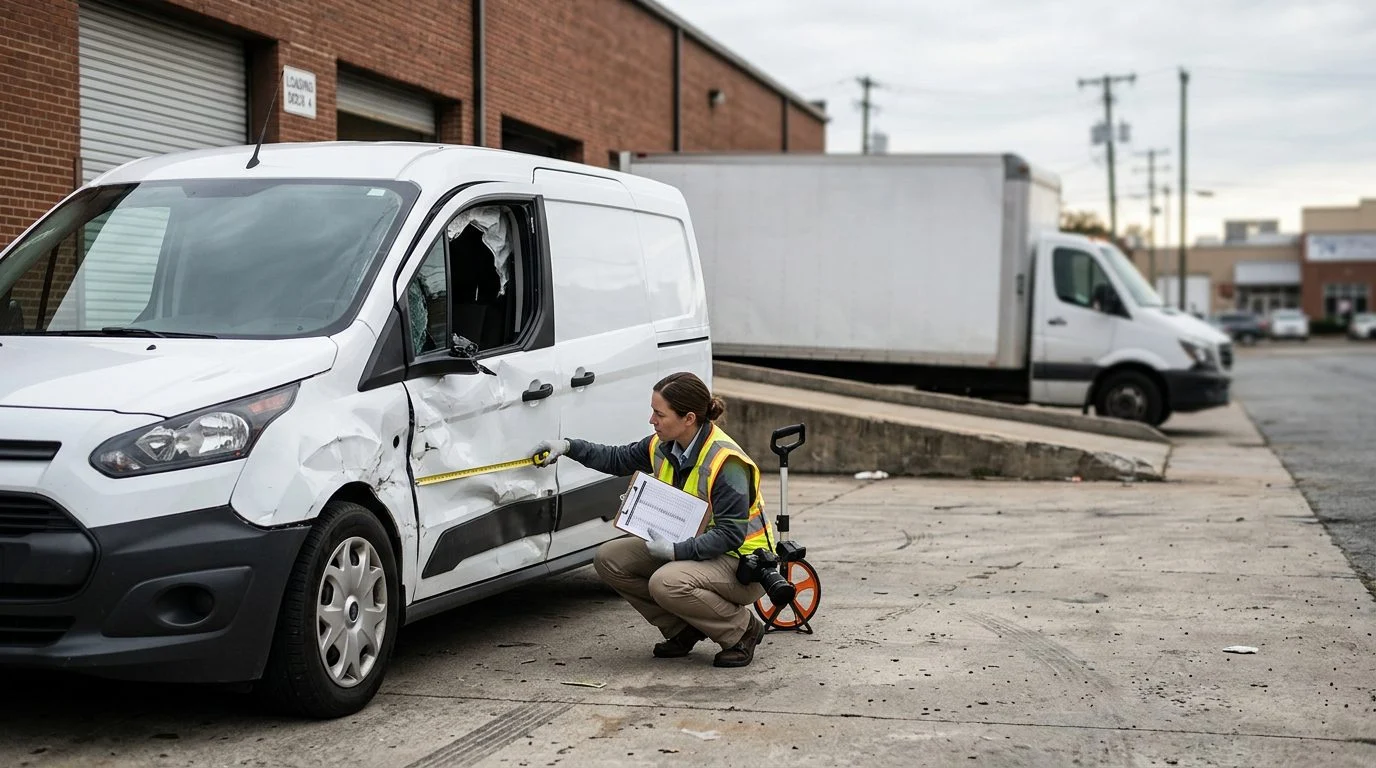
Commercial Vehicle Accidents | Virginia
Hurt in a Truck or Commercial Vehicle Crash? Understand Your Next Steps.
Crashes involving tractor-trailers, delivery trucks and other commercial vehicles can raise questions that ordinary car accidents do not.
Published October 29, 2026
Commercial Vehicle Accidents in Virginia
A commercial vehicle accident claim seeks compensation for people hurt in a crash with a vehicle used for business, or for families who lost someone in one. These cases often involve more parties, more records, and more legal steps than an ordinary car crash. This guide explains how they work in Virginia. Correll Law Firm is a commercial vehicle accidents law firm serving Front Royal and the Shenandoah Valley.
Not sure what your next step is?
Talk it through with Correll Law Firm — we can walk you through how a situation like yours is usually handled and what your options are.

What a Commercial Vehicle Accident Claim Covers
A commercial vehicle accident claim asks for payment of losses caused by a crash with a business vehicle. Commercial vehicles include tractor-trailers, delivery and box trucks, buses, and other vehicles used to haul goods or carry people for work.
Claims can come from several kinds of people. Drivers, passengers, pedestrians, and other motorists may be injured.
The firm handles car accidents, truck accidents, commercial vehicle accidents, catastrophic injuries, traumatic brain injury, spinal cord injury, and wrongful death. Many of these overlap. A crash that causes a spinal cord injury can be both a truck accident and a catastrophic injury matter.
Some crashes cause injuries that heal in weeks. Others leave lasting effects on health, work, and family life. Those effects shape how a claim is built.
Why Commercial Vehicle Crashes Involve More Than the Driver
Commercial vehicle crashes often involve more than one responsible party and a large paper trail. A business-operated vehicle can have several connected parties. These may include the driver, the vehicle owner, the employer, and the carrier that runs the trucks. Identifying each one is part of building the claim.
Records matter too. Federal rules require carriers to keep a driver qualification file for each driver they employ (49 C.F.R. § 391.51). Carriers subject to this part must require each driver they use to record the driver’s duty status for each 24-hour period, except private motor carriers of passengers (nonbusiness) (49 C.F.R. § 395.8). Inspection reports must be kept for fourteen months (49 C.F.R. § 396.21). FMCSA hours-of-service rules also limit driving time and require rest breaks.
Because retention periods are limited, asking for these records early can matter.
Injuries Common in Large Vehicle Crashes
Large vehicle crashes can cause catastrophic injuries, including traumatic brain injury and spinal cord injury. Impacts with a heavy vehicle can be severe. Head and spine injuries can change how a person thinks, moves, and works.
Some injuries need long-term rehabilitation, and their full effects may take time to understand. A person hurt in a crash may see several providers, from emergency staff to therapists. Keeping copies of every referral and appointment summary helps the timeline stay clear.
Medical records are often central to these claims. They show what was diagnosed, how the injury was treated, and what the treating providers recommend. In some cases, outside medical professionals review those records to explain the injury to an insurer or a court.
What Damages Virginia Law Allows
Virginia law sets out the damages that families and injured people may pursue. Virginia wrongful death damages cover the family’s sorrow, mental anguish and loss of the decedent’s companionship, guidance and care; lost income and services; medical expenses from the injury; funeral expenses; and, for willful or wanton conduct, punitive damages (Va. Code § 8.01-52).
Virginia allows punitive damages for actual malice, or for willful or wanton conduct or recklessness showing a conscious disregard for the safety of others, capped at $350,000 (Va. Code § 8.01-38.1).
Under Va. Code § 8.01-52, punitive damages are available for willful or wanton conduct, or for recklessness showing a conscious disregard for the safety of others. Before punitive damages can be awarded, the jury must find that the conduct met this standard.
Steps to Take After a Commercial Vehicle Crash
Report the crash to police right away, get medical care, and track the deadlines that apply. Virginia requires a driver involved in a crash with injury or death to stop and report it to police immediately (Va. Code §§ 46.2-371, 46.2-894). The driver must also give reasonable help to an injured person, including taking the person to a physician, surgeon, or hospital if it is apparent that medical treatment is needed or the injured person asks for it (Va. Code § 46.2-894).
Medical care creates a record that matters later. Symptoms do not always show up at the scene, so a documented medical evaluation helps connect the injury to the crash. A common mistake is giving a recorded statement to an insurer before talking through the facts.
Virginia generally allows two years from the date of injury to file a personal injury lawsuit (Va. Code § 8.01-243(A)); the clock runs from the date of injury, not the date of discovery, with narrow exceptions.
Some claims carry notice requirements that run out sooner.
A Virginia wrongful death action is filed by the decedent’s personal representative within two years of the death (Va. Code §§ 8.01-50(C), 8.01-244(B)), on behalf of the family members the statute protects. In plain terms, the decedent is the person who died.
Not sure what your next step is?
Talk it through with Correll Law Firm — we can walk you through how a situation like yours is usually handled and what your options are.
How the Process Works at Correll Law Firm
The first step is a case evaluation, a confidential first meeting with no obligation to continue. The firm usually works through these stages:
- Intake. The firm gathers the date, place, vehicles, and injuries involved in the crash.
- Records. The firm reviews police reports and medical records.
- Parties. The firm identifies the driver, the vehicle owner, and any employer or carrier.
- Evidence requests. Logs, qualification files, and inspection reports are requested before retention periods end.
- Decision. The firm decides with you whether to file a lawsuit within the deadlines above.
Timelines depend on the facts, so the firm explains each stage as the claim moves forward. Keep a list of the crash date, the vehicle details you recall, and any witness names, since those details help the review start. You may wish to talk with a lawyer early, because the deadlines above start running on the date of injury or death.
Where the Firm Serves Clients in the Shenandoah Valley
Correll Law Firm is based in Winchester and has an office in Harrisonburg. It serves people from the Front Royal area, the Shenandoah Valley, and Richmond and Henrico County.
The firm has support staff, including assistants and office staff. It focuses its work on the case types covered above. The firm makes no promise about how any particular claim will turn out.
Frequently Asked Questions
Can Front Royal residents work with Correll Law Firm?
The firm’s offices are in Winchester and Harrisonburg, and the firm represents people across the Shenandoah Valley in commercial vehicle accident matters.
Can a crash with an out-of-state truck still lead to a claim in Virginia?
It may. The state where the crash happened and the carrier’s home state can both affect which rules and courts apply, so the facts matter.
Does waiting to see if symptoms get worse change the deadline?
Symptoms that appear later do not restart the clock. The clock keeps running from the date of injury, so timing matters.
Can the firm handle a wrongful death claim after a commercial vehicle crash?
Yes, wrongful death is one of the case types the firm handles, including cases that involve commercial vehicles.
Related practice areas
- Commercial Vehicle Accident Lawyer in Shenandoah Valley