
Truck Accidents | Virginia
After a Truck Crash, the Records Tell the Story
Commercial trucks generate far more paperwork than passenger cars. Here is a plain-language guide to the records that often matter most in a Virginia truck crash claim.
Published November 14, 2026
A crash with a commercial truck can leave you hurt, shaken and full of questions. Much of the answer sits in paperwork most people never see.
In Virginia, the records that often matter most after a truck crash are the driver’s hours logs, inspection and repair files, the carrier’s driver qualification file, and the police crash report. Which records matter in a given case depends on the facts. This page explains what each record shows, the rule behind it and why it can matter.
Quick answers: the records that often matter most
Six kinds of records come up most often after a commercial vehicle crash. Each one shows something different.
- Hours-of-service logs and electronic logging device (ELD) data
- Driver qualification files
- Driver vehicle inspection reports
- Maintenance and repair records for the truck and trailer
- The police crash report
- Photos, dash cam footage and dispatch messages
Not every crash produces all six. The list is a starting point, not a checklist. For the wider picture of commercial vehicle accidents in Virginia, read the firm’s guide to that topic.
If a commercial truck crash hurt you or someone you love, you may have a claim, and the firm can talk with you about your options. Talk it through with Correll Law Firm — we can walk you through how a situation like yours is usually handled and what your options are.

Why trucking records differ from a typical car crash file
Commercial carriers work under federal rules, so many trucking records must exist and be kept. A car crash file usually centers on the drivers and vehicles involved. A truck file can also reach the carrier’s own paperwork, such as how it tracked hours, checked drivers and kept equipment in shape.
Federal retention rules set minimum periods for each record type. Under 49 C.F.R. § 379.3, companies keep records for the minimum periods in the rule’s appendix.
Because each period differs, the sooner records are requested, the less risk that a retention period has already run out.
Driver hour logs and electronic logging device data
Hours-of-service logs show how a driver’s time was split between driving, on-duty work, rest and off-duty time.
Federal rules require each driver to record duty status for each 24-hour period. Under federal rules, carriers must require ELD use, subject to listed exceptions, such as manual recording for vehicles from before the 2000 model year. The duty is set out in 49 C.F.R. § 395.8.
The limits are in 49 C.F.R. § 395.3. Under 49 C.F.R. § 395.3(a), a driver of a property-carrying commercial motor vehicle may not drive after a period of 14 consecutive hours after coming on-duty following 10 consecutive hours off-duty, except as provided in § 395.1. Within that window, a driver may drive 11 hours in total.
Why this matters: a log can be checked against the time of the crash. Fuel receipts, dispatch messages and GPS data may help test whether the log matches the trip, when those records exist.
The rules also limit changes. No driver or motor carrier may make a false report in connection with a duty status (49 C.F.R. § 395.8). A motor carrier must not alter or erase, or permit or require alteration or erasure of, the original hours-of-service information (49 C.F.R. § 395.30).
Driver qualification files
A driver qualification file is the carrier’s record of what it checked before a driver went on the road.
Federal rules require a carrier to keep one for every driver it employs. The file must include the driver’s application for employment, a motor vehicle record from each licensing authority, a road test certificate or an accepted equivalent, and a medical examiner’s certificate (49 C.F.R. § 391.51).
Except as provided in subpart G of this part, carriers must, at least once every 12 months, obtain the motor vehicle record of each driver they employ, covering at least the preceding 12 months, from each licensing authority where the driver held a commercial motor vehicle operator’s license or permit during that period (49 C.F.R. § 391.25). The carrier must consider the driver’s accident record during that review (49 C.F.R. § 391.25).
These files can bear on how the carrier oversaw the driver. A file may show a missing item, an old driving record or an accident that was never reviewed. Whether any of that matters turns on the details. The file is a place to check the carrier’s paperwork against what happened on the road.
Inspection reports: driver reports and roadside inspections
A driver vehicle inspection report is the written list of vehicle defects a driver must prepare.
Under federal rules, a driver writes this report at the end of each day’s work on each vehicle operated, unless no defect or deficiency is discovered by or reported to the driver.
The carrier must repair any listed defect likely to affect safe operation before it lets the vehicle run again, unless it operates only one commercial motor vehicle, or it is a private motor carrier of passengers (nonbusiness) or a driveaway-towaway operation (49 C.F.R. § 396.11). It must also certify on the report that the repair was made or was not needed.
Roadside inspections are different. Officers write those reports during a stop, and they are a separate record from the driver’s own report. The dates and times on both can be placed against the trip and the crash timeline.
Retention is short. A carrier must keep the report, the repair certification and the driver’s review for three months from the date the report was prepared (same rule). A brake or tire defect written on a report and never certified as repaired can become a central question. What it means turns on the details.
Maintenance and repair records for the truck and trailer
Maintenance and repair records show how a carrier kept the truck and trailer in safe condition over time.
Federal rules require a motor carrier to inspect, repair and maintain its vehicles systematically. Parts and accessories must be in safe and proper operating condition at all times (49 C.F.R. § 396.3).
Retention runs one year where the vehicle is housed or maintained, plus six months after the truck leaves the carrier’s control (same rule).
Gaps are worth noticing. A defect listed on one report with no matching repair, or a repair with no record at all, can raise questions. What those gaps mean turns on the details.
The trailer and any attached equipment have their own history. Ask for those records alongside the tractor’s.
Not sure what your next step is?
Talk it through with Correll Law Firm — we can walk you through how a situation like yours is usually handled and what your options are.
The police crash report and the duty to stop and report
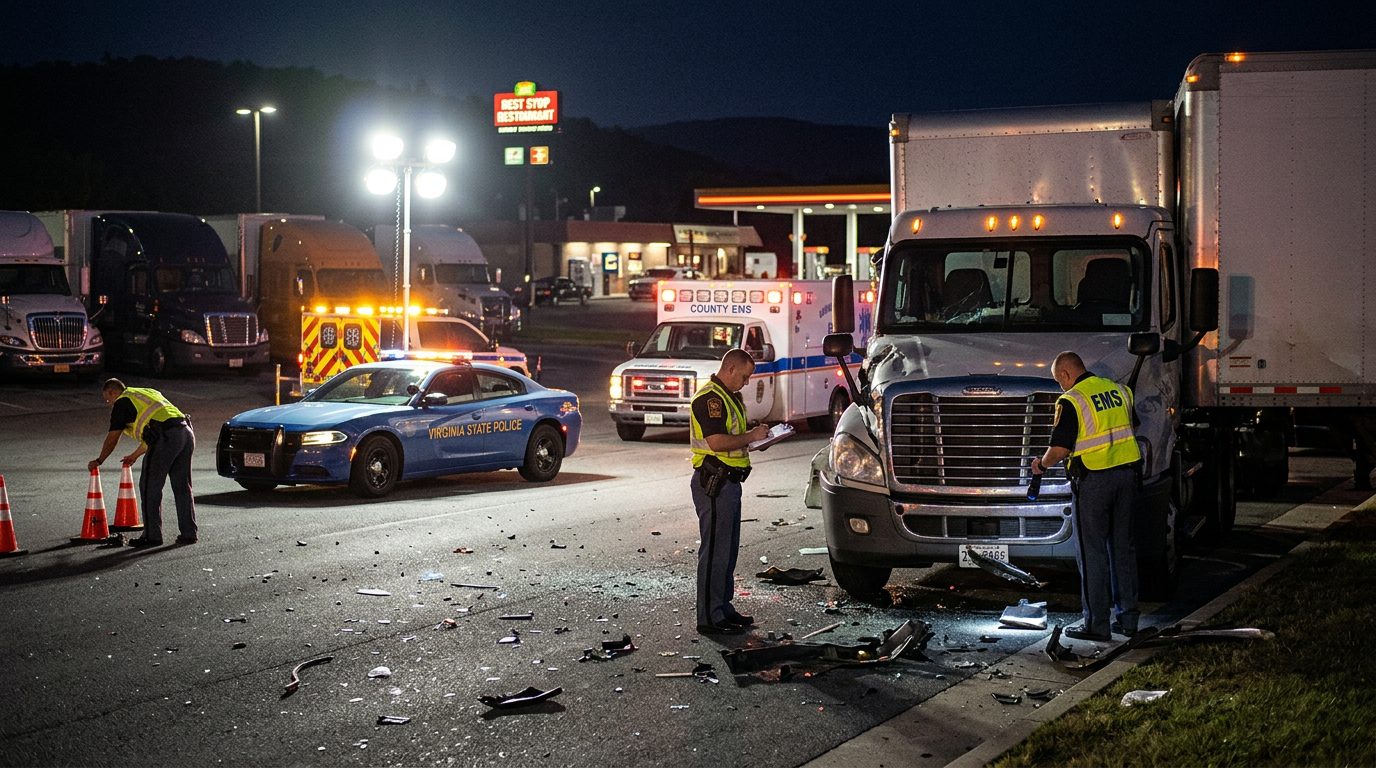
The police crash report is the officer’s written record of the crash, including the vehicles, drivers and conditions at the scene.
Virginia requires a driver involved in a crash with injury or death to stop and report it to police immediately (Va. Code §§ 46.2-371, 46.2-894). The statutes are at Va. Code § 46.2-371 and Va. Code § 46.2-894.
Section 46.2-894 also requires the driver to give name, address, license and registration details. The driver must also give reasonable help to an injured person.
The report is one record among several. Read it with the logs, inspection files and maintenance records to test the timeline of the trip. Check whether details such as lane, direction and damage match what the other records show.
Photos, dash cam footage, dispatch messages and other evidence
Photos, video and messages capture details that can change or disappear.
Photos of the scene, vehicle damage and road conditions record things as they looked right after the crash. Early photos can preserve details that change quickly, such as debris and vehicle positions.
Picture a loaded truck on a highway in the Shenandoah Valley, with traffic backing up behind it. Scene details can be cleared quickly once traffic resumes.
Dash cam footage, when a truck has a camera, may show lane position, speed and following distance. Whether footage exists and how long it is kept turns on the device and the carrier.
Dispatch messages, phone records and GPS data are other records a carrier or driver may hold. Whether they exist varies with each carrier.
For more on proving fault, see car accident fault evidence.

How the records fit together and why timing matters
Records matter most when they are read together to build a timeline of the trip and the crash.
Logs show hours. Inspection reports show equipment condition at the end of a day. Maintenance files show history. The crash report shows the scene. Photos and video show what the scene looked like.
Each record answers a different question, so a gap in one can often be tested against another.
Virginia generally allows two years from the date of injury to file a personal injury lawsuit (Va. Code § 8.01-243(A)); the clock runs from the date of injury, not the date of discovery, with narrow exceptions. The statute is at Va. Code § 8.01-243.
Some claims carry notice requirements that run out sooner than the filing deadline.
In short, logs, qualification files, inspection and maintenance records, the crash report and photos each show a different part of a truck crash. Which records matter after a truck crash in Virginia turns on the details of each crash.
Frequently asked questions
How long must a carrier keep inspection reports?
Under federal rules, a carrier keeps a driver vehicle inspection report and its repair certification for three months from the date the report was prepared (49 C.F.R. § 396.11).
How long must a carrier keep a driver qualification file?
Except as provided in paragraph (d), the carrier keeps the driver qualification file while the driver works for it and for three years after (49 C.F.R. § 391.51); certain records in the file, such as the note on the annual driving record review and the medical examiner’s certificate, may be removed three years after the date of execution.