
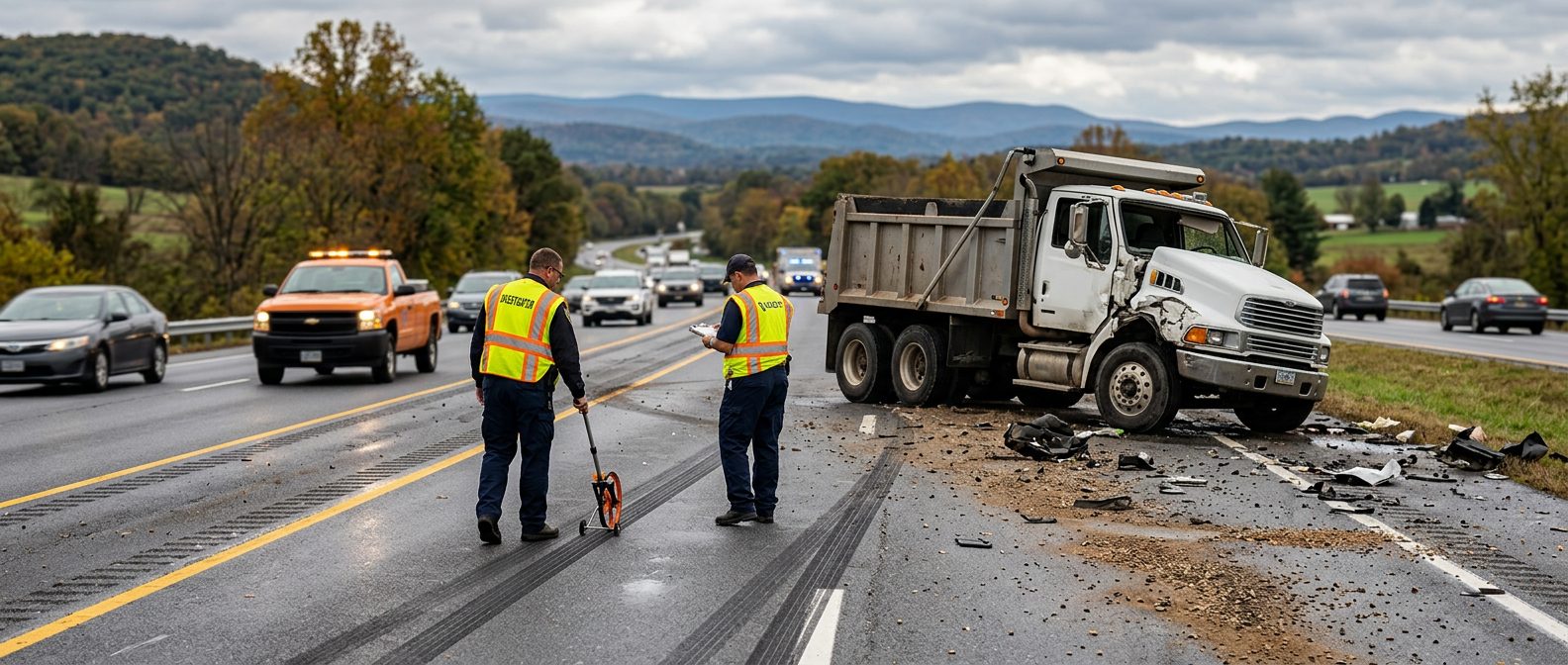
Truck Accidents | Virginia
Hurt in a Construction Truck Crash? Understand Your Options
Correll Law Firm, based in Winchester with an office in Harrisonburg, represents people across the Shenandoah Valley, Richmond and Henrico County after serious crashes.
Published November 16, 2026
If a construction truck or dump truck crash has hurt you or someone you love, you may be facing medical bills, lost work and hard questions about who is responsible. In Virginia, a claim may name more than the driver, depending on the facts, and the state sets firm deadlines for filing suit. This guide explains the basics in plain terms.
What Construction and Dump Truck Crash Claims Involve
A construction truck crash claim seeks payment for injury or death caused by a truck used on a job site or hauling building materials. Dump trucks, cement mixers and flatbeds are common examples. When someone is killed, the action is filed by the decedent’s personal representative on behalf of the family members the statute protects.
These crashes differ from ordinary car wrecks in several ways. Heavy loads can shift, and a high center of gravity raises the risk of tipping on turns or uneven ground. Trucks often back up near workers, and they move in and out of work zones where lanes and traffic patterns change quickly. Workers on foot have little protection from a vehicle that heavy.
The firm’s offices are in Winchester and Harrisonburg. It serves people across the Shenandoah Valley, and people in Richmond and Henrico County.
If a construction or dump truck crash has left you or someone you love hurt, you do not have to sort out the insurance questions alone; the firm is ready to talk through your situation. Talk it through with Correll Law Firm — we can walk you through how a situation like yours is usually handled and what your options are.

Who May Be Responsible, Including the Trucking Company?
Yes, a claim may name a trucking company, depending on the facts. The driver is only one possible party. Others may include:
- The company that employs or dispatches the driver
- The contractor or subcontractor whose work the truck was doing
- The owner of the truck or other equipment
- Any company that loaded, secured or maintained the truck
Job site work adds another point. In a civil action alleging personal injury, death by wrongful act or damage to property from the negligence of or breach of warranty by an independent contractor, it is not a defense that the contractor finished the work or that the owner accepted it as satisfactory (Va. Code § 8.01-39). Identifying every party early matters, because insurance may come from different companies and records may sit with different parties.
How Virginia’s Fault Rule Affects a Claim
Virginia’s rule on the injured person’s own fault is strict. Virginia follows contributory negligence: if you are found even partly at fault, you may be barred from recovering, with limited exceptions. Talk to a lawyer about your facts.
Drivers also must keep a proper lookout.
The facts that bear on fault often include signage at the work zone, lighting, warnings given to other drivers, speed and how the load was secured. Insurers often examine these details closely, so documenting them early is important.
Deadlines, Crash Reporting and Notice Rules
Unless otherwise provided, personal injury and fraud actions must be brought within two years after the cause of action accrues, while actions for injury to property must be brought within five years (Va. Code § 8.01-243). Virginia generally allows two years from the date of injury to file a personal injury lawsuit (Va. Code § 8.01-243(A)); the clock runs from the date of injury, not the date of discovery, with narrow exceptions.
A claim against a county, city or town for negligence generally requires a written statement of the claim within six months after it accrues, or the claim is barred (Va. Code § 15.2-209). A limited exception applies if the locality’s attorney, chief executive or mayor, or any insurer or entity providing coverage or indemnification of the claim, had actual knowledge of the claim, which includes the nature of the claim and the time and place at which the injury is alleged to have occurred, within that period. This can matter when the truck belonged to a county, city or town, such as a road-crew vehicle.
Virginia requires a driver involved in a crash with injury or death to stop and report it to police immediately (Va. Code §§ 46.2-371, 46.2-894). The two-year period is the deadline to file a lawsuit, not to report a crash (Va. Code § 8.01-243).
Evidence and Insurer Contact in the First Weeks
Evidence from a truck crash can disappear quickly, so early records matter most. Key items include:
- The police report and crash report number
- Photos of the vehicles, the load, the road and any work-zone signs
- Names and contact details of witnesses
- Medical records and bills
- Dash camera or nearby video
Commercial trucks create their own records. Federal rules also require drug and alcohol testing of CDL drivers, including after an accident (FMCSA).
Job site records, maintenance history and load tickets may also matter. An insurer may ask for a recorded statement soon after a crash. Early statements can be used later in the claim, so you may wish to understand your options before giving one.
Serious Injuries, Wrongful Death and Damages
Heavy truck crashes can cause traumatic brain injury, spinal cord injury, crush injuries and amputations, and they can lead to wrongful death. Injuries like these often need long-term medical planning, and their full effects may take time to understand.
A Virginia wrongful death action is filed by the decedent’s personal representative within two years of the death (Va. Code §§ 8.01-50(C), 8.01-244(B)), on behalf of the family members the statute protects. Damages are distributed to a defined class of beneficiaries, including a surviving spouse and children (Va. Code § 8.01-53).
Virginia wrongful death damages cover the family’s sorrow, mental anguish and loss of the decedent’s companionship, guidance and care; lost income and services; medical expenses from the injury; funeral expenses; and, for willful or wanton conduct, punitive damages (Va. Code § 8.01-52).
Virginia allows punitive damages for actual malice, or for willful or wanton conduct or recklessness showing a conscious disregard for the safety of others, capped at $350,000 (Va. Code § 8.01-38.1). The jury must find that the conduct met this standard, and it is not told about the cap in Va. Code § 8.01-38.1.
The firm handles catastrophic injury and wrongful death matters, and each one turns on its own facts.
Not sure what your next step is?
Talk it through with Correll Law Firm — we can walk you through how a situation like yours is usually handled and what your options are.
How the Firm Handles Construction Truck Claims
The firm starts with the crash facts, preserves evidence and identifies every party that may be responsible. Its work usually follows these steps:
- Review the crash facts and the injuries.
- Preserve evidence, including driver logs, maintenance records and load records.
- Identify insurers and responsible parties.
- Investigate the crash and gather medical documentation.
- Present a demand to the insurers.
- File suit if a fair resolution is not reached.
The first weeks focus on evidence and insurer notices. The middle stages involve records and medical documentation. Later stages may involve negotiation or filing suit. The length of each stage depends on the facts.
The firm focuses on car, truck and commercial vehicle crashes, catastrophic injuries and wrongful death. Its offices are in Winchester and Harrisonburg, and it serves people in Richmond and Henrico County as well.
Frequently Asked Questions About Construction Truck Crash Claims
Here are short answers to common questions about these claims.
Do construction truck crashes follow different rules?
The parties, evidence and insurers often differ, which can change how a claim develops.
Is a trucking company always responsible?
No. Responsibility depends on the facts, including who employed the driver and who controlled the work.
Why do driver logs matter?
Logs show where a driver was and when, which can help confirm the timeline of a crash.