
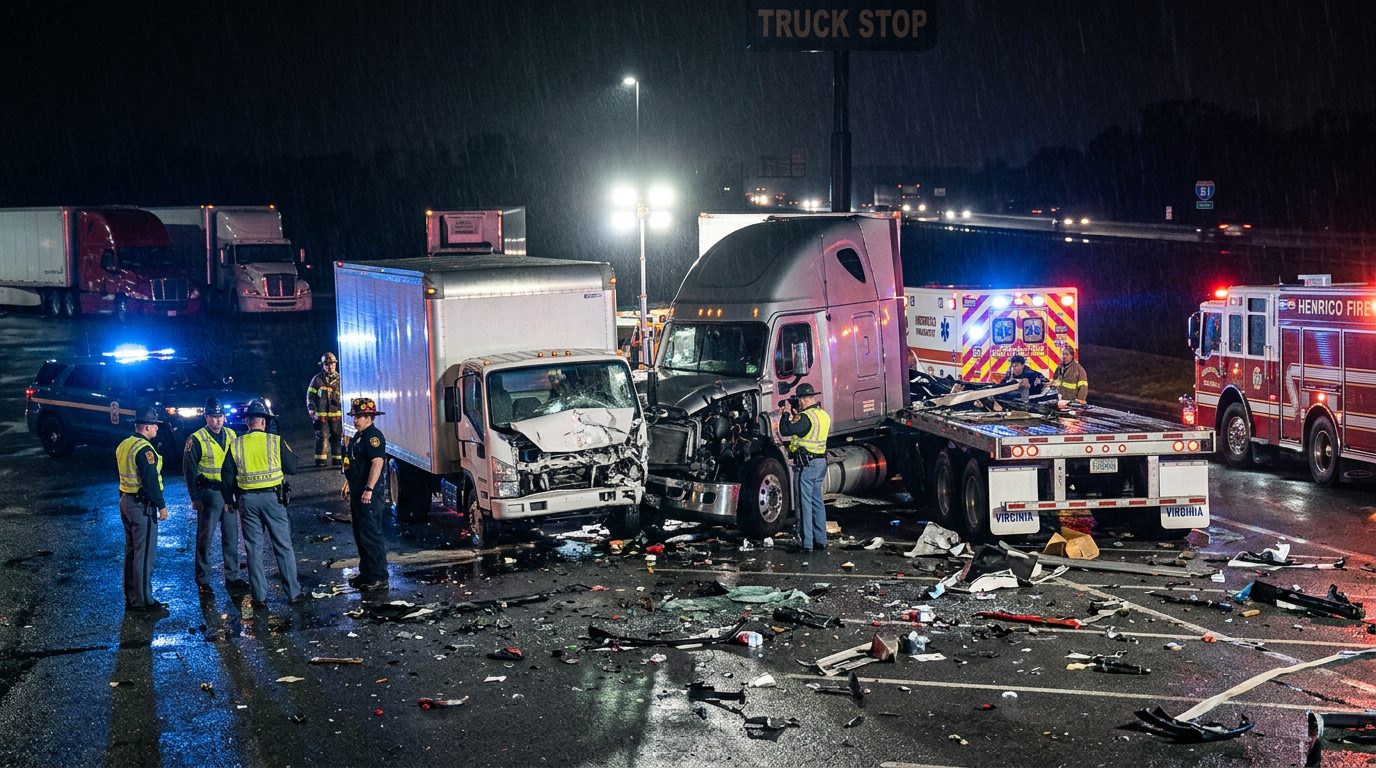
Truck accidents · Virginia
When a Truck Driver Leaves the Scene in Virginia
Families are left with injuries, damaged vehicles and unanswered questions. Here is how these cases unfold and what to do in the hours and days that follow.
Published November 13, 2026
Being hurt in a truck crash is frightening. When a truck driver left the scene of a crash in Virginia, the questions come fast, and many of them are urgent. Virginia requires a driver in a crash with injury or death to stop and report it. People hurt in these crashes may still have legal options. This guide covers the driver’s duties, the first steps to take, the trucking records that may matter, and the deadlines that may apply. The facts of each crash decide how the law applies.
What Virginia Law Requires After a Crash With Injury or Death
Yes, a truck driver in a crash with injury or death has a legal duty to stop and report it. Virginia requires a driver involved in a crash with injury or death to stop and report it to police immediately (Va. Code §§ 46.2-371, 46.2-894).
The driver must also immediately give notice of the accident to a law-enforcement officer when anyone is injured or killed (Va. Code § 46.2-371). The notice duty in Va. Code § 46.2-371 is to immediately give notice of the accident to a law-enforcement officer; taking the injured person to a physician, surgeon or hospital is covered by § 46.2-894 when it is apparent that medical treatment is necessary or the injured person requests it. The duties appear in Va. Code § 46.2-894 and Va. Code § 46.2-371.
Keep two timelines apart. The duty to report is immediate. For a wider look at these crashes, read the commercial vehicle accident guide.
If a truck driver left you or a family member hurt, you may have a claim, and you do not have to sort out the next steps alone. Talk it through with Correll Law Firm — we can walk you through how a situation like yours is usually handled and what your options are.

What “Leaving the Scene” Means in a Truck Crash
Leaving the scene is the everyday term for a driver who does not stop after a crash. Many people call it a hit-and-run.
The duty applies to the driver of any vehicle involved in the crash. A loaded truck and an empty truck carry the same duty. The driver must stop as close to the scene as possible without blocking traffic. The driver must also give identifying details to the State Police or local police, or to the people involved.
A truck may end up on a bridge, an embankment or the shoulder after a crash. If injuries keep the driver from stopping, the driver must make the report as soon as reasonably possible. The driver must also make a reasonable effort to find the people involved.
Confusion, fear or injury may explain why a driver left. The details recorded at the scene matter for that reason.
Steps to Take Right After the Crash
The first steps focus on safety, medical care and facts that fade fast.
Call 911 if you can, or ask someone nearby to make the call. Tell the dispatcher about any injuries and about a vehicle that left the scene. Ask for the police report number and write it down.
Get medical care for everyone hurt, even when injuries seem minor. Keep a record of every visit, test and prescription. Injuries from a large truck can be serious even when symptoms seem mild at first.
If you can do so safely, record details. Note the time, the location and the direction of travel. Write down the company name, unit or trailer numbers, any markings on the cab, the truck’s color, and anything the driver said or did. Collect witness names and contact details. Photograph the scene, skid marks, debris, road conditions and any damage to vehicles or guardrails.
Write these notes as soon as you can. Memory of a stressful event tends to blur. A written list made soon after the crash is easier to use later.
Identifying the Truck and Finding Its Records
Details noted at the scene, along with the police report, are often where identification starts.
Federal trucking rules add another source. Under 49 C.F.R. § 395.8, except for a private motor carrier of passengers (nonbusiness), a motor carrier must require each driver to record duty status for each 24-hour period. For each change of duty status, the city, town or village and the State abbreviation must be recorded. A note to 49 C.F.R. § 395.8(c) covers a duty-status change that happens outside a city, town or village: the record shows one of three things, either the highway number and nearest milepost, the highway number and the name of the service plaza, or the highway numbers of the nearest two intersecting roadways, each followed by the name of the nearest city, town or village and State abbreviation. The driver’s record must also show the name of the motor carrier for which the work is performed.
The ELD rules are in 49 C.F.R. § 395.20. Federal hours-of-service rules limit driving time and require rest breaks for commercial drivers.
These records can show where a truck was and how long the driver had been working. Read more in the trucking logbook and black box data guide.
Injuries That May Need Ongoing Medical Follow-Up
Some serious injuries are not obvious right after a crash, so follow-up care matters.
Large truck crashes can cause traumatic brain injury and spinal cord injury. Symptoms may appear or change over days and weeks. Watch for headaches, dizziness, memory or concentration changes, numbness, weakness or ongoing pain.
Keep a written list of each symptom, the date it began and any change. Share the list with each medical provider. A list gives a clearer picture than memory alone, and it shows how the injury affects daily life.
For more on brain injuries from this kind of crash, see the guide to traumatic brain injury in tractor-trailer crashes. Recovery differs from person to person, and no one can predict how a particular injury will progress.
When the Crash Is Fatal: Wrongful Death Claims in Virginia
When a crash kills someone, Virginia law allows a wrongful death action. The family’s role is different from what many expect.
A Virginia wrongful death action is filed by the decedent’s personal representative within two years of the death (Va. Code §§ 8.01-50(C), 8.01-244(B)), on behalf of the family members the statute protects.
Virginia wrongful death damages cover the family’s sorrow, mental anguish and loss of the decedent’s companionship, guidance and care; lost income and services; medical expenses from the injury; funeral expenses; and, for willful or wanton conduct, punitive damages (Va. Code § 8.01-52).
The statutes are Va. Code § 8.01-50, Va. Code § 8.01-244 and Va. Code § 8.01-52. A hit-and-run death can raise hard questions about who was driving and why the driver left. Those questions take time to answer, and the family’s grief does not wait for them.
Not sure what your next step is?
Talk it through with Correll Law Firm — we can walk you through how a situation like yours is usually handled and what your options are.

Filing Deadlines and How Fault Is Decided
Filing deadlines are the first thing to know after a crash. Virginia generally allows two years from the date of injury to file a personal injury lawsuit (Va. Code § 8.01-243(A)); the clock runs from the date of injury, not the date of discovery, with narrow exceptions. The full text is in Va. Code § 8.01-243.
Some claims carry notice requirements that run out sooner. Do not assume the full two years applies to every step.
Fault also matters. Virginia follows contributory negligence: if you are found even partly at fault, you may be barred from recovering, with limited exceptions. Talk to a lawyer about your facts.
Many factors can shape how fault is discussed after a crash, and each situation depends on its own facts.
Is leaving the scene the same as a hit-and-run?
Yes. Hit-and-run is the common name for a driver who leaves the scene of a crash.
Is reporting a crash the same as filing a lawsuit?
No. Reporting is a duty owed to police right away. A lawsuit is a separate step with its own time limit.