
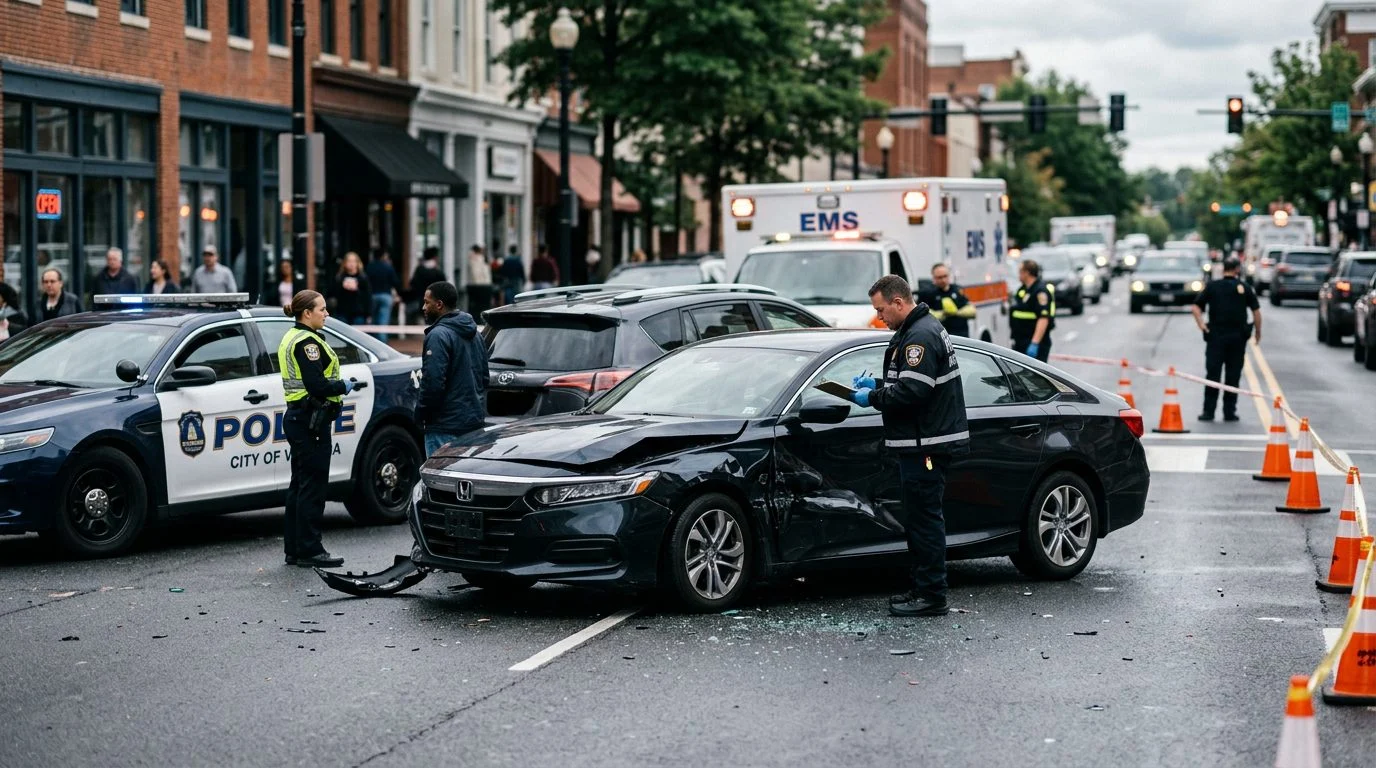
Car Accidents | Virginia
Can You Sue Someone Who Crashed Your Car in Virginia?
A plain-language look at who may be responsible after a crash, what a claim can cover, and how the firm helps people in Winchester, Front Royal, Harrisonburg, Richmond and Henrico County.
Published November 8, 2026
Short answer: can you sue the driver who crashed into your car?
Often, yes. A person hurt in a crash may have a legal claim against the driver whose conduct caused it. Whether a lawsuit is possible depends on the facts of the crash, the injuries and who was behind the wheel.
Many Virginia drivers and passengers ask this question in the days after a crash. This page answers it under Virginia law. For a wider look at car and truck crash claims, read the car and truck crash guide.
The at-fault driver is the most common target. A friend or family member who was driving can also be a defendant. Truck crashes can involve more than one party, so they need their own careful review.
Not sure what your next step is?
Talk it through with Correll Law Firm — we can walk you through how a situation like yours is usually handled and what your options are.
What the crash facts decide
The crash facts, the injuries and the driver’s conduct decide which claim, if any, fits. Gather details early, while memories and evidence are still fresh.
Useful facts include where and when the crash happened, who was driving, what each driver said at the scene, photos of both vehicles, and the police report number. Names of witnesses also help.
Virginia courts look closely at cause.
Injury severity matters too. A reader who wonders whether a crash is serious enough can read what qualifies as a serious accident. Many people feel fine right after a crash and notice symptoms only later. A dated list of symptoms, appointments and missed work can help, whatever path a reader later chooses.
If you were partly at fault
Partial fault can bar a claim in Virginia. Virginia follows contributory negligence: if you are found even partly at fault, you may be barred from recovering, with limited exceptions. Talk to a lawyer about your facts.
A narrow exception can apply. The facts decide whether it fits.
How long you have to file a lawsuit
Virginia generally allows two years from the date of injury to file a personal injury lawsuit (Va. Code § 8.01-243(A)); the clock runs from the date of injury, not the date of discovery, with narrow exceptions. The statute text is at Va. Code § 8.01-243.
Some claims carry notice requirements that run out sooner than the lawsuit deadline. A person who was hurt should not assume the full two years applies to every step. Evidence such as photos and records can fade or get lost over time, so early attention to timing helps.
Reporting the crash to police
Virginia requires a driver involved in a crash with injury or death to stop and report it to police immediately (Va. Code §§ 46.2-371, 46.2-894). The two-year period is the deadline to file a lawsuit, not the deadline to report a crash. Va. Code § 46.2-371 provides that the driver of any vehicle involved in an accident resulting in injury to or death of any person, or some person acting for him, shall immediately give notice of the accident to a law-enforcement officer. A willful failure to make that report is a Class 4 misdemeanor (Va. Code § 46.2-371).
If injuries from the accident keep the driver from reporting at the scene, Virginia law (Va. Code § 46.2-894) still calls for a report to the State Police or a local law-enforcement agency as soon as reasonably possible, and a reasonable effort to locate the person struck, the driver or another occupant of the other vehicle, or the custodian of the damaged property and give them the driver’s name, address, driver’s license number, and vehicle registration number.
When a crash causes a death: wrongful death claims
A Virginia wrongful death action is filed by the decedent’s personal representative within two years of the death (Va. Code §§ 8.01-50(C), 8.01-244(B)), on behalf of the family members the statute protects. Va. Code § 8.01-50(A) provides that when a death is caused by the wrongful act, neglect, or default of a person or corporation, and the same act would have entitled the injured party to maintain an action had death not ensued, the responsible party is liable to an action for damages, notwithstanding the death of the person injured (Va. Code § 8.01-50).
Virginia wrongful death damages cover the family’s sorrow, mental anguish and loss of the decedent’s companionship, guidance and care; lost income and services; medical expenses from the injury; funeral expenses; and, for willful or wanton conduct, punitive damages (Va. Code § 8.01-52). Who receives a share follows the class order in Va. Code § 8.01-53, which names the surviving spouse, children and children of a deceased child, and in some cases parents, brothers and sisters, and other relatives who were primarily dependent on the decedent and lived in the same household; if none of these survivors exist, the award passes in the course of descents under § 64.2-200, and a parent whose parental rights were terminated by a court or a permanent entrustment agreement cannot be a beneficiary.
Not sure what your next step is?
Talk it through with Correll Law Firm — we can walk you through how a situation like yours is usually handled and what your options are.
When the driver’s conduct may support punitive damages
If the jury finds that the defendant’s conduct met the legal standard for punitive damages, the total punitive award against all defendants found liable may not exceed $350,000 (Va. Code § 8.01-38.1). Va. Code § 8.01-38.1 provides that the total amount awarded for punitive damages against all defendants found liable is determined by the trier of fact, and that in no event may that total exceed $350,000 (Va. Code § 8.01-38.1).
Punitive damages require a jury finding that the conduct met the statutory standard described above.

Next steps and what to keep
The answer turns on the facts of each crash. Keeping good records makes those facts easier to review.
Useful papers include the police report, photos of both vehicles and the road, medical records and bills, employer records of missed work, and a dated list of symptoms and appointments. Keep them together in one folder, paper or digital.
Quick answers
Can a family sue after a fatal crash in Virginia?
Yes. A wrongful death action may be filed by the decedent’s personal representative for the family members the statute protects.
How long do you have to file a lawsuit?
Virginia generally allows two years from the date of injury, with narrow exceptions (Va. Code § 8.01-243).
Must a driver report a crash to police?
Virginia requires a driver in a crash with injury or death to stop and report it immediately.
Every crash has its own facts, and those facts shape the answer. A person who was hurt may wish to review them with a lawyer.