
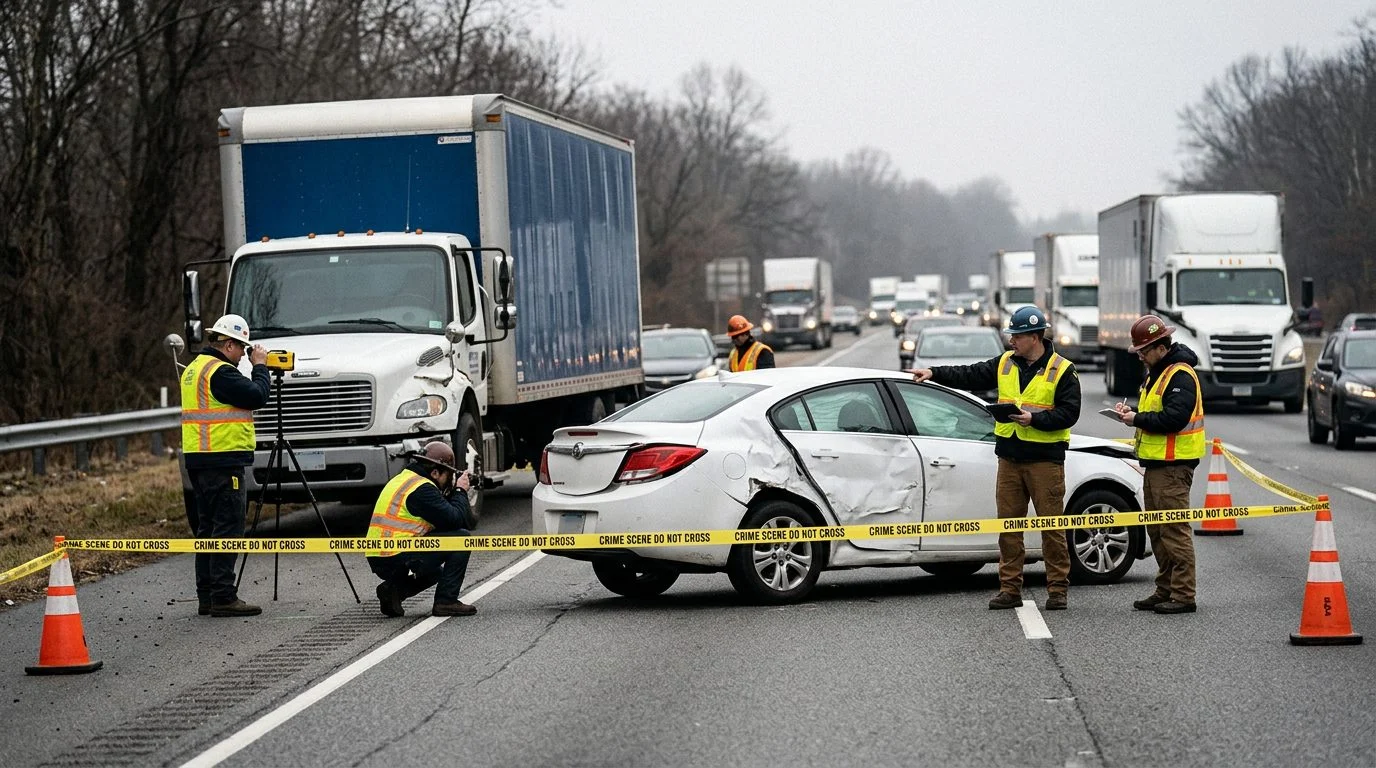
Virginia car crash records | I-81 corridor
Gathering Crash and Medical Records After a Spinal Injury on I-81
A plain-language guide to the reports, medical files and other records that help show how a spinal injury happened and how it has been treated.
Published November 10, 2026
After a crash on Interstate 81, a spinal injury may not show its full picture right away. The records made in the hours and weeks that follow often shape how that injury is understood later. The key records are the police crash report, EMS and emergency room notes, spine imaging reports, ongoing treatment files, and scene and witness details. This guide explains what each record shows and why it matters after a spinal injury car accident.
Why Records Matter After an I-81 Crash
Records matter because they capture what happened while the details are still fresh. Interstate 81 runs through the Shenandoah Valley, and a crash there can involve several vehicles at highway speed.
A spinal injury can develop or worsen over several days. Numbness, tingling or weakness may not be mentioned at the scene, so the first medical notes become an important starting point. Waiting to request records is a common mistake. Records are easier to find while the crash and treatment are recent.
The firm’s Winchester and Harrisonburg offices serve clients from the Shenandoah Valley to Richmond and Henrico County. The firm handles car accident, truck accident and spinal cord injury claims. For background on crash claims, see the firm’s car accident overview.
If you were hurt in a crash on I-81 and are dealing with a spinal injury, you may have a claim, and the firm is glad to talk through your records and your options. Talk it through with Correll Law Firm — we can walk you through how a situation like yours is usually handled and what your options are.

The Police Crash Report
A police crash report is the official record of when and where a crash happened, which vehicles were involved, and what the responding officer observed. It usually lists the date, time, location, drivers, vehicles and the officer’s notes from the scene.
Virginia requires a driver involved in a crash with injury or death to stop and report it to police immediately (Va. Code §§ 46.2-371, 46.2-894). You can read the statute text at Va. Code § 46.2-371 and Va. Code § 46.2-894.
Write down the report number and the agency that responded, because the report is requested from that agency. Check the report for errors in names, times, roads and vehicle details, and keep a copy exactly as it was issued.
Emergency Medical Service and Emergency Room Records
EMS run reports and emergency room charts are usually the first medical records of a spinal injury. The EMS report records the first assessment at the scene. It notes what the injured person said, whether they could move their arms and legs, and any neck or back complaints.
The emergency department record adds triage notes, neurological checks, any spinal immobilization and the physician’s first diagnosis. These early entries show what symptoms were noticed before treatment began.
Spinal nerves are grouped by region.
Ask the hospital for the complete chart, not only the discharge summary. Ask the EMS agency for its run report too, since it is a separate document.
Imaging and Spine-Specific Medical Records
Imaging reports describe what X-ray, CT and MRI scans showed. They may list fractures, disc damage, ligament injury or pressure on the spinal cord. A radiologist writes each report, and that written report is separate from the scan itself. Keep both when possible, because medical professionals can review each one.
Spine-specific records go further. Surgical notes, referral letters from spine or neurology providers, and orders for injections or physical therapy show how the injury was evaluated and treated. If a treating provider gives an opinion about what caused the injury, that opinion belongs in the provider’s own notes, where it can be read in full context.
Ask for records from every provider, including those you saw only once. For more on spinal injuries, see the firm’s spinal cord injury overview.
Ongoing Treatment and Follow-Up Records
Follow-up visits, therapy notes and medication records show how symptoms changed over time. Writing down the timeline of your treatment from the start can help. If a medical visit is missed, note why, such as a work shift or a transportation problem, and reschedule as soon as you can.
Keep a symptom journal with dates, activities that became hard, and work or household tasks that changed. Bring it to appointments. Keep receipts for medication and for mileage to medical visits.
The DARS long-term rehabilitation page lists those requirements.
Vehicle, Scene and Witness Information
Photos, vehicle records and witness details capture evidence that can change or disappear over time. Take pictures of the vehicles, the roadway, lane markings, weather and debris as soon as it is safe. Include the final resting positions of the vehicles, since they can show how the crash unfolded.
Keep tow yard and repair estimate records, which document the damage to each vehicle. Record the claim number each insurer assigns, along with the insurance details of every driver.
Collect the names and contact information of witnesses, and write down what each one said or saw. Note any traffic camera, dash camera or roadside video that may have recorded the crash. If there is video of the crash, ask for a copy early.
Not sure what your next step is?
Talk it through with Correll Law Firm — we can walk you through how a situation like yours is usually handled and what your options are.

Timing: Deadlines That Affect Your Records
Early records matter, particularly where a notice period applies. Virginia generally allows two years from the date of injury to file a personal injury lawsuit (Va. Code § 8.01-243(A)); the clock runs from the date of injury, not the date of discovery, with narrow exceptions. The statute text is at Va. Code § 8.01-243.
A negligence claim against a county, city or town is barred unless a written statement of the nature of the claim, including the time and place of the injury, is filed within six months after the claim accrued (Va. Code § 15.2-209). Failure to provide the written statement does not bar a claim against a county, city or town if the attorney, chief executive or mayor of that locality, or any insurer or entity providing coverage or indemnification of the claim, had actual knowledge of the claim, including its nature and the time and place of the injury, within six months after the cause of action accrued. The notice requirement is mandatory and shall be strictly construed, and compliance with it is procedural, not jurisdictional (Va. Code § 15.2-209). A claim against the Commonwealth or a transportation district is barred unless a written statement of the nature of the claim, including the time and place of the injury and the agency or agencies alleged to be liable, is filed within one year after the claim accrued, though a missing statement does not bar the claim if the officials or insurer named in the statute had actual knowledge of those details within that year, and if the claimant was under a disability when the claim accrued, the tolling provisions of § 8.01-229 apply (Va. Code § 8.01-195.6).
Is a crash report the same as a medical record?
No. A crash report is a police record of the scene, while medical records document the injury and treatment.
What if the police report contains an error?
Ask the responding agency how to request a correction, and keep the report as first issued.