
Car Accidents | Spinal Cord Injury | Winchester, Virginia
We Can Help You Sort Through What Comes Next.
Published November 6, 2026
A spinal cord injury from a car or truck crash can change how a person moves, feels and manages daily life. For people in Winchester, Virginia, with a spinal cord injury from a car crash, this page explains what the injury means, what a Virginia claim involves and what damages may cover. Each section answers one common question in plain language.
What a Spinal Cord Injury From a Car Accident Means
A spinal cord injury damages the bundle of nerves that carries signals between the brain and the rest of the body. When the cord is hurt, those signals can be weakened or blocked. That can affect movement, feeling and some bodily functions, such as bladder and bowel control.
Doctors often describe two main types:
- Incomplete injury: some signals still pass below the injury, so some movement or feeling may remain.
- Complete injury: no signals pass below the injury, so movement and feeling below that point are lost.
Where the injury sits on the spine matters. The Christopher & Dana Reeve Foundation notes that effects vary by level. It also says injuries above C3 carry respiratory risks.
Symptoms may not be fully clear right away. Shock, swelling and pain can hide the full picture at first. Early medical evaluation and careful records matter. Related injuries, such as brain injuries, can occur in the same crash.
If a spinal cord injury followed a car or truck crash, you do not have to face the questions alone, and the firm is ready to talk through what may apply to your situation. Talk it through with Correll Law Firm — we can walk you through how a situation like yours is usually handled and what your options are.
Who This Page Is For
Injured drivers and passengers can use this page, and so can family members helping someone with a new spinal cord injury. It also speaks to families whose loved one died after a crash that caused a spinal cord injury.
The firm handles car accidents, truck accidents, commercial vehicle accidents, catastrophic injuries and wrongful death. This page stays within those matters.
The firm serves people across the Shenandoah Valley, including Winchester and Harrisonburg. It also serves people from nearby communities to the north and people in Richmond and Henrico County.
Many readers ask three questions first: what the injury means for daily life, whether a claim is possible and what deadlines apply. Family members often carry the daily work of care, paperwork and appointments, so that work is covered too.
How Car and Truck Crashes Cause Spinal Cord Injuries
Spinal cord injuries in crashes usually come from sudden force on the spine. Several crash patterns can cause them:
- Direct impact: a blow to the head or back can bend or twist the spine.
- Rollover: a crushed roof or a body thrown around the cabin can strain the neck and back.
- Sudden stop: a body that keeps moving can strike the steering wheel, dash or seat frame.
- Side impact: a force from the side can push the spine out of its normal line.
A large truck is much heavier than a passenger car. A crash with a truck can produce greater force on the smaller vehicle and its occupants. Commercial vehicle crashes also raise questions about the driver, the carrier and any other party who may share responsibility.
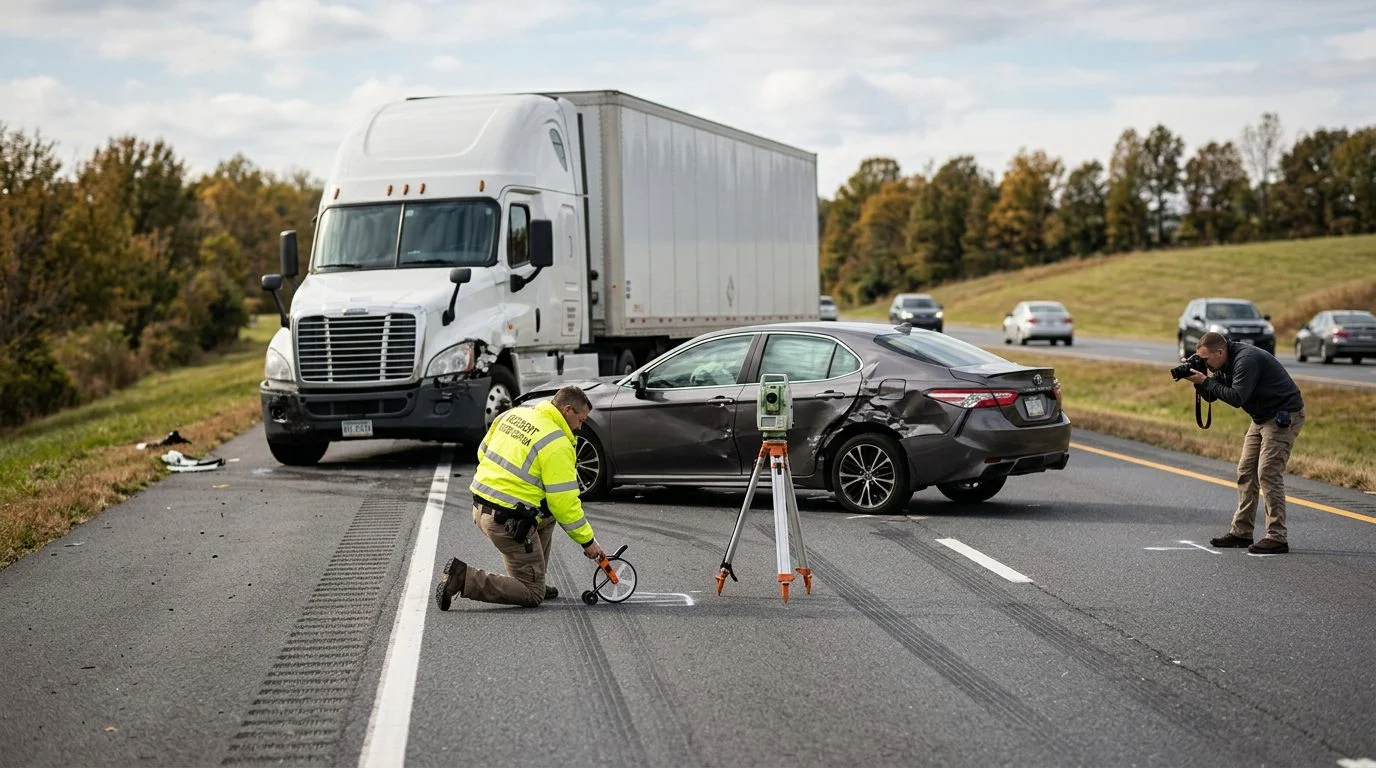
Crash details matter in a claim. Police reports, vehicle damage, photographs and imaging can show how the force reached the spine.
Steps to Take After a Crash
After a crash involving a person killed or injured, or attended property damage, stop, report your name, address, driver’s license and vehicle registration numbers, and render reasonable assistance to any injured person, including taking them to a doctor or hospital if medical treatment is apparently necessary or requested. Virginia law sets clear duties for drivers.
Virginia requires a driver involved in a crash with injury or death to stop and report it to police immediately (Va. Code §§ 46.2-371, 46.2-894).
The driver duties are set out in Va. Code § 46.2-894. A driver who is hurt and cannot comply must make the report to police as soon as reasonably possible and make a reasonable effort to locate the person struck, the other driver or occupant, or the property custodian, and report their name, address, driver’s license and vehicle registration numbers to them. The same law requires reasonable help for an injured person, including a trip to a physician or hospital when treatment is apparent or requested.
- Get medical evaluation promptly and follow the treating providers’ instructions.
- Keep every record, imaging report and appointment note in one place.
- Write down what you remember about the crash while it is fresh, including time, weather and road conditions.
- Note witness names and take photographs of the scene and vehicles.
- Keep a written symptom journal, noting changes in strength, feeling or sleep over time.
- You may wish to be careful with recorded statements or papers from an insurance company until you understand your claim.
How a Virginia Spinal Cord Injury Claim Is Built
A Virginia injury claim usually depends on three questions: who caused the crash, how it caused the injury and what losses followed. Medical records and the opinions of treating providers help connect the crash to the injury.
Deadlines matter as much as the facts. Virginia generally allows two years from the date of injury to file a personal injury lawsuit (Va. Code § 8.01-243(A)); the clock runs from the date of injury, not the date of discovery, with narrow exceptions.
Some claims carry notice requirements that run out sooner. You may wish to speak with a lawyer early, so deadlines are understood from the start.
What a Claim May Cover
A claim may seek money for losses the injury caused. Common categories include the following:
- Past and future medical care, including rehabilitation.
- Assistive equipment and changes to a home or vehicle.
- Lost income. Provable loss of income is not reduced by reimbursement from another source, and that reimbursement is not admitted into evidence (Va. Code § 8.01-35).
- Future needs, which are shown through medical records and medical opinions.
Seat belt use follows its own rule. A violation of the seat belt law is not negligence in a damages action, cannot be considered to reduce damages and is not admissible in evidence there (Va. Code § 46.2-1094).
Virginia allows punitive damages for actual malice, or for willful or wanton conduct or recklessness showing a conscious disregard for the safety of others, with a statutory maximum of $350,000 (Va. Code § 8.01-38.1). The jury must find that the conduct met this standard, and the jury is not told about the cap.
For families after a fatal crash, Virginia wrongful death damages cover the family’s sorrow, mental anguish and loss of the decedent’s companionship, guidance and care; lost income and services; medical expenses from the injury; funeral expenses; and, for willful or wanton conduct, punitive damages (Va. Code § 8.01-52).
Not sure what your next step is?
Talk it through with Correll Law Firm — we can walk you through how a situation like yours is usually handled and what your options are.
How the Process Works and What to Expect
Most claims move through five stages. Timing depends on the facts and the medical course.
- First conversation: you describe the crash, the injuries and the treatment so far.
- Investigation: the firm reviews crash reports, medical records and insurance information.
- Medical review: treating providers explain the injury, and other professionals may review records when needed.
- Insurance claim: the claim goes to the responsible insurer, and negotiation may resolve it without a lawsuit.
- Lawsuit if needed: if the claim does not resolve, a lawsuit may be filed within the Virginia deadline, followed by discovery and, if necessary, trial.
Rehabilitation support can run alongside a claim. The Virginia Department for Aging and Rehabilitative Services says Virginia residents with documented spinal cord injuries may qualify for long-term rehabilitation case management when they meet listed eligibility requirements.
What Injured Virginians Can Consider After a Serious Injury
Correll Law Firm represents people seriously hurt in car and commercial truck crashes, catastrophic brain and spinal cord injuries and families in wrongful death cases. After a spinal cord injury in a crash near Winchester, many people want a firm that focuses on this kind of injury.
The firm’s offices are in Winchester and Harrisonburg. Residents of communities north of Winchester and of Richmond and Henrico County are among those the firm serves.
The lawyer responsible for this page is one of the firm’s lawyers. The firm also has support staff, including assistants and office staff.
Truck cases can involve more than one company.

Frequently Asked Questions
These short answers cover the questions readers raise most often.
Does a spinal cord injury always mean paralysis?
Not always. Injuries range from incomplete to complete, and the effects depend on the level and severity of the injury.
Can I still have a claim if I was partly at fault?
Virginia follows contributory negligence: if you are found even partly at fault, you may be barred from recovering, with limited exceptions. Talk to a lawyer about your facts.
Can I sue more than one party after a truck crash?
Who files a wrongful death claim in Virginia?
A Virginia wrongful death action is filed by the decedent’s personal representative within two years of the death (Va. Code §§ 8.01-50(C), 8.01-244(B)), on behalf of the family members the statute protects. Family members do not file the action; they share in the recovery.