
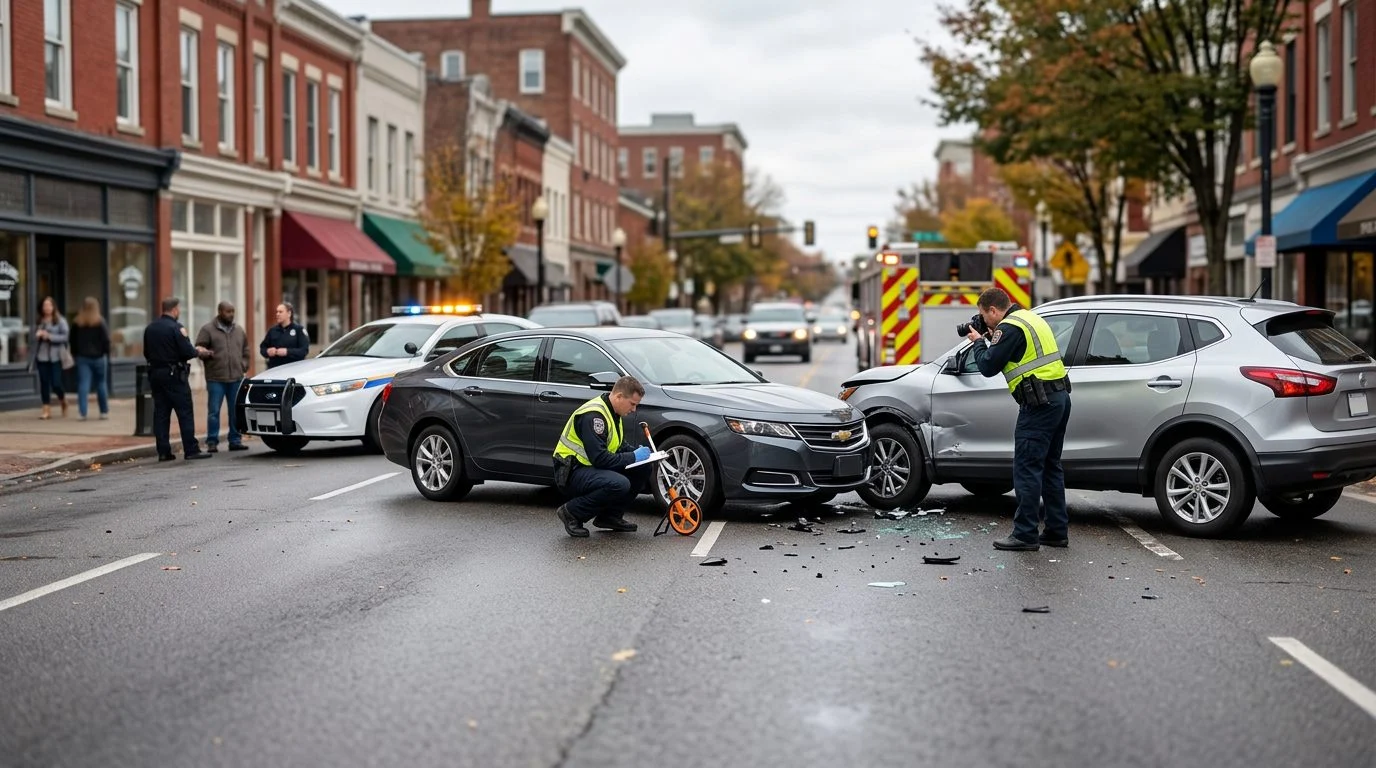
Car Accidents | Virginia
Car Accident Witnesses in Virginia: What You Can Do
A calm, accurate account from someone who saw the crash can matter to the people involved and to everyone who reviews what happened later.
Published November 11, 2026
Seeing a crash can be upsetting, and it is natural to wonder whether you should get involved. In Virginia, a witness can help most by calling 911 when it is safe, staying out of traffic, and sharing what they personally saw. Writing it down while the details are fresh matters too.
This guide explains what witnesses can do after seeing a car accident in Virginia, and why a neutral account can matter when drivers disagree.
Why a Witness’s Account Can Matter After a Crash
A witness’s account can matter because a witness has no stake in the outcome. When drivers describe the same crash in different ways, a neutral view can help show the order of events.
Memories of a crash fade quickly. Details you record soon after the event tend to be more reliable than details you recall weeks later. Specific details are also easier to check against photos and vehicle damage than general impressions.
Keep your notes about what you saw, not about who should win. This page covers what a witness can do. It does not predict how any claim will turn out, because every crash depends on its own facts. For a wider look at crash injuries, read the guide to car and truck crash injuries.
If a crash you saw has left someone hurt, you do not have to work out the next steps alone, and the firm can talk through your situation with you. Talk it through with Correll Law Firm — we can walk you through how a situation like yours is usually handled and what your options are.
Step 1: Call 911 and Help With Scene Safety
If it is safe, call 911 first. Give the location, the number of vehicles and whether anyone appears hurt. If you cannot safely reach the scene, tell 911 that you saw the crash from a distance.
Virginia requires a driver involved in a crash with injury or death to stop and report it to police immediately (Va. Code §§ 46.2-371, 46.2-894).
The two-year period discussed later is the deadline to file a lawsuit, not a deadline to report a crash (Va. Code § 8.01-243).
Stay out of traffic. Turn on your hazard lights if you have them, and do not stand between vehicles or near a fuel leak. Do not move injured people unless they are in immediate danger. Tell 911 how people were positioned and whether they were responsive when you arrived.
Step 2: Write Down What You Saw While It Is Fresh
Write your notes as soon as it is safe to do so, before details blur together. Use this list as a guide.
- The date, time, exact location, weather and road conditions.
- Each vehicle, its direction of travel and lane, and any turn, brake light or signal you saw before impact.
- Traffic lights or signs you could see, and whether people walking or cycling were nearby.
- What you saw and heard yourself, kept apart from anything other people told you. Label each one.
Write in your own words and date your notes. If you took photos or video, note the time each one was taken. Avoid guessing at speeds or distances unless you have a reliable basis, and say so when you are unsure.
Step 3: Share Your Observations With Police and Stick to Facts
Give the responding officer your name and how to reach you, then tell the officer what you personally saw. Describe what happened, not who you think was at fault. Deciding fault is for the officer and, later, the courts.
If a driver’s account differs from yours, do not argue at the scene. Tell the officer that your observations differ, and describe what you saw. Keep your voice calm and your answers short.
Ask for the report or incident number so you can refer to it later. If the officer asks you to sign a written statement, read it first and make sure it matches what you saw. If you feel pressured to take sides, say so and step back from the discussion.
When the Other Driver Tells a Different Story
When drivers disagree about a green light, a lane change or who was distracted, an independent witness can help clarify the order of events. Your account is one piece of evidence. Photos, vehicle damage and the police report are considered too.
Why does accuracy matter? Virginia follows contributory negligence: if you are found even partly at fault, you may be barred from recovering, with limited exceptions. Talk to a lawyer about your facts.
Answer questions only about what you saw. Do not guess about fault. Witnesses may also be asked by an insurer for a statement. A statement to an insurer is still a statement, so keep it to what you saw.
Keeping Your Notes and Following Up Over Time
Keep your written notes, any photos you took and the report number in one safe place. Keep a copy of anything you send to anyone, and write down the date you sent it. If your phone number or address changes, tell the investigating agency so a follow-up request can reach you.
Virginia generally allows two years from the date of injury to file a personal injury lawsuit (Va. Code § 8.01-243(A)); the clock runs from the date of injury, not the date of discovery, with narrow exceptions. Under Va. Code § 8.01-243, unless otherwise provided in that section or by other statute, every action for personal injuries, whatever the theory of recovery, shall be brought within two years after the cause of action accrues.
Some claims carry notice requirements that run out sooner. A written statement of a negligence claim against a county, city or town must be filed within six months, subject to the statute’s actual-knowledge provision (Va. Code § 15.2-209). Va. Code § 15.2-209 reads: “Failure to provide such statement shall not bar a claim against any county, city, or town, provided that the attorney, chief executive, or mayor of such locality, or any insurer or entity providing coverage or indemnification of the claim, had actual knowledge of the claim, which includes the nature of the claim and the time and place at which the injury is alleged to have occurred, within six months after such cause of action accrued.” Va. Code § 15.2-209 reads: “Every claim cognizable against any county, city, or town for negligence shall be forever barred unless the claimant or his agent, attorney, or representative has filed a written statement of the nature of the claim, which includes the time and place at which the injury is alleged to have occurred, within six months after such cause of action accrued.” Your notes can be useful if the facts are reviewed later.
Not sure what your next step is?
Talk it through with Correll Law Firm — we can walk you through how a situation like yours is usually handled and what your options are.
Witnesses to Serious Injury and Wrongful Death Crashes
When a crash causes a traumatic brain injury, spinal cord injury or death, a witness’s account of the moments before and after impact may matter more. The injured person may not remember the crash.
Passengers hurt in a crash have a different role at the scene. Read more about passenger injuries in a Virginia car accident.
If a crash involves a commercial truck, a witness who noticed the truck’s company name or markings can note them. The firm handles car accidents, truck accidents, commercial vehicle accidents, catastrophic injuries, traumatic brain injury, spinal cord injury and wrongful death. It has an office in Winchester and an office in Harrisonburg, and it serves people across the Shenandoah Valley, Richmond and Henrico County.
Readers in Richmond or Henrico County can review Richmond crash information or Henrico County crash information.
Do I need to call 911 if I see a crash?
If it is safe, calling 911 is a good first step, especially if someone may be hurt. Stay clear of traffic while you wait.
What if I only saw part of the crash?
Describe only the part you saw, and say clearly what you did not see. A partial account can still help the officer and anyone reviewing the facts later.