
Truck Accidents | Virginia
Losing a Limb in a Truck Crash: How Amputation Claims Work in Virginia
Plain-language guidance for people and families facing the medical, financial and emotional weight of an amputation after a commercial truck crash.
Published November 4, 2026
A Virginia truck accident injury that ends in amputation changes almost every part of a claim. The loss is permanent, and it can affect work, daily living and medical needs for years. This page explains what these claims involve in Virginia: the evidence that matters early, the deadlines that apply, and how a wrongful death claim differs when the injury proves fatal.
What an Amputation After a Truck Crash Means for a Claim
An amputation after a truck crash can support a claim for the person who was hurt, and each crash turns on its own facts.
A traumatic amputation is the loss of part of a limb in a sudden injury, such as a crash. It differs from many other injuries because the loss is permanent. Recovery often includes emergency surgery, stump care, possible revision surgeries, and fitting and training with a prosthetic device. Those steps can take months and shape work, home life and long-term medical needs.
Truck crashes often involve heavier vehicles than passenger cars. That size difference is one reason the medical course can be long and complex.
Several people or companies may be connected to a crash. These can include the commercial driver, the motor carrier that employed or dispatched the driver, and others whose conduct may have contributed.
The firm represents people seriously hurt in car and commercial truck crashes and handles catastrophic injury matters. From its Winchester and Harrisonburg locations, the firm serves people throughout the Shenandoah Valley, Warren County, Richmond and Henrico County.
Not sure what your next step is?
Talk it through with Correll Law Firm — we can walk you through how a situation like yours is usually handled and what your options are.

Evidence That Matters Early in an Amputation Claim
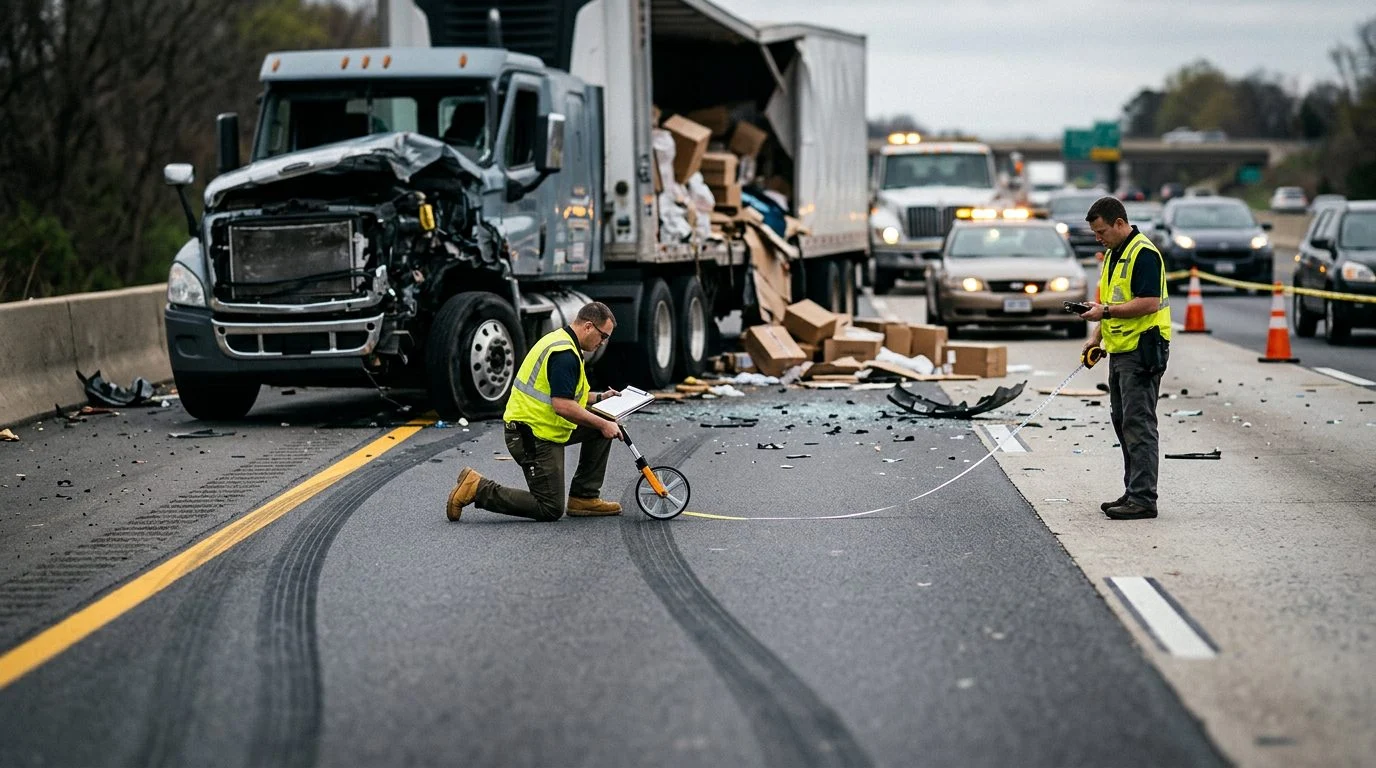
The most useful evidence usually comes from the crash scene, the truck’s records and the medical file. Some of it can disappear quickly.
- The police report, including any citations and the names of the responding officers.
- Driver duty-status records. Federal rules require a motor carrier to make each driver record duty status for each 24-hour period (49 C.F.R. § 395.8). The same section bars a false report about duty status.
- Electronic logging device data. The device automatically records items such as date, time, location, engine hours and vehicle miles (49 C.F.R. § 395.26).
- Dispatch messages, maintenance and inspection files, and the damaged truck and parts.
- Medical records from the emergency response through surgery, stump care and rehabilitation.
Electronic and vehicle records can be overwritten, repaired or thrown away if no one asks for them early. Written requests to preserve evidence protect these facts. That is why early investigation matters.
Damages an Amputation Claim May Include
An amputation claim may seek damages for medical care, prosthetic equipment, lost earning ability and the harm the injured person has suffered. Common categories include:
- Past and future medical care, such as emergency treatment, surgeries, revision surgeries, hospital stays and follow-up visits.
- Prosthetic devices and the changes they require to a home, vehicle or workplace.
- Rehabilitation, including physical and occupational therapy.
- Lost income and reduced ability to earn in the future, supported by employment records and medical opinions.
- Physical pain, emotional distress and loss of everyday abilities.
Early records often describe the injury, while later records show how daily life has changed. Each category turns on the records and medical proof in that case. No one can predict a particular amount before the medical course becomes clearer.
Virginia Deadlines and the Duty to Report the Crash
Two timing rules matter after a truck crash: the lawsuit deadline and the duty to report the crash right away.
Virginia generally allows two years from the date of injury to file a personal injury lawsuit (Va. Code § 8.01-243(A)); the clock runs from the date of injury, not the date of discovery, with narrow exceptions.
Some claims carry notice requirements that run out sooner. Those deadlines should be reviewed early.
Virginia requires a driver involved in a crash with injury or death to stop and report it to police immediately (Va. Code §§ 46.2-371, 46.2-894). The same statute (Va. Code § 46.2-894) also requires reasonable help for an injured person, including taking that person to a doctor or hospital when medical treatment is apparently necessary or is requested. The two-year period is the deadline to file a lawsuit, not the deadline to report a crash.
When an Amputation Injury Leads to a Death
When an amputation injury leads to death, a wrongful death claim may be brought by and in the name of the personal representative of the deceased person. Some amputation injuries are followed by death from later complications.
A Virginia wrongful death action is filed by the decedent’s personal representative within two years of the death (Va. Code §§ 8.01-50(C), 8.01-244(B)), on behalf of the family members the statute protects.
Virginia wrongful death damages cover the family’s sorrow, mental anguish and loss of the decedent’s companionship, guidance and care; lost income and services; medical expenses from the injury; funeral expenses; and, for willful or wanton conduct, punitive damages (Va. Code § 8.01-52).
Family members do not file the action themselves.
Partial Fault and Punitive Damages in Virginia
Virginia’s fault rule and its punitive damages rule can each change how a truck crash claim is evaluated.
Virginia follows contributory negligence: if you are found even partly at fault, you may be barred from recovering, with limited exceptions. Talk to a lawyer about your facts.
Virginia allows punitive damages for actual malice, or for willful or wanton conduct or recklessness showing a conscious disregard for the safety of others, capped at $350,000 (Va. Code § 8.01-38.1).
Not sure what your next step is?
Talk it through with Correll Law Firm — we can walk you through how a situation like yours is usually handled and what your options are.
The Claims Process, Step by Step
A typical Virginia truck accident injury claim moves from an early review to evidence work, medical documentation, and then negotiation or a lawsuit. The usual steps are:
- Initial review of the crash facts, the injuries and the medical status, and the records needed.
- Evidence preservation and investigation, including requests to the trucking company and collection of police and medical files.
- Medical documentation over time. The full scope of an amputation injury can take months to define, including prosthetic fitting and rehabilitation milestones.
- Review of responsible parties and insurance, and building the damages picture with supporting records.
- Negotiation or a lawsuit filed within Virginia’s deadlines. The timing turns on the medical course and on whether the case resolves before trial.
Readers in Richmond and Henrico County can follow the same steps. The firm serves those communities from its Winchester and Harrisonburg offices.
For more on how these matters move over time, read the Virginia truck accident case timeline.

Frequently Asked Questions
Short answers to common questions follow.
Can a rear-end crash caused by a truck driver still support a claim?
Possibly. Whether it does depends on the facts, including what the records show about how the crash happened.
Does a Virginia truck accident injury claim cover future prosthetic care?
Future prosthetic care can be part of a claim when medical records support the need for it.
Does the firm handle wrongful death claims for families?
Yes, the firm handles wrongful death matters.