
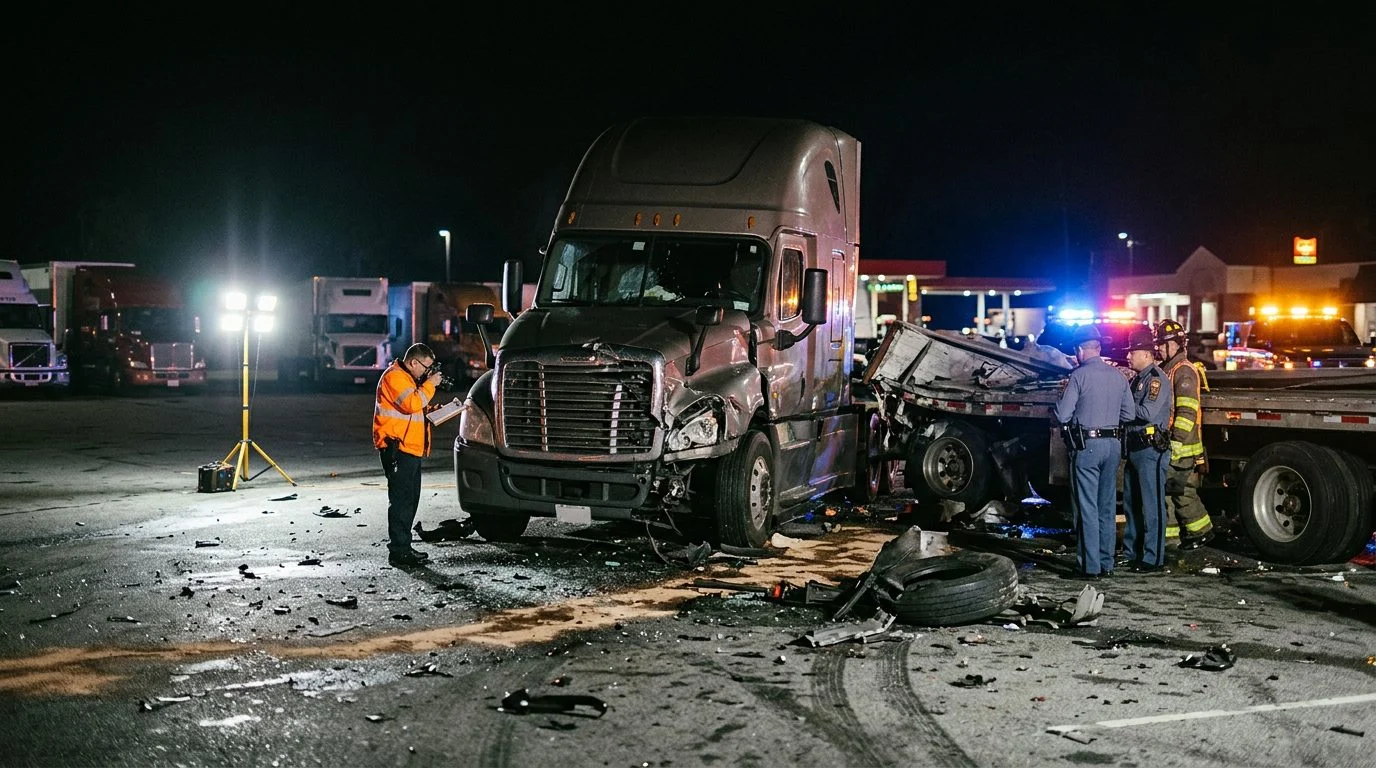
Truck Accidents | Virginia
Who Is Responsible When a Truck Crash Causes Harm?
Correll Law Firm focuses on car and commercial truck crash cases for people across the Shenandoah Valley, Richmond and Henrico County.
Published October 29, 2026
Are truck drivers responsible for damages? Often, yes, when the driver’s own negligence causes the crash. Responsibility is not automatic, though. It depends on the facts of each crash, and it can reach others besides the driver. This page explains how fault is examined in Virginia and what affects a claim.
Short Answer: Can a Truck Driver Be Held Responsible?
A truck driver can be held responsible when careless or unlawful driving causes damage or injury.
Many online threads say insurance always covers truck damage. Insurance can cover a claim, but it does not decide who was at fault. For a broader overview, read the truck accident claims overview.
If a truck crash left you or someone you love hurt, the firm offers a free case evaluation to talk through who may be responsible. Talk it through with Correll Law Firm — we can walk you through how a situation like yours is usually handled and what your options are.

What Makes a Driver Responsible for a Crash
A driver is usually responsible when that driver’s own careless choice is a proximate cause of the harm.
Common driver errors in truck crashes include:
- speeding or driving too fast for road conditions
- following too closely behind another vehicle
- changing lanes into a vehicle that is already there
- failing to yield the right of way
Distracted driving is another common problem. Phone use, eating, or using dispatch devices can pull attention from the road. Under 49 C.F.R. § 392.3, a driver may not operate a commercial motor vehicle when fatigue, illness, or another cause has so impaired, or is so likely to impair, the driver’s ability or alertness as to make it unsafe. In a case of grave emergency where compliance would increase the hazard, the driver may continue to operate the vehicle to the nearest place at which that hazard is removed.
A common mistake is to assume a rule violation settles fault. The violation still has to connect to the harm.
When the Trucking Company or Others May Share Responsibility
See Gina Chin & Assocs. v. First Union Bank.
The company’s role matters too. Decisions about routes, schedules and loads can show how much control a company had over the driver’s work. Federal rules also place duties on the motor carrier. Under 49 C.F.R. § 390.11, a motor carrier must require drivers to observe the duties and prohibitions prescribed for them in part 325 of subchapter A or in this subchapter. Each relationship is reviewed on its own facts.
Brokers and shippers can also be part of the picture. The answer for any broker or shipper turns on what that party did.
Mechanical Failure, Maintenance and Other Drivers
A truck crash can involve an equipment problem, another driver’s conduct, or both. See 49 C.F.R. § 396.11. Those written reports can show whether a known problem was reported and fixed. Brake problems are one example of a defect that may appear on these reports.
Van and bus crashes can raise similar questions. Readers can learn more about van accident claims in Virginia and bus crash claims in Virginia.
How Partial Fault Affects a Claim
Virginia follows contributory negligence: if you are found even partly at fault, you may be barred from recovering, with limited exceptions. Talk to a lawyer about your facts.
Truck crashes often lead each side to blame the other. Photos, witness statements and crash reports can all help show who did what. People often think a small share of blame is harmless. A truck driver who is hurt in a crash can face the same question.
Damages That May Be Claimed
An injured person may seek compensation for medical care, lost income, and the physical and emotional effects of the injury. Damage to a vehicle or cargo can also be part of a claim. The losses in each case depend on the injuries and the proof available.
Punitive damages are a separate question, governed by Va. Code § 8.01-38.1. Virginia allows punitive damages for actual malice, or for willful or wanton conduct or recklessness showing a conscious disregard for the safety of others, capped at $350,000 (Va. Code § 8.01-38.1).
Wrongful Death Claims
When a truck crash causes a death, the family’s claim follows a separate path. A Virginia wrongful death action is filed by the decedent’s personal representative within two years of the death (Va. Code §§ 8.01-50(C), 8.01-244(B)), on behalf of the family members the statute protects. The statute is Va. Code § 8.01-50. Family members generally do not file the case; the personal representative brings it, except that a fetal death action is brought by and in the name of the natural mother, or, if she dies or is under a disability, by the administrator of her estate, her guardian, or her personal representative qualified to bring such action. They share in the recovery.
Virginia wrongful death damages cover the family’s sorrow, mental anguish and loss of the decedent’s companionship, guidance and care; lost income and services; medical expenses from the injury; funeral expenses; and, for willful or wanton conduct, punitive damages (Va. Code § 8.01-52).
Not sure what your next step is?
Talk it through with Correll Law Firm — we can walk you through how a situation like yours is usually handled and what your options are.
Reporting the Crash and Filing Deadlines
Reporting a crash and filing a lawsuit are separate steps with separate timing. Virginia requires a driver involved in a crash with injury or death to stop and report it to police immediately (Va. Code §§ 46.2-371, 46.2-894). The driver’s notice duty appears in Va. Code § 46.2-371. The two-year period is the deadline to file a lawsuit, not to report a crash.
Virginia generally allows two years from the date of injury to file a personal injury lawsuit (Va. Code § 8.01-243(A)); the clock runs from the date of injury, not the date of discovery, with narrow exceptions. The general filing rule appears in Va. Code § 8.01-243.
Some claims carry notice requirements that run out sooner. Because the clocks differ, it may help to review the facts early.
Key Points to Keep in Mind
Are truck drivers responsible for damages? A driver can be. The driver, the employer and others are each examined on their own facts. Driver conduct, company control, equipment condition and the actions of other drivers all matter. Partial fault and filing deadlines can also shape how a claim unfolds, so the details of each crash matter.
Can a truck driver be sued personally?
Yes. A driver whose own negligence caused harm can be named in a lawsuit.
Can the trucking company be responsible for a driver’s mistake?