
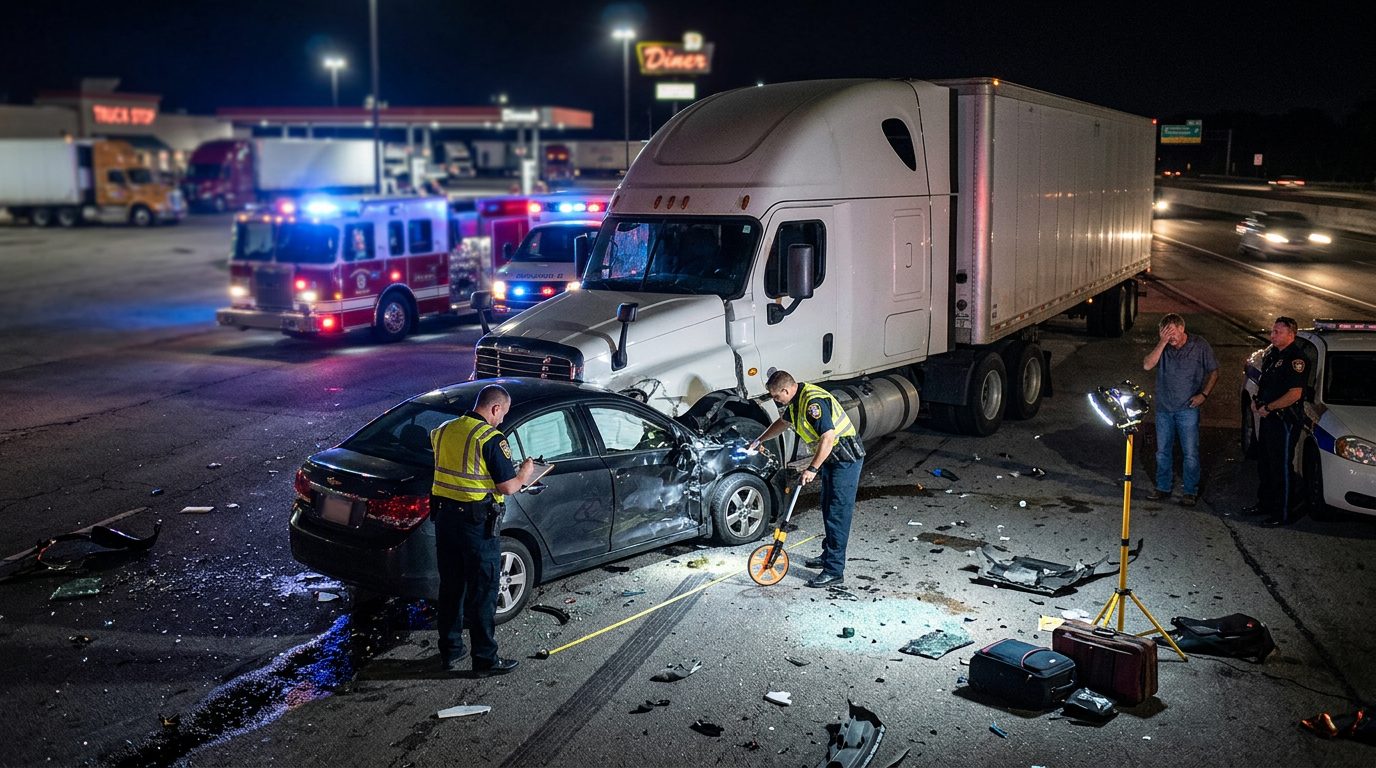
Truck Accidents | Winchester, Harrisonburg and the Shenandoah Valley
Hurt by a Commercial Truck? Learn When a Trucking Company Can Be Sued
Plain-language answers for people injured in truck crashes across the Shenandoah Valley, Richmond and Henrico County.
Where the firm works
2
Offices, in Winchester and Harrisonburg
Virginia
Serving people from the Shenandoah Valley to Richmond
Published October 23, 2026
The short answer: a lawsuit may be possible, depending on the facts
Can you sue a trucking company if their truck hits you? You may be able to, depending on what caused the crash and who was responsible for the truck that day.
A crash and a claim are different things. The crash is the event. The claim is the legal case that seeks compensation for the injuries and losses that followed.
Truck crash injuries can be serious. The Administration for Community Living describes traumatic brain injury as brain damage and lists automobile crashes among its causes.
Truck crashes often involve more parties than car crashes. A car crash may involve two drivers. A truck crash may involve a driver, one or more companies, and sometimes an outside maintenance shop or cargo loader. Each one may have had a role.
This page is one part of the firm’s wider guide to truck crash claims in Virginia. It explains who may be named, which records often matter, and the deadlines that apply.
If a commercial truck crash affected you or someone you love, you may have a claim, and the firm is ready to talk through the facts with you. Talk it through with Correll Law Firm — we can walk you through how a situation like yours is usually handled and what your options are.
Who can be named in a truck crash lawsuit
The driver, the company that employs or dispatches the driver, and the truck’s owner may all be possible defendants. Other parties whose conduct contributed may be named too, depending on the facts.
If you’re asking whether you can sue a trucking company if their truck hits you, the answer often depends on who is named. A lawsuit names the party or parties the facts support, not everyone involved.
Truck leases can matter. Under 49 C.F.R. § 376.12, a lease between an equipment owner and a carrier must state the carrier’s legal duty to keep insurance that protects the public. A lease can also show who controlled the truck.
Consider a hypothetical crash on Interstate 81 in the Shenandoah Valley. A truck rear-ends a car stopped in traffic. The truck’s brakes had been serviced days earlier by an outside shop. Both the driver and the company that serviced the brakes could be part of the claim analysis. The facts would decide who is named.
How the trucking company’s role and records can matter
Records often decide who was responsible and why the crash happened. Early requests can help keep them available.
Common records include the police crash report, driver logs, maintenance and inspection records, dispatch and route information, onboard or dashcam video, and photos of the scene and vehicles.
Driver logs are required by federal rules. Under 49 C.F.R. § 395.8, a motor carrier subject to the requirements of this part, except a private motor carrier of passengers (nonbusiness), must require each driver to record duty status for each 24-hour period. Those logs can show when the driver was driving and when the driver was on duty.
Some crashes also trigger drug and alcohol testing. Under 49 C.F.R. § 382.303, an employer must test each surviving driver for alcohol and controlled substances as soon as practicable after certain crashes. Federal rules require post-accident testing for some commercial motor vehicle crashes. For alcohol, the test applies to a driver who was performing safety-sensitive functions with respect to the vehicle if the accident involved the loss of human life, or to a driver who receives a citation within 8 hours of the occurrence for a moving traffic violation arising from the accident, if the accident involved bodily injury requiring immediate medical treatment away from the scene or a motor vehicle with disabling damage that had to be towed away. For controlled substances, the test applies to a driver who was performing safety-sensitive functions with respect to the vehicle if the accident involved the loss of human life, or to a driver who receives a citation within thirty-two hours of the occurrence for a moving traffic violation arising from the accident under the same injury or tow-away conditions (49 C.F.R. § 382.303). If an alcohol test is not given within two hours, the employer must keep a record of the reason.
Outside medical professionals and accident reconstruction analysts are often asked to explain injuries and how the crash happened. Their work is compared against records like these to see whether it fits the facts.
Virginia deadlines and the duty to report a crash
Timing matters in every truck crash claim. Two rules stand out.
Virginia generally allows two years from the date of injury to file a personal injury lawsuit (Va. Code § 8.01-243(A)); the clock runs from the date of injury, not the date of discovery, with narrow exceptions. The statute text is at Va. Code § 8.01-243.
Some claims carry notice requirements that run out sooner than the filing deadline. Whether a deadline applies, and when it starts, depends on the facts of each crash.
Virginia requires a driver involved in a crash with injury or death to stop and report it to police immediately (Va. Code §§ 46.2-371, 46.2-894). The statute text is at Va. Code § 46.2-371.
Keep a written record of your injuries, treatment, missed work, and what you saw at the scene. Photos taken safely at the scene can help.
When fault for a crash is disputed
Fault is often disputed in truck crashes. Each side may point to another driver, the road, the weather, or the truck’s condition.
The records described above are often used to test each party’s role.
Picture a tired driver and a dispatch schedule that left little room for rest. Both could be linked to the same crash, and the driver logs would help show how the hours fit together.

When a truck crash is fatal: wrongful death claims
A family may have a claim when a truck crash causes a death. Under Va. Code § 8.01-50, a person whose wrongful act causes a death can be liable for damages even though the injured person died.
A Virginia wrongful death action is filed by the decedent’s personal representative within two years of the death (Va. Code §§ 8.01-50(C), 8.01-244(B)), on behalf of the family members the statute protects.
Virginia wrongful death damages cover the family’s sorrow, mental anguish and loss of the decedent’s companionship, guidance and care; lost income and services; medical expenses from the injury; funeral expenses; and, for willful or wanton conduct, punitive damages (Va. Code § 8.01-52). The statute is at Va. Code § 8.01-52.
Punitive damages are available in Virginia only if the jury finds that the defendant’s conduct met the standard of actual malice, or of willful or wanton conduct or recklessness showing a conscious disregard for the safety of others. Any total punitive award against all defendants found liable is capped at $350,000, and the jury is not told of that limit (Va. Code § 8.01-38.1).
Crashes that strike people on foot raise similar questions. The firm’s pedestrian and cyclist page covers those crashes.
Common questions
Can you sue a trucking company if their truck hits you?
You may be able to, if the facts show the company or its driver was responsible.
The lawsuit deadline runs on its own schedule.
What records should you look at first?
The police crash report and any photos or video are often the first records to review.