
Truck Accidents in Virginia
Who Is Responsible After a Truck Accident in Virginia?
Several parties may share a role in a commercial crash. Here is how to think through the questions that come up after a serious collision.
Published November 9, 2026
After a crash with a big rig, many people ask about truck accident liability and who can be held responsible. The short answer is that more than one party may be involved, including the driver, the trucking company, and others tied to the truck or the trip. Who is actually at fault turns on what the evidence shows.
Crashes on Virginia interstates are rarely simple. Each of those links can matter after a crash.
Why Truck Crashes on Interstates Often Involve More Than One Party
A crash with a commercial truck rarely comes down to one person’s mistake. Interstates carry heavy traffic at high speed, and several vehicles can be involved in seconds. A truck may also travel a long route before the collision, passing through the hands of several companies.
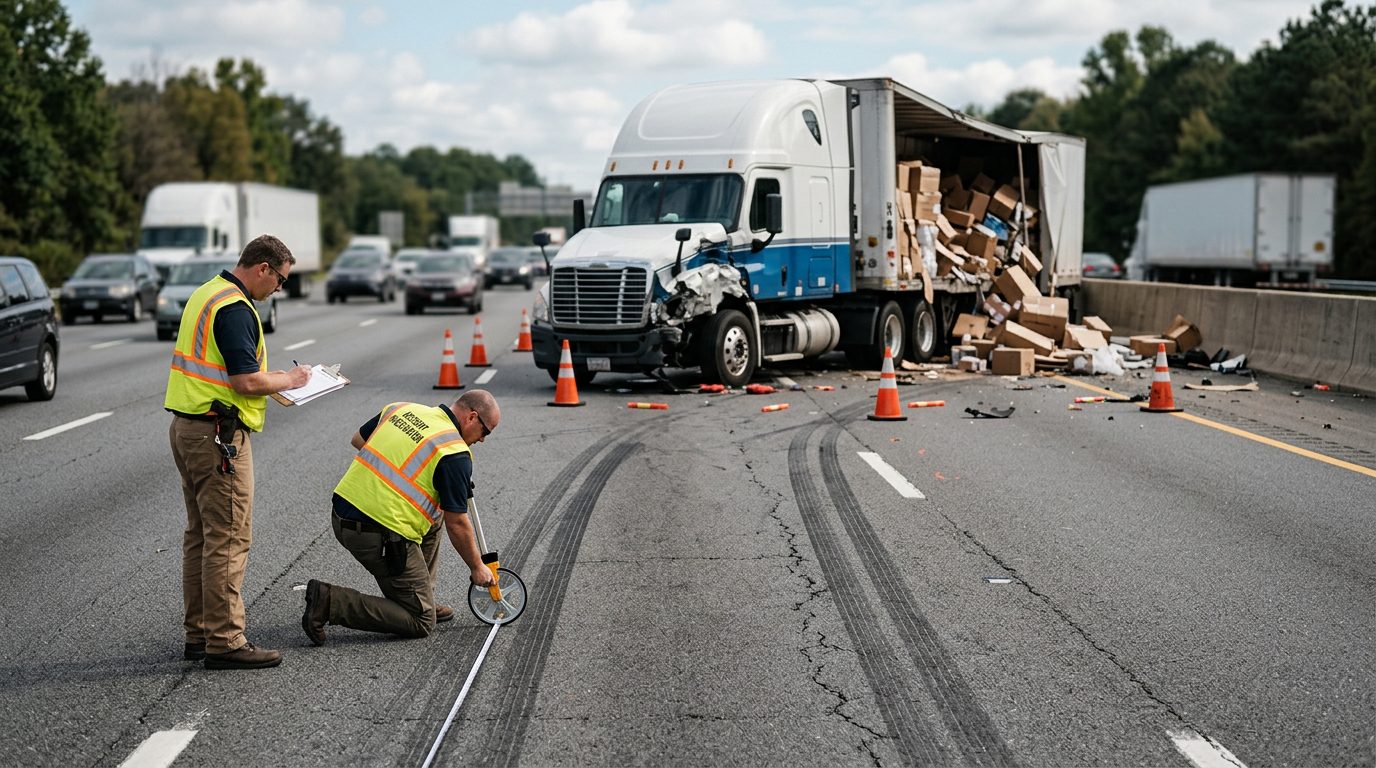
That is why investigators look past the moment of impact. They study the scene, including skid marks, debris and where each vehicle came to rest. They also study paperwork that shows who drove the truck, where it had been, and how it was kept up. No single record settles fault, but together they show how the crash happened.
For the wider picture of these claims, read the truck accident claims overview.
If a truck crash on I-64 left you or someone you love hurt, you may have a claim worth discussing, and you do not have to sort it out alone. Talk it through with Correll Law Firm — we can walk you through how a situation like yours is usually handled and what your options are.

Who Can Be Held Responsible for a Truck Accident on I-64?
Several parties may be responsible, including the truck driver, the company that operates the truck, and the truck’s owner when it is a different business. Whether any of them is responsible depends on the facts of the crash and the governing law.
People often ask about these parties:
- The truck driver
- The trucking company or carrier that operates the truck
- The owner of the truck or trailer, such as a leasing company
- Companies tied to maintenance, repairs, loading or securing cargo
- Other motorists whose actions helped cause the crash
This list shows who may be involved in a claim. It does not decide who is at fault. Some trucks cross several states before a crash on I-64, so the list can grow as facts come in.
The Truck Driver
The truck driver is the person behind the wheel, so the driver’s choices often come first in an investigation. The driver manages speed, following distance, lane position and road conditions. A posted limit is a maximum, and a safe speed can be lower when traffic or weather calls for it.
Virginia requires a driver involved in a crash with injury or death to stop and report it to police immediately (Va. Code §§ 46.2-371, 46.2-894). The statutes are at Va. Code § 46.2-371 and Va. Code § 46.2-894.
Federal rules add another layer. Except for a private motor carrier of passengers (nonbusiness), a motor carrier must require each driver to record duty status for each 24-hour period, and the record must show the carrier’s name (49 C.F.R. § 395.8). These logs show the driver’s work history over the trip. Investigators also weigh the police report, witness accounts and any camera footage. A driver’s conduct is one part of the picture, not the whole of it.
Which Companies Connected to the Truck May Share Responsibility?
The trucking company, the truck’s owner and any business that maintained or loaded the truck may all be possible parties. Each one’s role depends on facts that the evidence must establish.
Ownership and operation can differ. A truck may be leased, so the owner may be a leasing company while another business runs it. The contracts and records between them can matter.
Maintenance records matter too. Federal rules require a motor carrier to keep inspection, repair and maintenance records for each vehicle it controls, where the vehicle is housed or maintained for 1 year, and for 6 months after the vehicle leaves the carrier’s control (49 C.F.R. § 396.3). The rules cover parts such as wheels, suspension and steering, so those records can show what work was done and when.
Brokers can also be part of the picture. Equipment defects are examined only when the evidence points to one.
Can Other Drivers Be Held Responsible in a Truck Crash?
Yes. Another driver can share responsibility when that driver’s own actions helped cause the crash.
For illustration, picture a car that cuts into a lane just ahead of a truck and brakes hard. The truck may have no room to stop. The car driver’s move and the truck driver’s response may both matter, and the investigation has to separate them.
Multi-vehicle crashes on interstates often have several drivers whose movements contributed. Scene measurements, witness statements and the police report help show the order of events for each vehicle. Each driver’s path, speed and timing can change the picture.
What Happens If a Driver Is Not Responsible?
Virginia follows contributory negligence: if you are found even partly at fault, you may be barred from recovering, with limited exceptions. Talk to a lawyer about your facts.
Court decisions explain how that plays out.
Not sure what your next step is?
Talk it through with Correll Law Firm — we can walk you through how a situation like yours is usually handled and what your options are.
When Conduct Goes Beyond Ordinary Negligence
Virginia allows punitive damages for actual malice, or for willful or wanton conduct or recklessness showing a conscious disregard for the safety of others, capped at $350,000 (Va. Code § 8.01-38.1). The cap is in Va. Code § 8.01-38.1, and the jury is not told about it.
For illustration only, picture a driver who keeps driving after knowing that their ability to drive safely is impaired. A slow reaction to traffic is a different matter. The jury must find that the conduct met this standard before punitive damages are available.
How Time Limits Affect Who Can Pursue a Claim
Virginia generally allows two years from the date of injury to file a personal injury lawsuit (Va. Code § 8.01-243(A)); the clock runs from the date of injury, not the date of discovery, with narrow exceptions. The statute is at Va. Code § 8.01-243.
Some claims carry shorter notice rules. Don’t assume the two-year period applies to every claim.
It is not the deadline to report a crash, which must happen immediately.
Frequently Asked Questions
Can more than one party be responsible for a truck accident?
Yes. “The proximate cause of an event is that act or omission which, in natural and continuous sequence, unbroken by an efficient intervening cause, produces that event, and without which that event would not have occurred” (Ford Motor Co. v. Boomer).
Can a trucking company answer for its driver?
That question turns on the relationship between the driver and the company, and on how Virginia law applies to those facts.
What records can show who is responsible in a truck crash?
Duty-status logs, maintenance and repair records, and the police report are common starting points.