
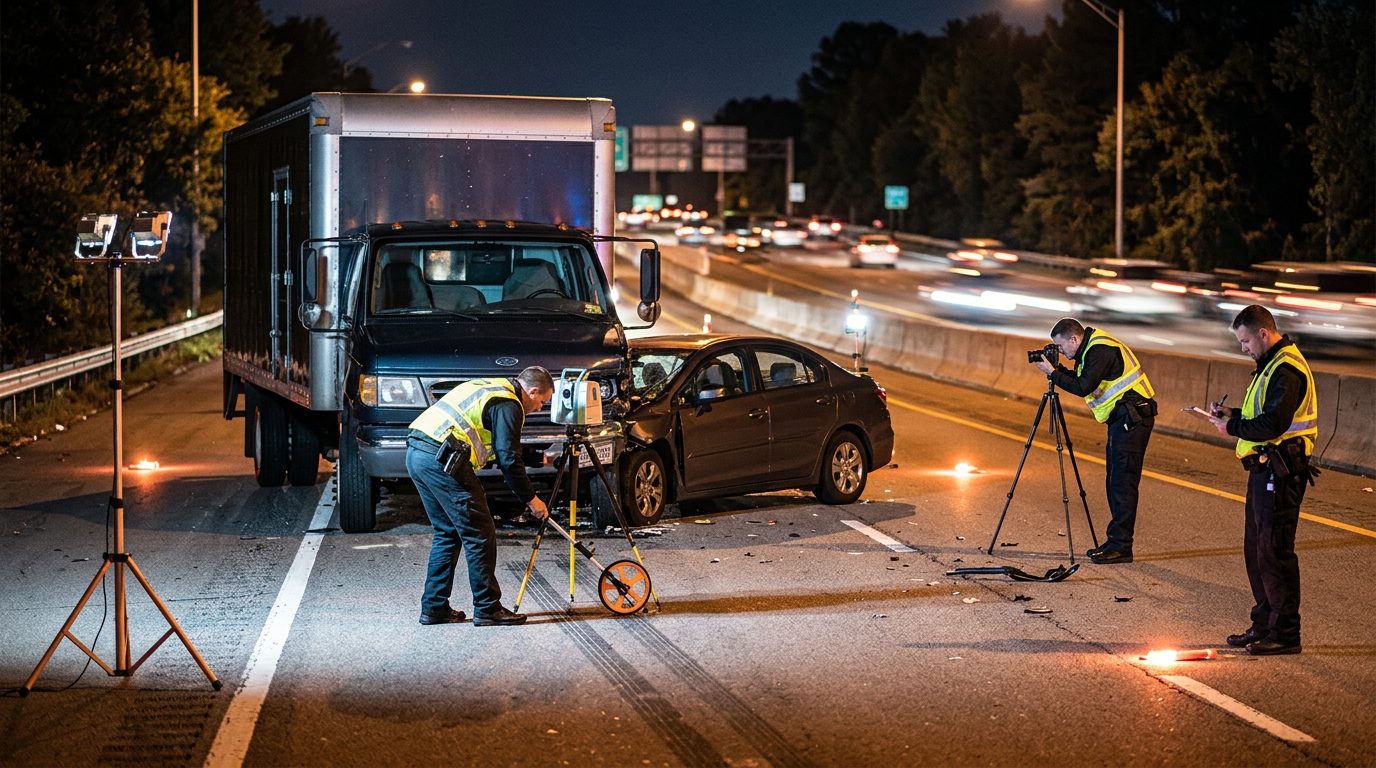
When a Death Is Caused by Someone Else, Your Family Deserves Clear Answers
Correll Law Firm helps families across the Shenandoah Valley, Richmond and Henrico County understand wrongful death claims after car and commercial truck crashes.
Published October 21, 2026
Wrongful Death Front Royal: A Family Guide
For families in the Shenandoah Valley, that loss can follow a car or truck crash on a local road or highway. This guide explains who can bring these claims in Virginia, what they can cover, and how the process often unfolds. Correll Law Firm handles wrongful death matters and serves families in the Shenandoah Valley.
Not sure what your next step is?
Talk it through with Correll Law Firm — we can walk you through how a situation like yours is usually handled and what your options are.

What Is a Wrongful Death Claim?
A wrongful death claim asks a court for money to make up for a family’s losses after a death. Under Virginia law, if a death is caused by a wrongful act, neglect or default, the party who would have been liable had the injured person lived can be sued (Va. Code § 8.01-50). That can include a driver whose negligence caused a crash, and a company responsible for that driver.
Causation is central.
A wrongful death case is a civil matter. It is separate from any criminal charge against the driver.
Who Can File a Wrongful Death Claim in Virginia?
In Virginia, the decedent’s personal representative brings the claim for the family. The law puts it this way:
A Virginia wrongful death action is filed by the decedent’s personal representative within two years of the death (Va. Code §§ 8.01-50(C), 8.01-244(B)), on behalf of the family members the statute protects.
Family members do not file the case themselves. They share in the recovery. The statute that sets the order of sharing is Va. Code § 8.01-53. A surviving spouse and children come first. If none of those survive, the award goes to parents, brothers and sisters, and certain relatives who depended on the decedent and lived in the same household. Va. Code § 8.01-53 reads: “only if there is a surviving spouse, children of the deceased, or children of any deceased child of the deceased, the parents of the decedent if any of such parents, within 12 months prior to the decedent’s death, regularly received support or regularly received services from the decedent for necessaries, including living expenses, food, shelter, health care expenses, or in-home assistance or care, or (ii) if there is no surviving spouse, children of the deceased, or children of any deceased child of the deceased, then to the parents, brothers and sisters of the deceased, and to any other relative who is primarily dependent on the decedent for support or services and is also a member of the.”
Wrongful Death in Car and Truck Accidents
A wrongful death claim can follow a crash involving a passenger car, a pickup or a commercial truck. These crashes can happen on neighborhood streets and busy highways alike.
Negligence in these crashes often involves speeding, distracted or impaired driving, running a red light, or driving a vehicle that is not kept in safe condition. Picture a driver glancing at a phone and drifting into oncoming traffic. Facts like that help show how the death happened.
Commercial trucks add more layers. Federal rules require a motor carrier to systematically inspect, repair and maintain its vehicles, with parts in safe and proper operating condition at all times (49 C.F.R. § 396.3). Motor carriers, except for a private motor carrier of passengers (nonbusiness), must keep these records: they must be retained where the vehicle is either housed or maintained for a period of 1 year and for 6 months after the motor vehicle leaves the motor carrier’s control (49 C.F.R. § 396.3).
What Losses Can a Wrongful Death Claim Address?
Virginia wrongful death damages cover the losses a family suffers. The law describes them this way:
Virginia wrongful death damages cover the family’s sorrow, mental anguish and loss of the decedent’s companionship, guidance and care; lost income and services; medical expenses from the injury; funeral expenses; and, for willful or wanton conduct, punitive damages (Va. Code § 8.01-52).
The statute lists these items in Va. Code § 8.01-52. Virginia’s survival statute, Va. Code § 8.01-25, provides that causes of action survive death, and a wrongful death action under Va. Code § 8.01-50 is a separate action. What a family can recover depends on each death’s circumstances and on the family’s relationship to the decedent.
What Shapes the Outcome of a Wrongful Death Claim?
The outcome depends on the evidence, how the death happened, and how Virginia law applies to those facts. Families must show that the defendant’s conduct was a proximate cause of the death. Useful evidence often includes the police crash report, witness statements, medical records, inspection and maintenance records for a truck, and accident reconstruction analysis.
Punitive damages are a separate question. Virginia allows punitive damages for willful or wanton conduct, or for recklessness that shows a conscious disregard for the safety of others. The jury must find that the conduct met this standard (Va. Code § 8.01-52). Virginia allows punitive damages for actual malice, or for willful or wanton conduct or recklessness showing a conscious disregard for the safety of others, capped at $350,000 (Va. Code § 8.01-38.1).
In a motor vehicle death, Va. Code § 8.01-44.5 lets the fact-finder, in its discretion, award punitive damages if the evidence proves the defendant acted with malice or with conduct so willful or wanton as to show a conscious disregard for the rights of others. It also says that when a defendant has unreasonably refused to submit to a blood alcohol content test, the defendant’s conduct is deemed willful or wanton if the evidence proves the defendant was intoxicated when the incident occurred, knew or should have known that his ability to drive was impaired, and that intoxication was a proximate cause of the injury or death (Va. Code § 8.01-44.5).
Not sure what your next step is?
Talk it through with Correll Law Firm — we can walk you through how a situation like yours is usually handled and what your options are.
Families Across the Shenandoah Valley
The firm’s practice areas include car accidents, truck accidents, commercial vehicle accidents, catastrophic injuries, traumatic brain injury, spinal cord injury and wrongful death.
Families dealing with a wrongful death often start with one question: how did the crash happen? The firm focuses on the crash facts, the records and the legal steps that follow. It also serves families from the Shenandoah Valley to Richmond and Henrico County.
What to Do After a Wrongful Death
Early steps protect evidence and help a family answer questions later. Consider keeping these items together:
- Photos of the scene, vehicle damage, road conditions and weather.
- The police crash report, requested from the agency that responded. The Virginia DMV crash page explains how crash records are handled.
- Medical records and the death certificate.
- Records of the decedent’s job, income and role in the household.
Insurance adjusters may ask for a recorded statement soon after a death. You may wish to talk with a lawyer before giving one.
Virginia requires a driver involved in a crash with injury or death to stop and report it to police immediately (Va. Code §§ 46.2-371, 46.2-894).
The Wrongful Death Process in Virginia
A wrongful death case often moves through investigation, a claim to the insurer, negotiation and, if needed, a lawsuit. Investigation comes first. Investigators gather crash evidence, interview witnesses and collect records. Next, the claim goes to the at-fault party’s insurance company, and the sides may negotiate. If no fair resolution is reached, a lawsuit can be filed within the time limit.
Any settlement needs court approval. A personal representative may compromise a wrongful death claim before or after a lawsuit is filed, with the approval of the court where the action was brought, or with the consent of a circuit court if no action was brought (Va. Code § 8.01-55). The process can take many months.
What Decides the Value of a Wrongful Death Claim?
No fixed amount applies to every family. Value is shaped by the decedent’s age, earnings and work history, the family members who depended on them, and how the death happened. These details shape what a family can recover under the damage categories described above.
When an award is made, the jury or court sets how it is split. If the jury does not specify the split, the court does, under Va. Code § 8.01-54. A specific dollar figure offered before the evidence is reviewed deserves caution.

Next Steps for Families
A family that lost a loved one in a car or truck crash may have legal rights worth reviewing. The questions below cover common points.
Who can file a wrongful death lawsuit in Virginia?
The decedent’s personal representative files it on behalf of the family members the statute protects. Family members share in the recovery.
How long does a family have to file?
Virginia requires a wrongful death action within two years of the death, under Va. Code § 8.01-244.
Can more than one party be sued?
Yes.
Does a wrongful death settlement need court approval?
Yes. Under Va. Code § 8.01-55, the personal representative’s compromise requires court approval.