
Truck Accident Wrongful Death | Virginia
Losing a loved one in a truck crash? Understand your family's options in Virginia.
Correll Law Firm helps Virginia families through the wrongful death claim that can follow a commercial truck crash, from the Shenandoah Valley to Richmond and Henrico County.
Where the firm works
Virginia
Serving families from the Shenandoah Valley to Richmond
Published October 29, 2026
A Virginia wrongful death claim after a truck crash is filed by the personal representative of the person who died, not by each family member. This page explains who that representative is, who may be named in a truck case, how the deadline works, and what a family may seek. The rules below are general. Each crash turns on its own facts.
Who Can File a Wrongful Death Claim in Virginia
The personal representative files the claim, and family members share in what is recovered. A Virginia wrongful death action is filed by the decedent’s personal representative within two years of the death (Va. Code §§ 8.01-50(C), 8.01-244(B)), on behalf of the family members the statute protects.
A personal representative is the person legally in charge of the estate of the person who died. Families often ask who that is first. The answer comes from the estate’s paperwork, so it is worth confirming early.
Virginia law sets out who shares in the award, starting with the surviving spouse and children, and it allows parents and certain other relatives to share in some situations (Va. Code § 8.01-53).
Not sure what your next step is?
Talk it through with Correll Law Firm — we can walk you through how a situation like yours is usually handled and what your options are.
Who a Truck Accident Wrongful Death Claim May Be Brought Against
A claim may be brought against each party whose negligence helped cause the crash. In a commercial truck crash, that list is often longer than in a car crash.
A truck trip can involve the driver, the company that operated the truck, and others tied to the load or the trip. Whether each one played a role is a question for the facts of the crash.
Identifying every involved party early helps the personal representative understand who may be responsible. Crash reports, company records and witness statements are common places to start.
In a hypothetical situation, a family might learn that a driver had been on the road for a very long shift. They might also learn that the trucking company set the schedule. Each fact would need careful review.
Virginia’s Two-Year Deadline and Crash Reporting
The lawsuit clock starts at the death, not at the crash. Virginia’s statute requires the action to be brought “within two years after the death of the injured person” (Va. Code § 8.01-244).
Some claims carry notice requirements that run out sooner.
Crash reporting is a separate duty. Virginia requires a driver involved in a crash with injury or death to stop and report it to police immediately (Va. Code §§ 46.2-371, 46.2-894). A willful failure to make the report under § 46.2-371 is a Class 4 misdemeanor.
Reporting a crash and filing a lawsuit are different steps. A Virginia wrongful death action is filed by the decedent’s personal representative within two years of the death (Va. Code §§ 8.01-50(C), 8.01-244(B)), on behalf of the family members the statute protects. That two-year period is the deadline to file a lawsuit, not to report a crash (Va. Code § 8.01-243).
What a Virginia Wrongful Death Claim Can Recover
Virginia wrongful death damages cover the family’s sorrow, mental anguish and loss of the decedent’s companionship, guidance and care; lost income and services; medical expenses from the injury; funeral expenses; and, for willful or wanton conduct, punitive damages (Va. Code § 8.01-52).
In plain terms, the losses include the person’s presence and guidance in the family’s life, the income and household help they provided, and the medical bills tied to the injury. For example, a hypothetical parent who managed the household budget and helped with childcare would leave gaps that money alone does not measure.
In a wrongful death case, the jury, or the judge in a bench trial, must specifically state any punitive damages it awards for willful or wanton conduct or recklessness showing a conscious disregard for the safety of others. Virginia allows punitive damages for actual malice, or for willful or wanton conduct or recklessness showing a conscious disregard for the safety of others, capped at $350,000 (Va. Code § 8.01-38.1).
The injured person’s own claim is different.

Evidence Families Should Preserve After a Truck Crash
Families should keep records that show what happened and what the loss was. Useful items include:
- The crash report from the State Police or local law enforcement.
- Photos and video of the scene, the vehicles and any damage.
- Names and contact details for witnesses.
- Medical, hospital and treatment records.
- Wage records, tax returns and proof of household help the person provided.
- Funeral and burial receipts.
Truck records matter too. 49 C.F.R. § 395.8(a)(1) provides: “Except for a private motor carrier of passengers (nonbusiness), as defined in § 390.5 of this subchapter, a motor carrier subject to the requirements of this part must require each driver used by the motor carrier to record the driver’s duty status for each 24-hour period using the method prescribed in paragraphs (a)(1)(i) through (iii) of this section, as applicable.” The motor carrier, intermodal equipment provider, or other entity responsible for the inspection must also keep periodic inspection reports for fourteen months from the report date, where the vehicle is housed or maintained. If the carrier did not perform the last annual inspection, it must get the original or a copy of the report when an authorized Federal, State, or local official demands it (49 C.F.R. § 396.21). Because that window is limited, families may want to ask for those records early.
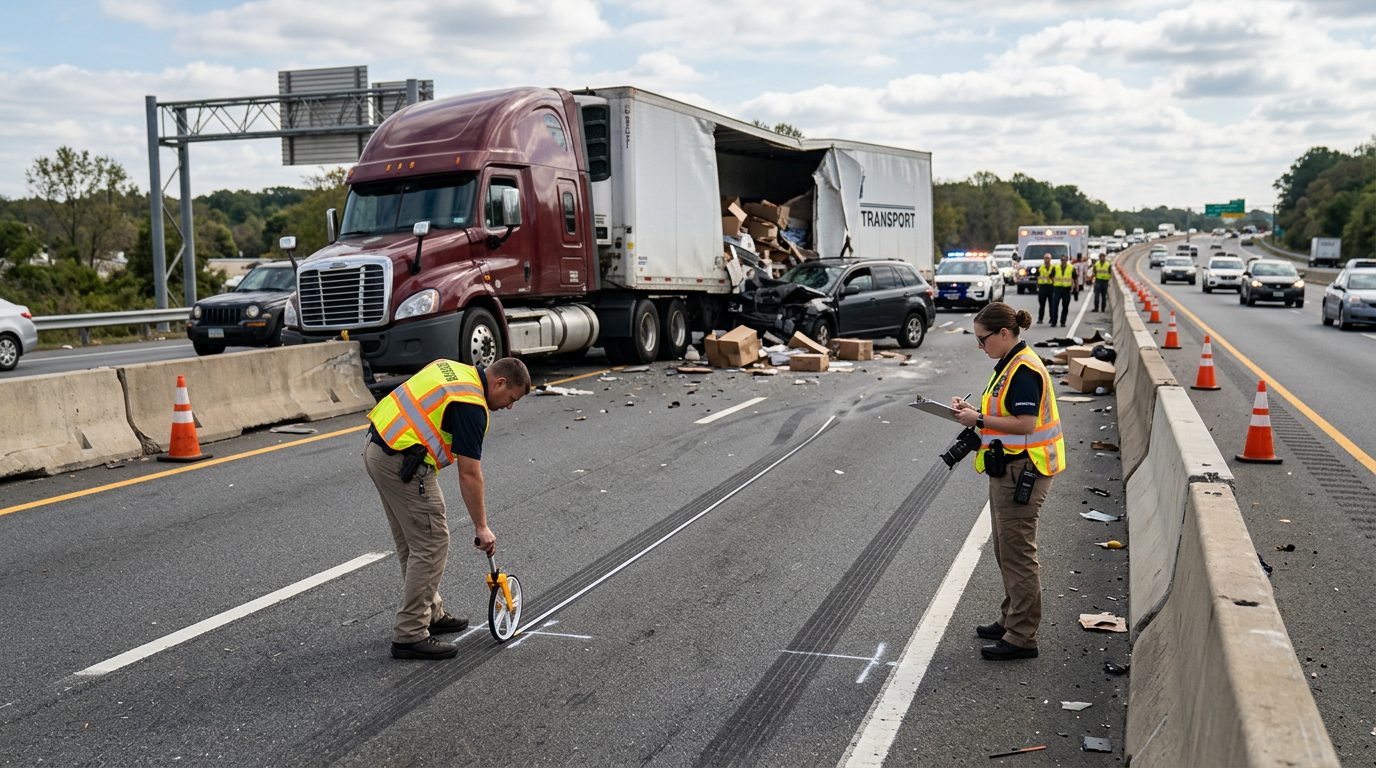
Some cases also involve accident reconstruction professionals, who study how a crash happened, and medical professionals who explain injuries to a court.
How a Wrongful Death Claim Typically Moves Forward
A wrongful death claim usually moves through a series of steps, beginning with who can act for the estate. Timing varies from case to case.
- Confirm the personal representative and whether the estate is open.
- Gather crash, medical, wage and funeral records.
- Identify every party who may share responsibility.
- Look into the truck, its maintenance and the carrier’s records.
- Review the losses the law allows the family to seek.
- File the lawsuit within the two-year period.
Each step builds on the one before it. Missing records early can make later steps harder, which is why the first two steps often move fastest.
Not sure what your next step is?
Talk it through with Correll Law Firm — we can walk you through how a situation like yours is usually handled and what your options are.
Common Questions About Filing a Wrongful Death Claim in Virginia
Can a family member file the claim alone?
No. The personal representative files it on behalf of the family members the statute protects.
What if the person who died was partly at fault for the crash?
Virginia follows contributory negligence: if you are found even partly at fault, you may be barred from recovering, with limited exceptions. Talk to a lawyer about your facts.
Does a truck crash claim have a different deadline than a car crash claim?
The two-year wrongful death period applies to both types of crash. Reporting the crash is a separate duty.
Where Correll Law Firm Handles These Cases
Correll Law Firm has an office in Winchester and an office in Harrisonburg, Virginia. The firm serves families from the Shenandoah Valley, Richmond and Henrico County.
The firm handles car accidents, truck accidents, commercial vehicle accidents, catastrophic injuries, traumatic brain injury, spinal cord injury and wrongful death. The firm has support staff, including assistants and office staff, who work on case files and scheduling.