
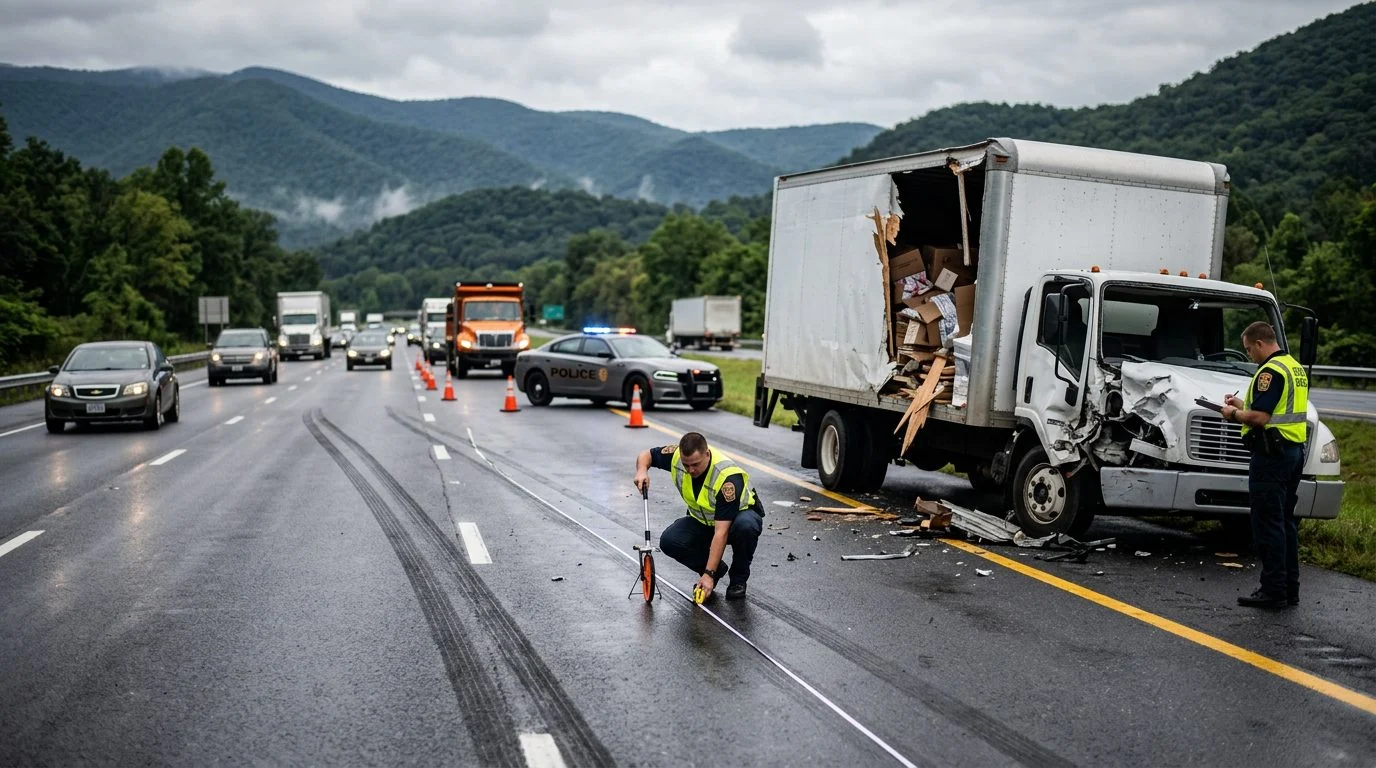
Box Truck Accidents | Shenandoah Valley
Hurt in a Box Truck Crash? Correll Law Firm Helps Shenandoah Valley Families Understand Their Options
Published October 30, 2026
If you need a box truck accident lawyer in the Shenandoah Valley, this page explains what these claims involve. Box trucks look smaller than tractor-trailers, but their crashes can still cause serious injuries. Correll Law Firm handles these claims for people across the Shenandoah Valley and Virginia. You’ll find the Virginia rules that may apply, the evidence that matters, and how a claim usually moves forward.
What a Box Truck Accident Lawyer Handles
A box truck accident lawyer handles injury and wrongful death claims that arise from crashes involving these trucks.
A box truck is a straight truck. Its cab and enclosed cargo box sit on one frame. Businesses use them for deliveries, moving jobs, and local and regional freight. A large, heavy box can cause severe harm when it hits a car, motorcycle, bicycle, or person on foot.
The firm represents:
- Drivers and passengers hurt in cars or other vehicles
- Pedestrians and cyclists struck by a truck
- Families of people killed in a crash
The firm’s work covers car accidents, truck accidents, commercial vehicle accidents, catastrophic injuries, traumatic brain injury, spinal cord injury, and wrongful death. The firm is based in Winchester, with a second location in Harrisonburg. It serves people from the northern Shenandoah Valley, the wider Shenandoah Valley, Richmond and Henrico County, and across Virginia.
If a box truck crash left you or someone you love hurt, you may have a claim, and the firm is glad to talk through your facts. Talk it through with Correll Law Firm — we can walk you through how a situation like yours is usually handled and what your options are.

Box Trucks and the Rules That May Apply
Federal and Virginia rules for commercial vehicles can apply to a box truck, depending on the facts.
Box trucks vary widely. A smaller truck and a large straight truck can fall under different rules. The truck’s weight, its cargo, and how it is used all matter. A local delivery route, a moving job, and interstate hauling can each bring different records into play.
Under 49 C.F.R. § 395.8, a motor carrier subject to the requirements of this part must require each driver to record the driver’s duty status for each 24-hour period, except for a private motor carrier of passengers (nonbusiness). Carriers operating commercial motor vehicles must use electronic logging devices, subject to some exceptions (49 C.F.R. § 395.8).
Virginia requires a driver involved in a crash with injury or death to stop and report it to police immediately (Va. Code §§ 46.2-371, 46.2-894). That reporting duty is separate from the deadline to file a lawsuit.
Common Causes and Injuries in Box Truck Crashes
Box truck crashes often come from driver fatigue, distraction, blind spots, and maintenance problems.
Common causes include:
- Tight delivery schedules that lead to driver fatigue
- Distraction, such as phone use or a missed turn
- Wide turns, lane changes, and blind spots
- Backing maneuvers in tight spaces
- Cargo that shifts or is not secured
- Worn brakes, tires, or lights
The injuries the firm handles include traumatic brain injury, spinal cord injury, broken bones, internal injuries, and crush injuries. Some injuries show up days or weeks after a crash. An early medical evaluation creates the record a claim relies on.
Picture a box truck turning right at an intersection while a car sits in its blind spot. The driver may never have seen the car. Facts like this are why witness accounts and onboard video can matter.
Medical questions are best answered by treating providers.
Who May Be Responsible and What Evidence Matters
More than one party can be connected to a box truck crash, and key evidence can be lost over time.
A claim may look at the driver, the company that operates or dispatches the truck, the vehicle owner or leasing company, cargo loaders, and maintenance contractors.
Useful evidence often includes:
- The police report and photos of the scene and vehicles
- Witness names and how to reach them
- Dashcam or other onboard video
- Electronic logs and driver hours records
- Maintenance and inspection records
- Driver qualification files
Federal rules require employers to test surviving drivers for alcohol and controlled substances as soon as practicable after certain crashes. If an alcohol test is not given within two hours, the employer must keep a record of the reasons. Company records can be lost or overwritten, so early requests matter.
Damages and Deadlines in Virginia
Virginia sets a filing deadline for injury claims and specific rules for wrongful death.
Virginia generally allows two years from the date of injury to file a personal injury lawsuit (Va. Code § 8.01-243(A)); the clock runs from the date of injury, not the date of discovery, with narrow exceptions. Some claims carry notice requirements that run out sooner.
For an injured person, a claim may seek compensation for medical bills, lost income, and other losses the injury causes.
Virginia wrongful death damages cover the family’s sorrow, mental anguish and loss of the decedent’s companionship, guidance and care; lost income and services; medical expenses from the injury; funeral expenses; and, for willful or wanton conduct, punitive damages (Va. Code § 8.01-52). Under Va. Code § 8.01-53, the damages go to a class of beneficiaries, starting with the surviving spouse and children of the deceased. Va. Code § 8.01-53 reads: “only if there is a surviving spouse, children of the deceased, or children of any deceased child of the deceased, the parents of the decedent if any of such parents, within 12 months prior to the decedent’s death, regularly received support or regularly received services from the decedent for necessaries, including living expenses, food, shelter, health care expenses, or in-home assistance or care, or (ii) if there is no surviving spouse, children of the deceased, or children of any deceased child of the deceased, then to the parents, brothers and sisters of the deceased, and to any other relative who is primarily dependent on the decedent for support or services and is also a member of the same household as the decedent.” The section goes on to say that if the decedent left a surviving spouse and a parent or parents but no child or grandchild, the award goes to the spouse and those parents. If there are survivors in the first group or in that spouse-and-parents group, any other relative who is primarily dependent on the decedent and lives in the same household also shares.
A Virginia wrongful death action is filed by the decedent’s personal representative within two years of the death (Va. Code §§ 8.01-50(C), 8.01-244(B)), on behalf of the family members the statute protects. For wrongful death actions under subsection A, the family does not file the case: it is brought by and in the name of the personal representative of the deceased person (Va. Code § 8.01-50(C)).
Virginia allows punitive damages for actual malice, or for willful or wanton conduct or recklessness showing a conscious disregard for the safety of others, capped at $350,000 (Va. Code § 8.01-38.1). The cap is set out in Va. Code § 8.01-38.1.
How a Claim Typically Moves Forward
A claim usually moves from an initial conversation to investigation, medical records, insurance talks, and, if needed, a lawsuit.
- Initial conversation. You describe the crash, your injuries, your treatment, and any papers you hold.
- Investigation. The firm gathers the police report, video, and company records. It may work with accident reconstruction professionals when the facts call for it.
- Medical documentation. Records from treating providers show the injuries and how they have progressed.
- Demand and negotiation. The firm presents the claim to insurers and reviews their responses.
- Lawsuit, if needed. If a resolution is not reached, a lawsuit may be filed in a Virginia court.
How long each step takes varies from claim to claim. Not every claim goes to trial.
Not sure what your next step is?
Talk it through with Correll Law Firm — we can walk you through how a situation like yours is usually handled and what your options are.
Why the Firm Handles These Cases
Correll Law Firm focuses on personal injury matters for people seriously hurt in car and commercial truck crashes, catastrophic brain and spinal cord injuries, and wrongful death.
Box truck crashes in the Shenandoah Valley are handled by the firm from its Winchester and Harrisonburg locations. The firm’s work also reaches people in Richmond, Henrico County, and across Virginia.
Box truck cases often involve several companies, many records, and firm deadlines. The firm’s support staff, including assistants and office staff, help manage that paperwork.

Questions About Box Truck Accident Claims
Most box truck questions come down to who was involved, what records exist, and when a lawsuit must be filed.
Is a box truck crash handled differently from a semi-truck crash?
Vehicle size and use can change which rules and records apply. Questions about fault, injuries, and damages follow the same basic path.
What should I do right after a box truck crash?
Get medical care, report the crash to police, and write down what you remember. Keep photos and records of medical bills and missed work.
Do I have to hire a lawyer?
You may wish to speak with a lawyer about your situation. Whether to do so is your choice.
What if the driver says I caused the crash?
A driver’s statement is one piece of evidence. Police reports, video, and company records also matter.
Can I still have a claim if I was partly at fault?
Virginia follows contributory negligence: if you are found even partly at fault, you may be barred from recovering, with limited exceptions. Talk to a lawyer about your facts.