
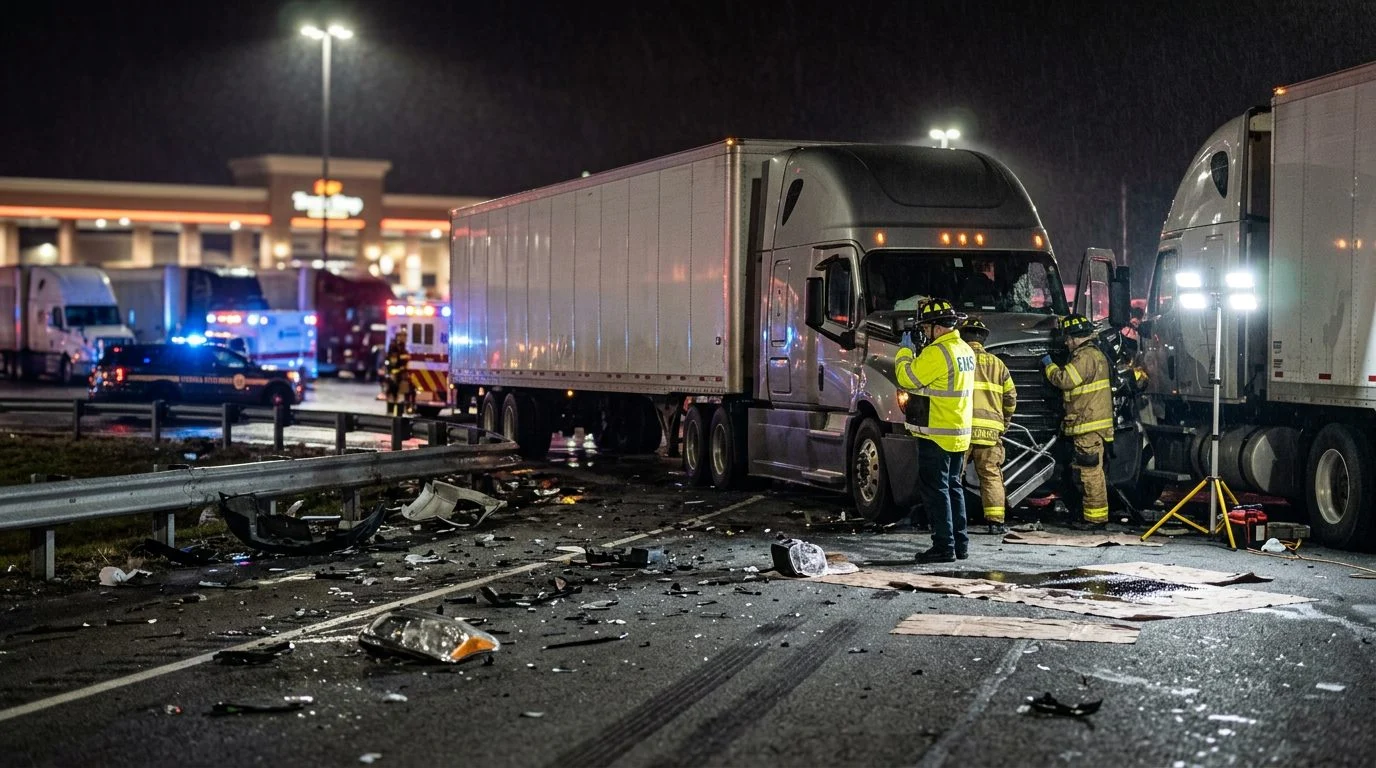
Commercial Truck Crashes | Virginia
Hurt in a Truck Crash? Understand the Basics of a Broken-Bone Claim
A plain-language guide for people in the Shenandoah Valley, Richmond and Henrico County who are recovering from a serious injury.
Published November 19, 2026
A broken bone or torn ligament after a commercial truck crash can change work, driving and daily life. A claim may be possible against the people responsible, and Virginia’s main filing deadline generally starts on the date of injury.
This guide explains the injuries, the Virginia timing rules, how fault works, what evidence matters and how a claim usually moves forward. It is written for people hurt in these crashes and for family members helping them.
Who This Guide Is For and What a Claim Can Cover
A claim for a broken bone or ligament injury asks the responsible people to pay for the harm the crash caused. In a truck crash, that often means the driver, the trucking company or the company’s insurer.
A claim may address several kinds of loss:
- Medical treatment, including surgery, imaging and therapy
- Lost income from missed work or a job change
- The physical limits the injury creates in daily life
Lost income is treated in a specific way. Under Va. Code § 8.01-35, provable lost income is not reduced because the person was reimbursed from another source.
Every claim turns on its own facts. The same kind of injury can lead to very different claims, so no amount can be predicted from a general guide.
The same questions come up in car accidents and commercial vehicle accidents, and the firm handles those as well.
If a truck crash left you with a broken bone or torn ligament, you may have a claim, and the firm can talk through your facts with you. Talk it through with Correll Law Firm — we can walk you through how a situation like yours is usually handled and what your options are.

Common Broken Bones and Ligament Injuries After Truck Crashes
Truck crashes often cause fractures of the ribs, collarbone, wrist, forearm, pelvis, leg, ankle and foot. They can also tear ligaments in the knee, ankle, shoulder and wrist.
Common examples include:
- Rib and collarbone fractures from a seatbelt or impact with the door or steering wheel
- Wrist and forearm fractures from bracing against the dashboard
- Pelvis and femur fractures from high-force impacts
- Ankle and lower leg fractures from the foot slamming into the pedals or floor
- ACL and MCL tears in the knee, which can happen when the knee strikes the dashboard
- Rotator cuff tears in the shoulder from a sudden pull or fall
A driver does not have to be thrown from the vehicle to be hurt. Sudden force, bracing, and impact from cargo or the vehicle’s structure can all cause serious injury.
An open fracture, where bone breaks through the skin, needs urgent medical care. Some fractures and ligament tears do not cause clear symptoms right away.
When care starts late, an insurer may argue that the injury came from something else. Getting checked early keeps the link to the crash clear.
Virginia Deadlines and Crash Reporting
Virginia generally allows two years from the date of injury to file a personal injury lawsuit (Va. Code § 8.01-243(A)); the clock runs from the date of injury, not the date of discovery, with narrow exceptions. Va. Code § 8.01-243(A) provides that, unless otherwise provided in that section or by other statute, every action for personal injuries, whatever the theory of recovery, must be brought within two years after the cause of action accrues (Va. Code § 8.01-243).
Some claims carry notice requirements that run out sooner. Raise the deadline question early.
Reporting the Crash
Virginia requires a driver involved in a crash with injury or death to stop and report it to police immediately (Va. Code §§ 46.2-371, 46.2-894). The driver’s duties appear in Va. Code § 46.2-371 and Va. Code § 46.2-894.
The two-year period is the deadline to file a lawsuit, not to report a crash (Va. Code § 8.01-243). The police report that follows often becomes key evidence about what happened.
Fault, Partial Blame and Contact With the Insurance Company
Fault decides whether a truck crash claim can move forward. Insurers often focus on fault first.
Virginia follows contributory negligence: if you are found even partly at fault, you may be barred from recovering, with limited exceptions. Talk to a lawyer about your facts.
Fault is judged from facts such as the police report, witness accounts, vehicle damage and how each driver acted. A short statement about the crash can shape how those facts are read later.
A trucking company’s insurer may contact the injured person early and ask for a recorded statement. Early statements can be used to question how serious an injury is before the medical picture is clear.
Keep notes of every call. Write down the caller’s name, the company and the claim number. You may wish to speak with a lawyer before giving a recorded statement.
Building the Medical and Evidence Record
The medical record is the main proof of a broken bone or ligament injury. It links the injury to the crash and shows how the injury affects daily life.
Medical records that usually matter include:
- Emergency room and urgent care notes from the day of the crash
- X-ray, CT and MRI reports and the images themselves
- Surgical reports, if surgery was needed
- Physical therapy notes and follow-up visit notes
- Work restriction slips and records of missed work
Consistent treatment matters. Gaps in care can make it harder to connect the injury to the crash.
Trucking evidence can also matter. Useful items include the crash report, photos, dashcam or onboard camera footage if it was saved, driver logs, maintenance records and cargo documents.
Trucking records do not last forever. A motor carrier must keep records of duty status for not less than 6 months from receipt (49 C.F.R. § 395.8).
Under federal rules, some truck crashes require the employer to test surviving drivers for alcohol and controlled substances, but only when specific conditions are met. After a crash involving injury or a tow-away, testing applies only if a citation is issued within a set time. After a fatal crash, testing applies to drivers performing safety-sensitive functions. Under 49 C.F.R. § 382.303, when a crash involving a commercial motor vehicle operating on a public road in commerce causes bodily injury to a person who, as a result, immediately receives medical treatment away from the scene, or leaves a vehicle with disabling damage that requires it to be towed or transported away, the employer’s post-accident testing duty covers a surviving driver who receives a citation under State or local law for a moving traffic violation arising from the accident. Alcohol testing applies if that citation comes within 8 hours of the occurrence, and controlled substances testing applies if it comes within 32 hours. Because time limits are short, early requests to the carrier matter.
How a Truck Crash Injury Claim Typically Moves Forward
A typical claim moves through intake, investigation, medical review, negotiation and, if needed, a lawsuit.
- Intake: The injured person describes the crash, the injuries, the treatment and any insurer contact.
- Investigation: Records are requested from the insurer, the carrier and the police.
- Medical review: Treating providers document the diagnosis, the treatment and any need for future care.
- Demand and negotiation: A written demand goes to the insurer, followed by talks.
- Lawsuit: If a fair resolution is not reached, a suit may be filed within the Virginia deadlines above.
Early steps keep records and deadlines on track. A person may wish to speak with a lawyer early for that reason.
How long each step takes depends on the facts and on how much treatment is still ongoing.
Not sure what your next step is?
Talk it through with Correll Law Firm — we can walk you through how a situation like yours is usually handled and what your options are.
Why Injured People Bring These Claims to the Firm
The firm has offices in Winchester and Harrisonburg. The firm serves people from the Shenandoah Valley, Richmond and Henrico County.
The firm handles:
- Car accidents
- Truck accidents
- Commercial vehicle accidents
- Catastrophic injuries
- Traumatic brain injury
- Spinal cord injury
- Wrongful death
The firm’s approach centers on gathering medical and trucking records early. It also explains the Virginia timing rules and handles a case from intake through resolution.
The firm serves people in Richmond and Henrico County. Its offices are in Winchester and Harrisonburg.
Frequently Asked Questions About Broken Bones and Ligament Injuries in Truck Crashes
Can a broken bone from a truck crash support a claim?
It may, depending on the crash facts, who is responsible and what the medical records show.
Are ligament tears handled differently from broken bones?
Both are documented through medical records and imaging. Ligament tears often need longer follow-up.
Do I need a lawyer to make a claim?
You may wish to speak with a lawyer about your facts. The choice is yours.
What if the trucking company’s insurer calls me?
Keep notes of every call. You may wish to speak with a lawyer before giving a recorded statement.
Does the firm handle claims in Richmond and Henrico County?
Yes, the firm serves people there. Its offices are in Winchester and Harrisonburg.
How long does recovery take?
Recovery time depends on the injury and the medical course. No one can promise a timeline.