
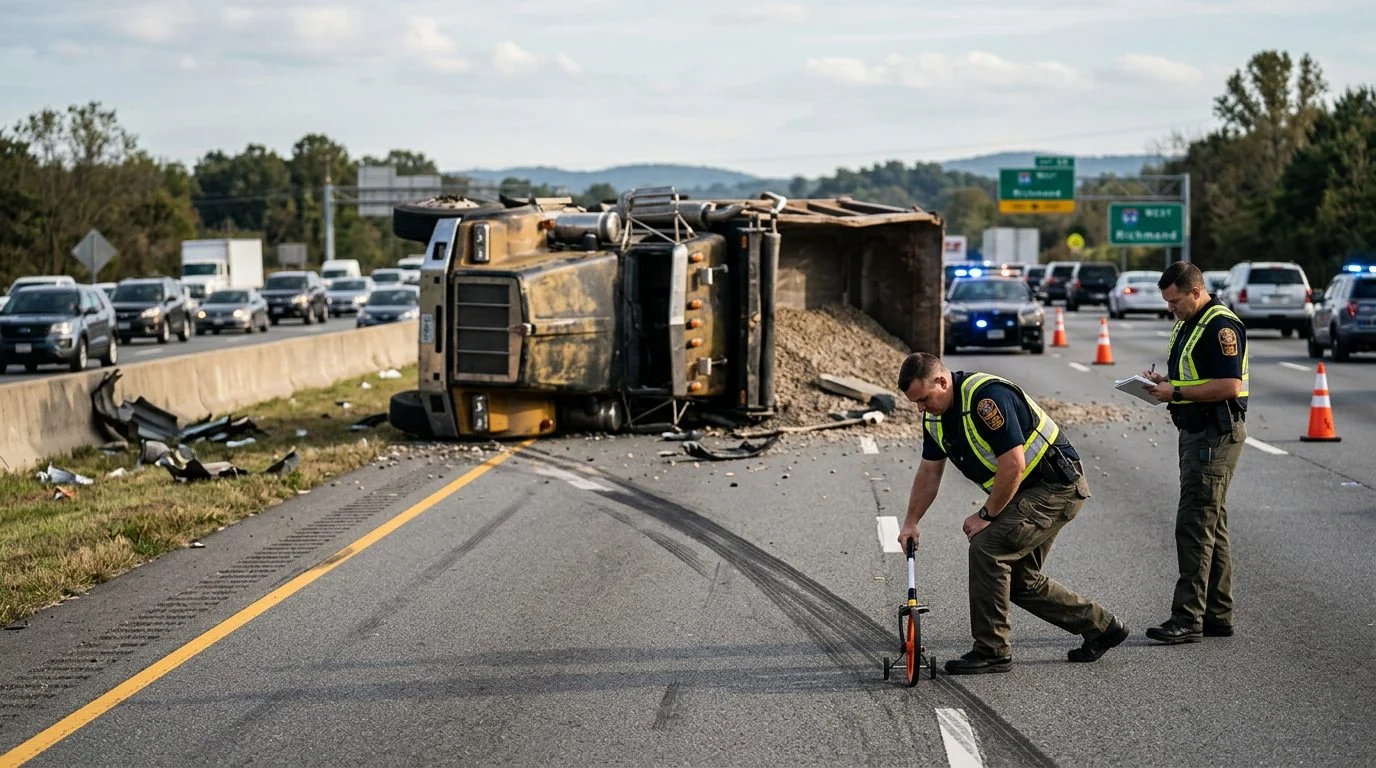
Truck Accidents | Winchester, Harrisonburg and the Shenandoah Valley
Hurt in a Dump Truck Crash? Correll Law Firm Focuses on Serious Truck Injury Cases
Dump trucks are heavy, and crashes involving them can cause catastrophic injuries and wrongful death. The firm represents people and families across the Shenandoah Valley, with offices in Winchester and Harrisonburg, and serves Richmond and Henrico County.
Published November 2, 2026
A dump truck or tanker truck crash can cause serious injuries, and it often raises different questions than a car crash. The weight of the truck, the way its load moves, and the company records behind it can all matter. This page explains those differences, the parties who may share responsibility, and what the firm handles in these cases.
What a Dump Truck or Tanker Truck Crash Involves
A dump truck or tanker truck crash involves a heavy commercial vehicle built to haul loose material or liquid cargo.
A dump truck has a hydraulic bed that tilts to unload gravel, dirt or debris. Many work on construction sites and local roads. A tanker truck carries liquid or gas cargo in a sealed tank. Both kinds travel Virginia’s highways, including Interstate 81 through the Shenandoah Valley and Interstate 64 toward Richmond.
These matters often involve drivers, passengers, pedestrians and cyclists hurt in a crash. Families of people killed in these crashes may also have questions about a wrongful death claim.
The firm’s work in this area falls under commercial vehicle accidents. It also handles car accidents, truck accidents and catastrophic injury matters.
If a dump truck or tanker truck crash hurt you or someone you love, you do not have to face the questions alone, and the firm can talk through your options with you. Talk it through with Correll Law Firm — we can walk you through how a situation like yours is usually handled and what your options are.

Why These Crashes Differ From Ordinary Car Accidents
Weight, load position and cargo movement are the main reasons these crashes differ from ordinary car accidents.
A loaded dump truck or tanker can weigh far more than a passenger vehicle. That extra mass means longer stopping distances and more force at impact. Injuries in these crashes can be severe, and some are catastrophic.
A dump bed that is raised or not fully lowered changes the truck’s height and balance. Liquid in a partly filled tank can slosh from side to side. That movement can shift weight and change how the truck brakes and turns. A poorly secured load can also spill onto the road.
The Federal Motor Carrier Safety Administration (FMCSA) sets drug and alcohol testing rules for commercial drivers. A safety violation can become part of the evidence in a case. Hazardous cargo in a tanker can also bring cleanup crews, a larger scene and extra reports, which can affect the records made after the crash.
Who May Share Responsibility for the Crash
More than one party may share responsibility, and the facts of each crash decide who may be liable.
Possible parties include:
- The driver.
- The trucking company or owner-operator.
- A company that leased or hired the truck.
- A loader or contractor who secured the cargo.
- A maintenance provider that serviced the brakes, tires or tank.
Maintenance records also matter. Federal rules require motor carriers to inspect, repair and maintain their vehicles and to keep records of that work (49 C.F.R. § 396.3). Brake, tire and tank inspection history can show whether a known problem was fixed.
Evidence That Often Matters in These Cases
The evidence that matters most is usually the crash report, photos of the scene and truck, and the company’s own records.
Virginia requires a driver involved in a crash with injury or death to stop and report it to police immediately (Va. Code §§ 46.2-371, 46.2-894). The duty to stop at the scene is set out in Va. Code § 46.2-894. The reporting duty is separate from the deadline to file a lawsuit.
Evidence often requested early includes:
- The police or crash report and its report number.
- Photos of the scene, the truck, its markings and any load.
- Cargo papers and shipping records.
- Names and contact details for witnesses.
- Medical records and bills.
Electronic logging devices (ELDs) record a driver’s duty status. ELD and hours-of-service records can show driving time and rest breaks, which matters when fatigue is part of the question.
Timing matters. Some company records are kept only for set periods. Under 49 C.F.R. § 379.3, companies must keep records for the minimum retention periods in appendix A to that part, and after the required retention periods the records may be destroyed at the discretion of each company’s management. The rule does not excuse compliance with the lawful requirements of any other governmental body that sets longer retention periods for any category of records (49 C.F.R. § 379.3). Early written requests can help preserve them, and a lawyer can send those requests.
What to Expect: Steps and Timeline
A typical claim moves from intake to investigation, then medical documentation, then talks with insurers or a lawsuit if one is needed.
- Intake. The injured person or family shares the crash date, the location, the truck’s company and the medical care received.
- Investigation. The crash report is obtained, company and maintenance records are reviewed, and driver logs are requested.
- Medical documentation. Records show the injuries, the treatment, and how the injuries affect work, daily life and future care.
- Discussions or lawsuit. Talks with insurers or responsible parties continue, and a lawsuit is filed if needed.
Virginia generally allows two years from the date of injury to file a personal injury lawsuit (Va. Code § 8.01-243(A)); the clock runs from the date of injury, not the date of discovery, with narrow exceptions. Some claims carry notice requirements that run out sooner, so early review helps.
Catastrophic Injuries and Wrongful Death Claims
Catastrophic injuries and wrongful death are the most serious results of these crashes, and both need careful records.
Heavy-truck crashes can cause traumatic brain injury and spinal cord injury. These injuries may need ongoing medical review. Records should show current needs, expected future care and any lost capacity to work.
When a crash causes a death, the claim follows its own rules. A Virginia wrongful death action is filed by the decedent’s personal representative within two years of the death (Va. Code §§ 8.01-50(C), 8.01-244(B)), on behalf of the family members the statute protects.
Virginia wrongful death damages cover the family’s sorrow, mental anguish and loss of the decedent’s companionship, guidance and care; lost income and services; medical expenses from the injury; funeral expenses; and, for willful or wanton conduct, punitive damages (Va. Code § 8.01-52).
Virginia allows punitive damages for actual malice, or for willful or wanton conduct or recklessness showing a conscious disregard for the safety of others, capped at $350,000 (Va. Code § 8.01-38.1).
Not sure what your next step is?
Talk it through with Correll Law Firm — we can walk you through how a situation like yours is usually handled and what your options are.
How the Firm Handles Commercial Vehicle Cases
The firm handles commercial vehicle accidents, including dump truck and tanker truck crashes, serving clients from Winchester and Harrisonburg.
The firm focuses on car accidents, truck accidents, commercial vehicle accidents, catastrophic injuries, traumatic brain injury, spinal cord injury and wrongful death. It serves people across the Shenandoah Valley, including Front Royal, and people in Richmond and Henrico County.
The firm has more than one lawyer and support staff. Matters are handled by the firm’s lawyers, while support staff help with records, requests and scheduling. The firm can review the facts of a dump or tanker crash and talk through the steps that may apply. No result can be promised, because each case turns on its own facts.

Common Questions About Dump and Tanker Truck Crashes
Most questions come down to fault, deadlines and records. The answers depend on the facts of each crash.
What if I was partly at fault?
Virginia follows contributory negligence: if you are found even partly at fault, you may be barred from recovering, with limited exceptions. Talk to a lawyer about your facts.
Can I sue the company, not just the driver?
Often, yes. The driver, the carrier and others may each be responsible, and the facts decide who.
Do I need to keep photos or damaged parts?
Keeping photos, the crash report number and medical records can help. People may wish to speak with a lawyer early, before records are lost.
What if the crash happened on I-81 or I-64, far from home?
Where a case is filed depends on the facts of the crash. The firm serves people across the Shenandoah Valley, Richmond and Henrico County.