
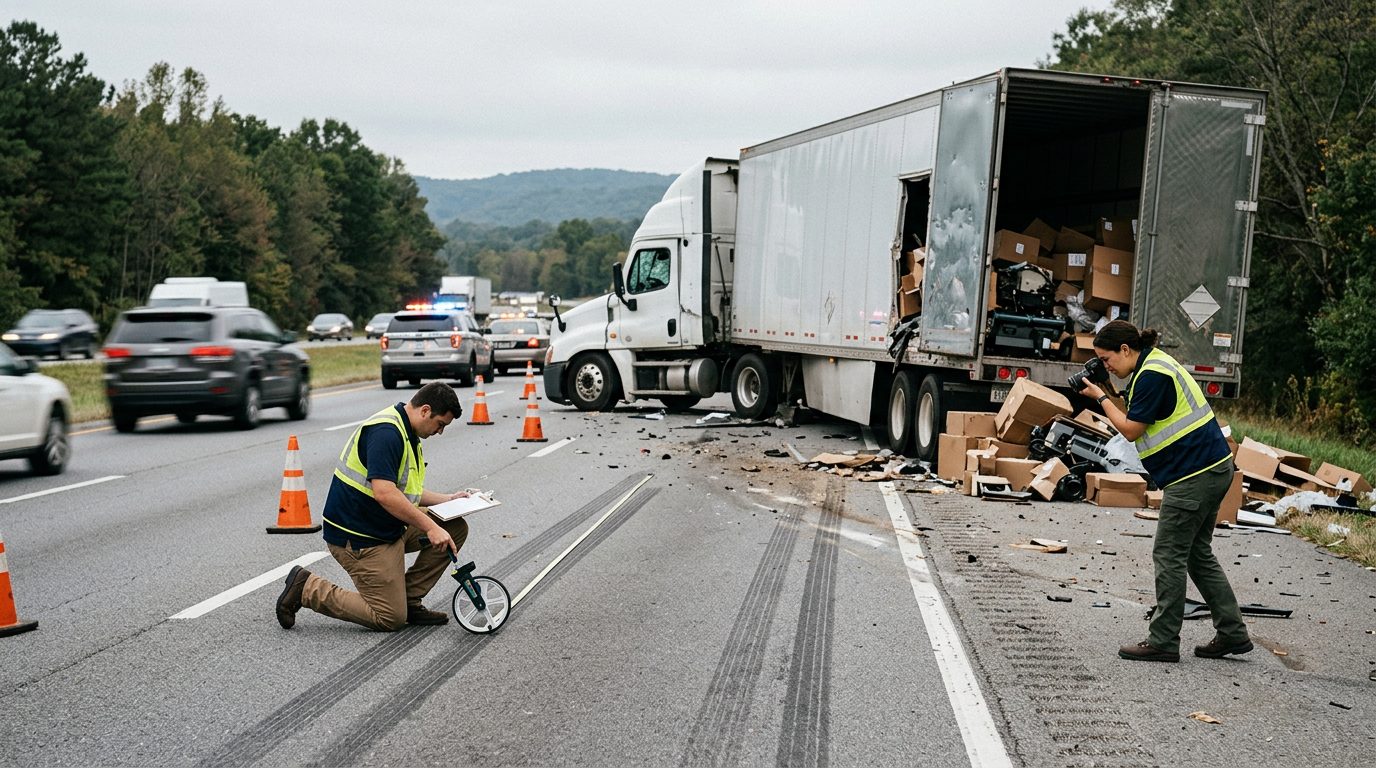
Evidence After a Semi Truck Crash in Virginia: A Practical Checklist
A plain-language guide to what to gather, preserve and write down after a crash with a commercial truck, from the Shenandoah Valley to Richmond and Henrico County.
Published November 3, 2026
Evidence after a semi truck crash in Virginia is easiest to gather early, before video is overwritten and records are lost. The most useful items are photos of the scene, dash camera video, witness names, truck markings and trucking company paperwork. This guide explains what to keep and why.
Why Evidence From a Semi Truck Crash Can Differ From a Car Crash
A semi truck crash usually involves more parties than a car crash. The driver, the company that operates the truck, and the company that owns the trailer or cargo may each hold part of the picture. Sometimes a separate maintenance provider is involved too.
Much of the most useful information sits with the trucking company, not with the people at the scene. That makes your own early notes more important. Some trucks also carry onboard recording devices, and some company records have short required retention periods. Waiting can mean losing them.
Your evidence list should cover both the scene and the paper trail that follows it. The scene can be recorded in minutes, but paperwork can take weeks to request. The federal rules that govern these trucks are covered in the commercial vehicle guide. This page focuses on what you can gather and keep yourself. Start one folder, paper or digital, on the day of the crash.
Talk it through with Correll Law Firm — we can walk you through how a situation like yours is usually handled and what your options are.

Scene Photos to Take and What Each One Should Show
Photos capture a scene before traffic, weather or cleanup changes it. Take them as soon as it is safe to do so. Aim for three kinds of shots:
- Wide shots from several directions, showing the highway, lanes, shoulder, guardrail and nearby signs or mile markers.
- Close-ups of the tractor and trailer from every side, plus the position of both vehicles.
- Road marks and conditions, including skid marks, debris, fluid, weather, lighting and any work zone signs.
Also photograph your own injuries and vehicle damage before anything is moved, if it is safe. Turn on the date and time settings. Write down where you stood for each photo, because a photo without a location note is harder to place later. Keep the original files, not only copies sent to a group chat.
Take more photos than you think you need. A detail that seems minor at the scene can matter later, when someone asks how the lanes and traffic looked. Photograph the truck’s position in relation to the lane lines, and note whether the trailer blocked any part of the road. Photos show where things were, but they do not by themselves decide who was at fault.
Dash Camera and Other Video Evidence
Video can show the order of events and the traffic around a crash. Start by finding out whether your own vehicle or a nearby one had a dash camera. Note where the footage is stored, such as a memory card or a cloud app.
- Save an original copy of the video file as soon as possible. A phone recording of a screen is not the same as the original file.
- Ask nearby businesses about traffic or security cameras, and note the time window each would have covered.
- Act quickly. Some camera systems overwrite footage on a schedule, so the footage may be gone if no one asks in time.
Write down what the video appears to show and at what time, while the details are fresh. Do not edit, trim or post the clip online. Editing can make it harder to show that the file is complete. If you are not sure whether any camera recorded the crash, write that down too. That note helps anyone looking into the crash know where to ask.
Witness Names, Contact Details and Their Accounts
Witnesses can describe the crash from a different spot than yours. Collect names and phone numbers from drivers, passengers, pedestrians and workers who saw the crash or arrived right after it. Ask each person where they were standing and what they saw. Write down their account in their own words where possible.
Note any responders who spoke at the scene, such as officers or emergency medical staff, and the names they gave. Keep witness information in a private note or folder, not only in social media posts. Posts can be deleted or edited later.
Ask witnesses to write their account soon after the crash, while details are fresh. Do not pressure anyone to change or sharpen what they saw. An honest first account is more useful than a polished one. A witness who saw only the moments before impact can still help place the vehicles. If a witness leaves before you get details, note the time, the vehicle they left in and any description you have.
Truck Markings, Vehicle Damage and the Trailer
A commercial truck displays markings that help identify the companies involved. Under federal rules, a self-propelled commercial motor vehicle subject to the Federal Motor Carrier Safety Regulations must display its USDOT number, preceded by the letters “USDOT” (49 C.F.R. § 390.21T). If another person’s name also appears, the operating carrier’s name must be followed by its legal name or single trade name and its USDOT number, and be preceded by the words “operated by.”
- The carrier’s name and USDOT number on the cab or doors.
- The trailer number and the license plate of the tractor and trailer.
- Any leasing company name on the equipment. It can show who owned or leased the equipment, which helps identify every company to ask for records.
Photograph damage to the front, sides, rear, lights and mirrors, and any rear under-ride guard, from several angles. If cargo shifted or spilled, photograph the trailer with its doors open if it is safe. Describe tire and brake condition as you see it, without guessing at the cause. Leave the cause to the people who investigate the crash.
Cargo, Trip and Company Records
Trucking company records often hold trip details that the scene cannot show. Federal rules require a motor carrier to keep a driver’s record of duty status for at least 6 months from the date of receipt (49 C.F.R. § 395.8). Supporting documents such as bills of lading and dispatch records fall under separate rules (49 C.F.R. § 395.11). Under 49 C.F.R. § 395.11, subject to paragraphs (d)(3) and (4) of this section, a motor carrier need not retain more than eight supporting documents for an individual driver’s 24-hour period under paragraph (c) of this section. If the carrier has more than eight, it must keep the documents with the earliest and latest time indications among the eight it retains. And for any period when a driver kept paper records of duty status, it must keep toll receipts (49 C.F.R. § 395.11(d)). No motor carrier or driver may obscure, deface, destroy, mutilate, or alter existing information contained in a supporting document.
Periodic inspection reports must be kept for fourteen months from the date of the inspection report (49 C.F.R. § 396.21). For companies subject to this part, once the required retention periods end, records may be destroyed at the discretion of each company’s management; this does not excuse compliance with any longer retention periods set by other governmental bodies (49 C.F.R. § 379.3). Because these periods are limited, ask for records in writing soon after the crash, and keep a copy of your request. Look for these items:
- Bills of lading, load tickets or dispatch slips you can see or photograph.
- The shipper, the consignee and the pickup and delivery locations on any paperwork.
- The company’s name and any contact the driver gave you.
- Any statement from the driver or a company representative, with the time and the speaker’s name.
Documents that show who employed or dispatched the driver can show which companies to ask for records.
Not sure what your next step is?
Talk it through with Correll Law Firm — we can walk you through how a situation like yours is usually handled and what your options are.
Police Reports and Medical Records
Police reports and medical records create a dated record of the crash and your injuries. Virginia requires a driver involved in a crash with injury or death to stop and report it to police immediately (Va. Code §§ 46.2-371, 46.2-894). Note the investigating officer’s name, the agency and the report or incident number. Request a copy of the report once it is available. A police report is one useful record, but photos, witness accounts and company records can add detail it may not include.
Keep every medical record, prescription and appointment note in one folder, with dates. Tell each doctor how the crash happened, and ask that your symptoms be written down. Start a written timeline of symptoms, missed work and daily limits soon after the crash, since memory of these details fades. Medical records can also show when symptoms first appeared, which is why dates matter.

Why Timing Matters for Evidence and Claims
Evidence can change or disappear over time. Keeping evidence after a semi truck crash in Virginia in one dated folder gives anyone reviewing the crash a clear starting point.
Virginia generally allows two years from the date of injury to file a personal injury lawsuit (Va. Code § 8.01-243(A)); the clock runs from the date of injury, not the date of discovery, with narrow exceptions.
Some claims carry shorter notice rules. Claims against a county, city or town for negligence are barred unless a written statement of the claim, including the time and place of the injury, is filed within six months after the claim accrues; if the person was under a disability when the claim accrued, the tolling provisions of § 8.01-229 apply (see Va. Code § 15.2-209). Va. Code § 8.01-243 sets general limitation periods, unless otherwise provided in that section or by other statute. A missing statement does not bar the claim if the attorney, chief executive or mayor of the locality, or any insurer or entity providing coverage or indemnification of the claim, had actual knowledge of the claim, including its nature and the time and place of the injury, within that six-month period (Va. Code § 15.2-209).
Virginia follows contributory negligence: if you are found even partly at fault, you may be barred from recovering, with limited exceptions. Talk to a lawyer about your facts.
Truck crashes are one of the case types the firm handles, alongside car accidents, commercial vehicle accidents and catastrophic injuries.
Can I use dash camera video from a truck accident in Virginia?
Video can show what happened, so keep the original file and write down where it is stored.
Is a police report enough evidence after a truck crash?
It is one record among several. Keep the other items in this guide too.
What is an electronic logging device?
It is a device that records a driver’s duty status. Federal rules prohibit drivers and motor carriers from tampering with an electronic logging device in a way that prevents it from accurately recording and retaining required data (49 C.F.R. § 395.8).