
Truck Accidents | Virginia
Garbage Truck Crash? Start With Your Health and the Facts
A heavy refuse truck can turn an ordinary morning into a medical and legal emergency. Here is how to protect your health and your records in the days after a crash.
Published November 10, 2026
A garbage truck crash can change a day in a few seconds. If you were hurt in one, or lost a loved one in one, you may have many questions about what comes next.
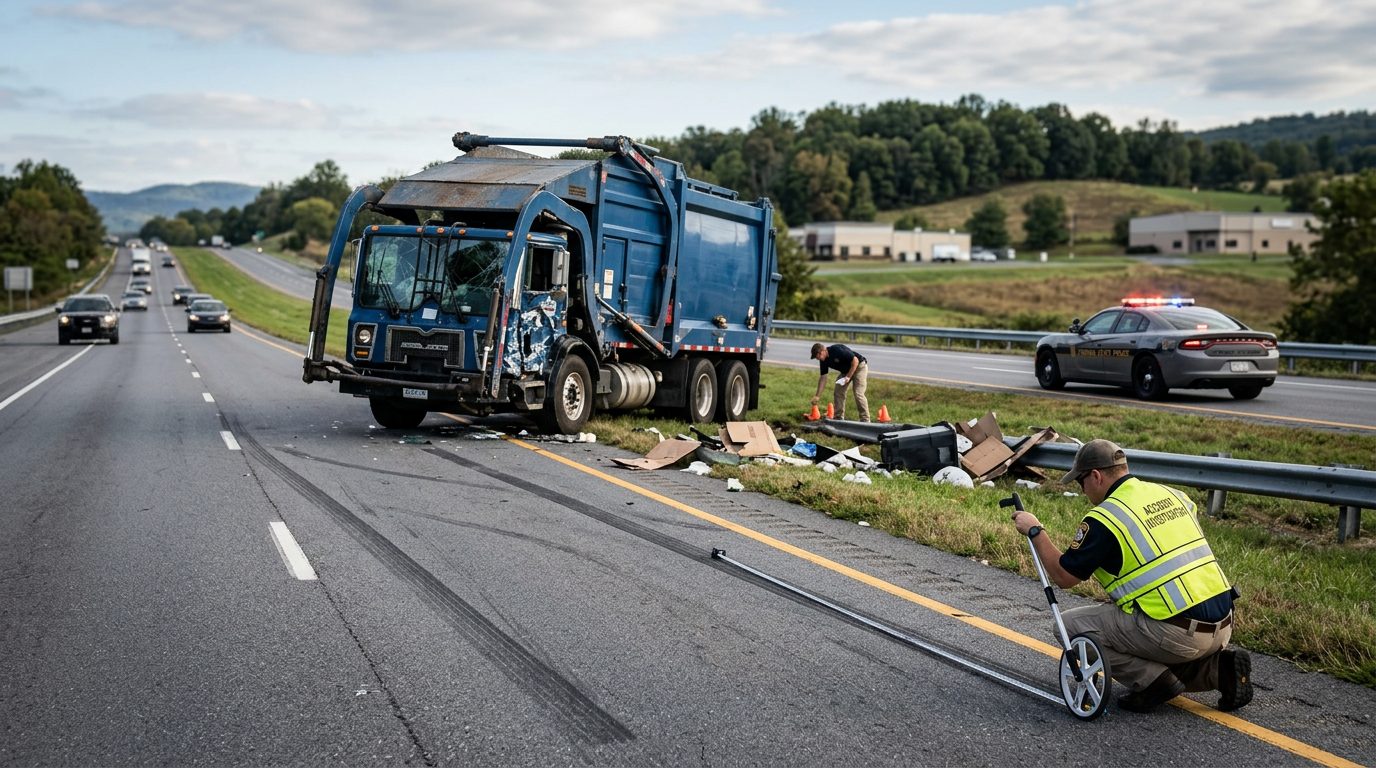
Garbage truck accident injuries in Virginia can be serious. The most common serious injuries involve the head, spine, bones and crushing force. The first steps are medical care, a police report and a careful written record. This page explains why these crashes cause harm, what injuries to watch for, and which Virginia rules may apply. Drivers and pedestrians in Winchester, Harrisonburg, Richmond and Henrico County all share roads with these trucks.
Why Garbage Truck Crashes Cause Serious Injuries
Garbage truck crashes often cause serious harm because the trucks are heavy, tall and built for frequent stops. A refuse truck can weigh far more than a passenger car. In a collision with a car, bicycle or pedestrian, the smaller party usually takes more of the impact.
Much of the work happens in short bursts. Drivers stop often, back up and operate the lift arm at the curb. Rear-loading trucks can have blind spots and sudden movement that drivers and nearby people may not expect.
Crew members often ride on the back or the step of the truck. That puts workers and passersby close to moving equipment. Residential streets, narrow alleys and curbside pickups bring the truck close to parked cars, pedestrians and cyclists. Less space leaves less room to react.
Not sure what your next step is?
Talk it through with Correll Law Firm — we can walk you through how a situation like yours is usually handled and what your options are.

Common Injuries After a Garbage Truck Accident
The injuries that show up most often after these crashes involve the head, spine, bones and soft tissue.
Traumatic brain injury. A head can strike the truck, the pavement or a curb. Injuries range from a concussion to more serious brain injuries that can affect thinking, memory, balance and mood.
Spinal cord injury and neck or back trauma. Damage to the spine can affect movement and feeling. Spinal injuries call for prompt medical evaluation, even when the person feels able to walk away.
Broken bones and crush injuries. Legs, hips, pelvis, arms and ribs are common sites of fracture. A person pinned against a vehicle or run over can suffer crush injuries.
Internal injuries and deep tissue damage. Internal bleeding and organ injuries may not be visible. Road rash and deep tissue wounds can also need long treatment.
For the wider picture of large vehicles on Virginia roads, read the firm’s commercial vehicle crash guide.
Why Some Symptoms Appear Days or Weeks Later
Some symptoms, especially after a head injury, appear days or weeks after a crash. Headaches, memory trouble, dizziness, sleep changes and mood shifts can develop slowly.
Back, neck and numbness symptoms may not be obvious at the scene. Adrenaline can mask pain for hours. Many people feel shaken, assume they are fine and wait to see a doctor. That delay can make it harder to connect later symptoms to the crash.
Keeping every follow-up appointment creates a clear medical record. Describe all symptoms to the treating clinician, even small ones. Write them down with dates in plain words. A simple symptom diary can help you and your medical team track changes over time.
First Steps After a Garbage Truck Crash
The first steps are medical care, a report to police and a careful record of what happened.
Get medical evaluation right away, even if injuries seem minor. Follow the treatment plan that is recommended. Virginia requires a driver involved in a crash with injury or death to stop and report it to police immediately (Va. Code §§ 46.2-371, 46.2-894). The duty to stop and give reasonable help to an injured person appears in Va. Code § 46.2-894.
Ask for the police report number and the responding officer’s name. Photograph the scene, the vehicle damage, visible injuries, road conditions and signs. Write down the truck’s company name, unit number and license plate as soon as you can.
Get names and contact details for witnesses. Include crew members who were on the truck. Keep medical bills, prescription receipts, mileage to appointments, records of time missed from work and wage records. Write each step down while your memory is fresh.
How Fault and Liability Are Investigated
Fault is usually decided on evidence, and in a truck case that evidence can include company records. Investigators often review the police report, photographs, witness accounts and any camera footage that exists. For a commercial truck, they may also review maintenance and inspection records.
Federal rules require motor carriers to systematically inspect, repair and maintain their vehicles (49 C.F.R. § 396.3). After some crashes, federal rules also require the employer to test the driver for alcohol and drugs (49 C.F.R. § 382.303). Those tests apply to crashes involving a death, but for those crashes only to surviving drivers who were performing safety-sensitive functions with respect to the vehicle, and to certain injury or tow-away crashes where a citation follows (49 C.F.R. § 382.303).
Routes, backing procedures, crew training and company safety rules may also matter.
Virginia follows contributory negligence: if you are found even partly at fault, you may be barred from recovering, with limited exceptions. Talk to a lawyer about your facts.
More than one party can share responsibility.
Virginia Deadlines for an Injury Claim
Virginia generally allows two years from the date of injury to file a personal injury lawsuit (Va. Code § 8.01-243(A)); the clock runs from the date of injury, not the date of discovery, with narrow exceptions.
Some claims carry notice requirements that run out sooner. Check the time limits for each type of claim early.
Evidence can also disappear over time. Photos fade, video is overwritten, and medical records build up without a clear summary. Acting early helps keep the record complete.
Not sure what your next step is?
Talk it through with Correll Law Firm — we can walk you through how a situation like yours is usually handled and what your options are.
When a Garbage Truck Crash Causes a Death
A Virginia wrongful death action is filed by the decedent’s personal representative within two years of the death (Va. Code §§ 8.01-50(C), 8.01-244(B)), on behalf of the family members the statute protects. Family members do not file the case. They share in the recovery, if there is one.
The damages the statute lists are set out in Va. Code § 8.01-52. Virginia wrongful death damages cover the family’s sorrow, mental anguish and loss of the decedent’s companionship, guidance and care; lost income and services; medical expenses from the injury; funeral expenses; and, for willful or wanton conduct, punitive damages (Va. Code § 8.01-52).
Families may want to keep the same photographs, police documents and bills described above. A written list of the decedent’s daily routines and household contributions can also help.

Punitive Damages in Virginia
Virginia allows punitive damages for actual malice, or for willful or wanton conduct or recklessness showing a conscious disregard for the safety of others, capped at $350,000 (Va. Code § 8.01-38.1).
Whether conduct meets this standard depends on the facts of each crash.
Frequently Asked Questions
What injuries are most common after a garbage truck accident?
Head, spine, bone and crush injuries are among the most serious. Some symptoms can appear days or weeks after the crash.
Do truck companies have to keep maintenance records?
Yes. Federal rules require motor carriers, except a private motor carrier of passengers (nonbusiness), to keep the vehicle inspection and maintenance records they must maintain for one year where the vehicle is housed or maintained, and for six months after it leaves their control (49 C.F.R. § 396.3).
Does the two-year deadline apply to reporting a crash?
No. A personal injury lawsuit generally must be brought within two years after the cause of action accrues, not within two years of reporting a crash (Va. Code § 8.01-243).