
Virginia Injury Claims
Showing You Were Not at Fault After a Crash
Clear evidence, careful records and a steady timeline can help show what really happened on the road.
Published November 10, 2026
Being hurt in a crash is hard enough. Then the other driver says the crash was your fault. You show an accident was not your fault by gathering evidence that records how the crash happened, and by keeping that evidence safe from the start.
This page covers the types of proof that matter most in Virginia car and truck crash cases. It explains what each type can show, and where it has limits.
Why Fault Matters in a Virginia Crash Claim
Fault is the central question in most car and truck crash claims. Virginia’s fault rule is strict, so the proof matters a great deal.
Virginia follows contributory negligence: if you are found even partly at fault, you may be barred from recovering, with limited exceptions. Talk to a lawyer about your facts.
Some drivers say a sudden emergency explains what happened. Your evidence is how you answer those claims. Evidence gathered close to the crash is harder to dispute than memories pieced together months later. Nothing on this page predicts how any claim will turn out.
If another driver is blaming you, you do not have to sort out the evidence alone, and the firm can talk with you about your facts. Talk it through with Correll Law Firm — we can walk you through how a situation like yours is usually handled and what your options are.
Report the Crash and Get the Police Report
Virginia requires a driver involved in a crash with injury or death to stop and report it to police immediately (Va. Code §§ 46.2-371, 46.2-894). You can read the text of § 46.2-371 and § 46.2-894.
The two-year period discussed later is the deadline to file a lawsuit, not a deadline to report a crash (Va. Code § 8.01-243).
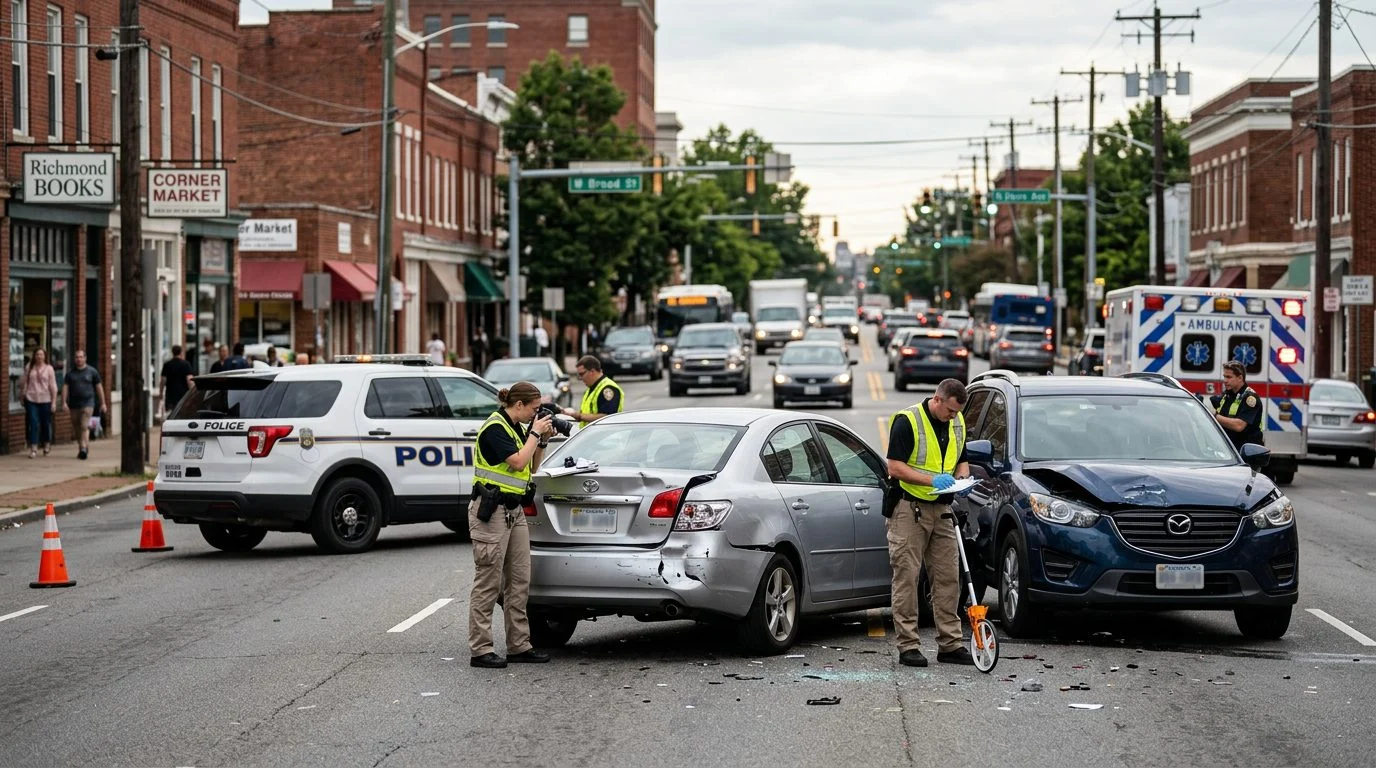
A police report usually lists the drivers, the vehicles, road and weather conditions, witness names, a diagram and the officer’s observations. An officer’s view of fault may or may not match the physical evidence. Treat the report as one piece of proof, not the whole story.
Ask for a copy and read it closely. Check for errors such as wrong directions of travel, wrong lane positions, wrong street names or missing witnesses. If something is wrong, you may wish to ask for a correction in writing.
Photos, Video and Scene Evidence
Photos are often the clearest record of where vehicles stopped and how they were damaged. Useful scene evidence includes rest positions, damage patterns, skid or scuff marks, debris, traffic signals, signs, lane markings and sight lines.
Take wide shots that show the road and the vehicles, plus close shots of the damage. Take still photos as well as video, because video frames can be unclear. Keep the original files with their date and time stamps.
If injuries keep you from taking photos, ask someone who is present to do it for you.
Witness Statements and Contact Information
Independent witnesses can help confirm the order of events. They may have seen the signal color, a vehicle’s speed or a sudden lane change.
Collect each witness’s full name, phone number and email. Ask for a short account of what they saw. Write it down as soon as you can, while memory is fresh. Note where the witness was standing and whether anything blocked the view, such as a parked truck or a tree.
Passengers and bystanders, including people in other cars, may also have seen the crash. Their accounts can differ from yours, and that is normal. Collecting them early keeps the record complete.
Traffic Cameras, Dashcams and Vehicle Data
Recordings and vehicle data can show what each car did before impact. Common sources include nearby business or traffic cameras, personal dashcams, and the event data recorder in each vehicle. The airbag control module may also store crash data.
Footage can be overwritten on a routine schedule, so ask early for it to be saved. Vehicle data can show speed, braking and throttle use. It may be lost if a vehicle is repaired, sold or scrapped, so ask that the vehicle be kept while the claim is looked into.
A dashcam can record the seconds before impact, which matter in a red-light or lane-change dispute. Keep the original file rather than a copy sent through a messaging app, since compressed copies can lose detail.
Statements to Police and Insurance Companies
What you say at the scene, to police or to an insurer can become part of the record. Stick to facts you know. Avoid guessing about speed, fault or injuries.
Do not admit fault, even to be polite. Read any document before you sign it. An insurer may ask for a recorded statement. You may wish to talk with a lawyer before giving one.
Keep a simple log of every call with an insurer. Note the date, the person’s name and what was said. Insurers investigate fault for their own purposes. That investigation is separate from a court’s decision, and insurers can rely on the same records described on this page.
Not sure what your next step is?
Talk it through with Correll Law Firm — we can walk you through how a situation like yours is usually handled and what your options are.
Proving Fault When a Commercial Truck Is Involved
In truck crashes, key records are often held by the carrier and the driver, not by the person who was hurt. These can include records of duty status (driver logs), maintenance and inspection records, dispatch records and driver qualification files.
Federal rules set how long some of these records must be kept. A motor carrier must keep records of duty status and supporting documents for at least six months from the date of receipt (49 C.F.R. § 395.8). A driver qualification file must be kept while the driver is employed and for three years after, except that certain records in it may be removed three years after execution (49 C.F.R. § 391.51).
After certain truck crashes, an employer must test each surviving driver for alcohol and for controlled substances as soon as practicable, under conditions set out in 49 C.F.R. § 382.303. Under 49 C.F.R. § 382.303, when a commercial motor vehicle operating on a public road in commerce is in a crash that involved a loss of human life, the employer must test each surviving driver who was performing safety-sensitive functions with respect to the vehicle. For crashes involving bodily injury with immediate medical treatment away from the scene, or a motor vehicle with disabling damage requiring a tow truck or other vehicle to transport it away, testing applies only if the driver receives a citation under state or local law for a moving traffic violation arising from the crash: within 8 hours for alcohol testing, or within 32 hours for controlled substances testing. If a controlled substances test is not administered within 32 hours following the accident, the employer must stop attempting it. The Federal Motor Carrier Safety Administration describes these post-accident testing rules as well (FMCSA).
After the required retention periods end, a company may destroy its records at its discretion, but this does not excuse compliance with the lawful requirements of any other governmental body that prescribes longer retention periods (49 C.F.R. § 379.3). Requests for carrier records are best made promptly. The firm’s guide to commercial vehicle accidents in Virginia covers the wider framework.

Timing, Limitations and Organizing Your Evidence
Virginia generally allows two years from the date of injury to file a personal injury lawsuit (Va. Code § 8.01-243(A)); the clock runs from the date of injury, not the date of discovery, with narrow exceptions. The statute is at § 8.01-243.
Some claims carry shorter notice rules. A negligence claim against a county, city or town, for example, needs a written statement filed within six months after the claim accrued, with narrow exceptions (Va. Code § 15.2-209). Va. Code § 15.2-209 reads: “Failure to provide such statement shall not bar a claim against any county, city, or town, provided that the attorney, chief executive, or mayor of such locality, or any insurer or entity providing coverage or indemnification of the claim, had actual knowledge of the claim, which includes the nature of the claim and the time and place at which the injury is alleged to have occurred, within six months after such cause of action accrued.” Va. Code § 15.2-209 reads: “Every claim cognizable against any county, city, or town for negligence shall be forever barred unless the claimant or his agent, attorney, or representative has filed a written statement of the nature of the claim, which includes the time and place at which the injury is alleged to have occurred, within six months after such cause of action accrued.”
Organize your evidence in one dated folder. Include:
- The police report number and a copy of the report
- Photos and video, with notes on who took them and when
- Witness names and contact details
- Medical records and bills
- A written timeline of the crash, started soon after it happened
A timeline written close to the event keeps the sequence clear if memories shift later.
Frequently asked questions
Does the police report decide who was at fault?
No. The report is one piece of proof, and the officer’s view does not settle the claim.
What if the other driver says the crash was my fault?
Keep your own notes and gather the scene, witness and vehicle evidence described above. Their account is one version of events, not the final word.