
Truck Crash Claims | Shenandoah Valley and Richmond
Hurt in a Truck Crash? Learn Who Can Be Held Responsible in Virginia
Serious truck crashes can involve more than one party. Here is a plain-language guide to the company, the driver and the evidence that often matters.
Published November 10, 2026
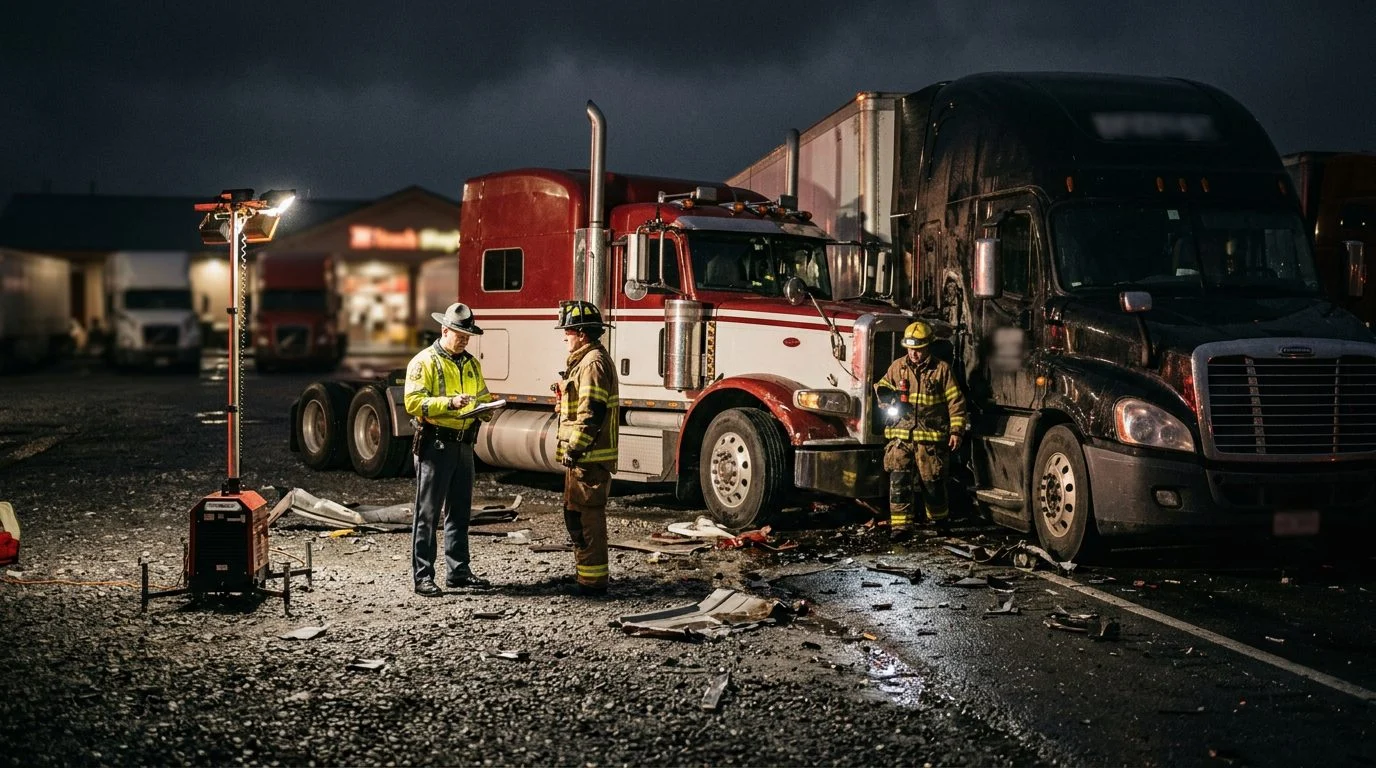
A crash with a large truck can leave you hurt, shaken, and unsure who to blame. Many people ask whether they can sue the trucking company and the driver in Virginia.
Yes, a claim can name both. This page explains how these claims work, the deadlines that apply, and the evidence that matters most.
Short Answer: Who Can Be Named After a Virginia Truck Crash
The driver and the trucking company can both be named in one lawsuit, but they answer different questions. The driver is the person who operated the truck. The company may be the carrier that employed, contracted with, or controlled the driver and the equipment.
Whether the company is a proper defendant depends on the facts of the crash and how the company was connected to the driver and the truck. Records about who employed the driver and who controlled the truck often answer that question early.
Virginia lets an injured person pursue more than one party. For the wider picture, see the commercial vehicle accident guide.
If a truck crash left you or a family member hurt, the firm can talk through who may be responsible and what your options look like. Talk it through with Correll Law Firm — we can walk you through how a situation like yours is usually handled and what your options are.
Suing the Driver: What the Claim Looks At
A claim against the driver asks what the driver did and whether that conduct caused the injuries. The central questions are how the crash happened, what the driver was doing, and whether the driver’s actions were a cause of the harm. Speed, following distance, attention, and compliance with traffic rules are common points of proof.
Virginia also sets duties that apply right after a crash. Virginia requires a driver involved in a crash with injury or death to stop and report it to police immediately (Va. Code §§ 46.2-371, 46.2-894). Under Va. Code § 46.2-371, the driver must immediately give notice of the accident to a law-enforcement officer; the duty to give reasonable assistance to an injured person is in Va. Code § 46.2-894. The stop-and-report duty is set out in Va. Code § 46.2-894, and the notice duty appears in Va. Code § 46.2-371.
Those duties concern reporting a crash. The two-year period discussed below is the deadline to file a lawsuit, not the deadline to report a crash (Va. Code § 8.01-243).
Suing the Trucking Company: The Company’s Own Conduct
A claim against the company can look at decisions the company made, not only at what the driver did. Those decisions can include how the company scheduled trips, supervised drivers, maintained its equipment, and loaded cargo.
Federal safety rules apply to property-carrying commercial motor vehicles. Under 49 C.F.R. § 395.3, a driver may drive a total of 11 hours within a 14-hour period that follows 10 consecutive hours off duty. Under 49 C.F.R. § 395.3, driving is not permitted after more than 8 hours of driving time without a consecutive 30-minute interruption, except for drivers who qualify for either of the short-haul exceptions in § 395.1(e)(1) or (2). The same rule sets a 60-hour on-duty limit over 7 consecutive days if the carrier does not operate every day of the week, and a 70-hour limit over 8 consecutive days if the carrier operates every day of the week.
The federal rules also place duties on the carrier. 49 C.F.R. § 390.11 states that when a duty is prescribed for a driver in part 325 of subchapter A or in this subchapter, or a prohibition is imposed on the driver, it is the motor carrier’s duty to require that the driver observe it. 49 C.F.R. § 396.3 requires every motor carrier to systematically inspect, repair, and maintain the vehicles under its control.
It is not a conclusion drawn from the crash alone. The maintenance rules also require records to be kept for one year where the vehicle is housed, and for six months after it leaves the carrier’s control.
Causes of Truck Crashes That Often Shape Who Is Named
The cause of a crash often decides whether the driver, the company, or both are named. Some causes trace back to the driver’s own choices. Others trace back to how the company ran its operation.
Driver fatigue, distracted driving, and impairment are driver-focused causes. A tired driver may be tired because of a schedule the company set, and hours records can show that. Those records can also show whether the driver had the rest the federal hours rules require.
Improperly loaded cargo, equipment failures, and maintenance problems are often company-level causes. A loader, a maintenance contractor, or the carrier itself may be connected to the problem. Records show who had control of the load and the equipment.
Each cause calls for different proof. A crash report may show what happened on the road. Maintenance and loading records may show what happened before the truck left the yard.
Partial Fault and Why It Matters in the Claim
Virginia follows contributory negligence: if you are found even partly at fault, you may be barred from recovering, with limited exceptions. Talk to a lawyer about your facts.
In truck crash claims, the other side often argues that the injured person contributed to the crash. Whether an injured person’s conduct was remote or proximate is a question the evidence has to answer.
Evidence about timing, speed, and visibility at the scene often matters to this question. Keep notes on what you remember and when you remember it.
The Filing Deadline for a Virginia Truck Crash Lawsuit
Virginia generally allows two years from the date of injury to file a personal injury lawsuit (Va. Code § 8.01-243(A)); the clock runs from the date of injury, not the date of discovery, with narrow exceptions.
Under Va. Code § 8.01-243, unless otherwise provided in that section or by other statute, an action for personal injuries, whatever the theory of recovery, must be brought within two years after the cause of action accrues. It applies to every action for personal injuries, whatever the theory of recovery. Some claims carry notice requirements that run out sooner, so the date of the crash is the date to track from the first day.
Waiting for records or insurance answers generally does not change the start date. Gathering evidence takes time, so it helps to begin early.
Not sure what your next step is?
Talk it through with Correll Law Firm — we can walk you through how a situation like yours is usually handled and what your options are.
When a Truck Crash Causes a Death: Wrongful Death Claims
A Virginia wrongful death action is filed by the decedent’s personal representative within two years of the death (Va. Code §§ 8.01-50(C), 8.01-244(B)), on behalf of the family members the statute protects.
Virginia wrongful death damages cover the family’s sorrow, mental anguish and loss of the decedent’s companionship, guidance and care; lost income and services; medical expenses from the injury; funeral expenses; and, for willful or wanton conduct, punitive damages (Va. Code § 8.01-52).
Families facing a fatal crash often need help sorting out the paperwork and the timeline at the same time.
Punitive Damages: When the Conduct Is Willful or Reckless
Punitive damages are available in Virginia only for the kind of conduct the statute describes, not for ordinary carelessness. Virginia allows punitive damages for actual malice, or for willful or wanton conduct or recklessness showing a conscious disregard for the safety of others, capped at $350,000 (Va. Code § 8.01-38.1). The cap is set out in Va. Code § 8.01-38.1.
The jury must find that the conduct met this standard before punitive damages are available.
Punitive damages are a separate question from compensatory damages. A claim for them turns on the specific conduct the evidence shows. A routine lapse and a deliberate choice to keep an unsafe truck on the road are judged on different facts.
Evidence That Supports a Claim Against the Driver and the Company
The most useful evidence shows what the driver did and what the company did. Early evidence can disappear, so it helps to gather it soon.
For the crash itself, the crash report, photos, witness names, and the injured person’s medical records help show what happened and who did what. Medical records also help connect the injuries to the crash.
For the company, driver logs, maintenance files, and hiring and training records can show whether the company’s own rules were followed. The trucking company crash evidence guide lists more of what to look for.
Keep a factual record of statements made at the scene and in later calls with insurers. Write down what was said, who said it, and when. Those statements can matter later in the case.

Related Commercial Vehicle Situations
The same driver-and-company questions come up in other commercial vehicle crashes. A garbage truck accident raises questions about the vehicle, the driver, and the employer, for example.
Each commercial vehicle crash turns on its own facts, including the vehicle, the employer, and the records available. The rule that allows suit against one or all negligent parties applies to the facts of each case. A careful review of the crash and its records is the right starting point for any of these situations.