
Winchester · Harrisonburg · Virginia
Where the firm works
Virginia
Serving the Shenandoah Valley, Front Royal, Richmond and Henrico County
If you were hurt in a crash with a commercial truck or bus, you may be wondering what the driver’s license means for the driver and for your claim. Whether a crash affects a commercial driver’s license (CDL) can depend on the specific facts involved.
This page explains the basics of a CDL, what a conviction can mean for it, and the testing and records federal rules require. It also covers the Virginia deadlines that often come up. The information is educational and written in plain language.
What a commercial driver’s license is and who needs one
A person generally needs a CDL to legally operate a commercial motor vehicle (CMV).
A state issues the CDL, so Virginia licensing rules and federal rules both apply. The federal rules are in 49 CFR Part 383. They go beyond the license itself, because a driver must pass knowledge and driving skills tests that meet federal standards for the vehicle he or she operates or expects to operate.
A standard driver’s license does not require these extra tests. CMV operators must have knowledge of 20 general areas, including safe operations, the effects of fatigue, and the effects of alcohol and drug use (49 CFR 383.111).
Not sure what your next step is?
Talk it through with Correll Law Firm — we can walk you through how a situation like yours is usually handled and what your options are.

What a crash can mean for the driver’s CDL
Federal disqualification depends on the offense, and the offenses are listed in the tables of 49 CFR 383.51. A crash can be serious without any conviction, so the license question is separate from the injury question.
Table 1 covers major offenses, and the period depends on the type of vehicle the driver was operating at the time of the violation (49 CFR 383.51(b)). Table 2 covers serious traffic violations.
A second conviction for any combination of listed serious offenses, in a separate incident within a 3-year period while operating a CMV, results in disqualification from operating a CMV (49 CFR 383.51(c)). A person required to have a CLP or CDL who is disqualified must not drive a CMV. Each disqualification period is in addition to any earlier period (49 CFR 383.51(a)).
Disqualification is a bar on driving commercial vehicles, and its length depends on the offense and on any prior offenses. The tables set those periods.
Post-crash drug and alcohol testing for commercial drivers
Federal rules require an employer to test surviving drivers for alcohol and drugs after certain crashes involving a commercial motor vehicle on a public road.
The triggers are set out in 49 CFR 382.303. Alcohol testing applies when the crash caused a loss of human life and the driver was performing safety-sensitive functions.
For alcohol testing, a moving-violation citation issued within 8 hours of the crash can be a trigger. The crash must have involved either an injury that led to medical treatment away from the scene, or a vehicle with disabling damage that had to be towed.
The rule also protects medical care. Nothing in it requires delaying necessary medical attention for injured people. A driver may leave the scene for the time needed to get help or emergency care (49 CFR 382.303(e)).
If a required alcohol test is not given within two hours following the accident, the employer must keep a written record of the reasons (49 CFR 382.303(d)(1)). A test result is one record among several. It does not explain a crash by itself.
Reporting the crash and why the report matters
Virginia sets the duty to report a crash in its own statutes, and that duty starts at the scene.
Virginia requires a driver involved in a crash with injury or death to stop and report it to police immediately (Va. Code §§ 46.2-371, 46.2-894).
The text of Va. Code § 46.2-894 sets out those duties.
The two-year period discussed later is the deadline to file a lawsuit, not the deadline to report a crash (Va. Code § 8.01-243).
A police report is created soon after the crash, so it can be one of the earliest records of the vehicles and people involved. Witness names and vehicle details recorded at the scene can matter later, because they are fixed in writing before memories change.
Driver qualification files, hours-of-service logs and maintenance records
Federal rules require motor carriers to keep a driver qualification file for each driver they employ.
The qualification file must include, among other items, the motor vehicle record, the road test certificate, the annual driver record inquiry and the medical examiner’s certificate (49 CFR 391.51). The file is kept while the driver is employed and for three years after.
Carriers, except private motor carriers of passengers (nonbusiness), must also require each driver to record duty status for each 24-hour period (49 CFR 395.8).
Carriers must systematically inspect, repair and maintain every vehicle they control (49 CFR 396.3).
These records show what the carrier kept and when. They do not, by themselves, show what caused a particular crash.
How CDL questions can come up in an injury claim
License class, testing history, medical certification and driving logs can come up in an injury claim, depending on the facts.
The firm handles car accident, truck accident and commercial vehicle accident claims. Its offices are in Winchester and Harrisonburg, and it serves people from the Shenandoah Valley to Richmond and Henrico County.
Consider a hypothetical truck crash in which the driver receives a citation. The citation, the police report and the employer’s testing records each answer a different question.
Virginia generally allows two years from the date of injury to file a personal injury lawsuit (Va. Code § 8.01-243(A)); the clock runs from the date of injury, not the date of discovery, with narrow exceptions.
Some claims carry notice requirements that run out sooner than the lawsuit deadline. The statute text is at Va. Code § 8.01-243.
A pedestrian struck by a commercial vehicle can raise the same questions about the driver’s records and testing.
Not sure what your next step is?
Talk it through with Correll Law Firm — we can walk you through how a situation like yours is usually handled and what your options are.
When a crash has caused a death
Families often ask about the driver’s license, testing and records after a fatal crash, and Virginia law sets out who files the case.
A Virginia wrongful death action is filed by the decedent’s personal representative within two years of the death (Va. Code §§ 8.01-50(C), 8.01-244(B)), on behalf of the family members the statute protects.
The wrongful death statutes are at Va. Code § 8.01-244 and Va. Code § 8.01-50.
Post-crash testing and the carrier’s records described above can be part of the questions a family raises after a death. Each record answers a different question, so a family may need several of them to understand what happened. Keeping crash details and vehicle information organized helps match each record to the event it describes.
Reading commercial driver records with the right questions
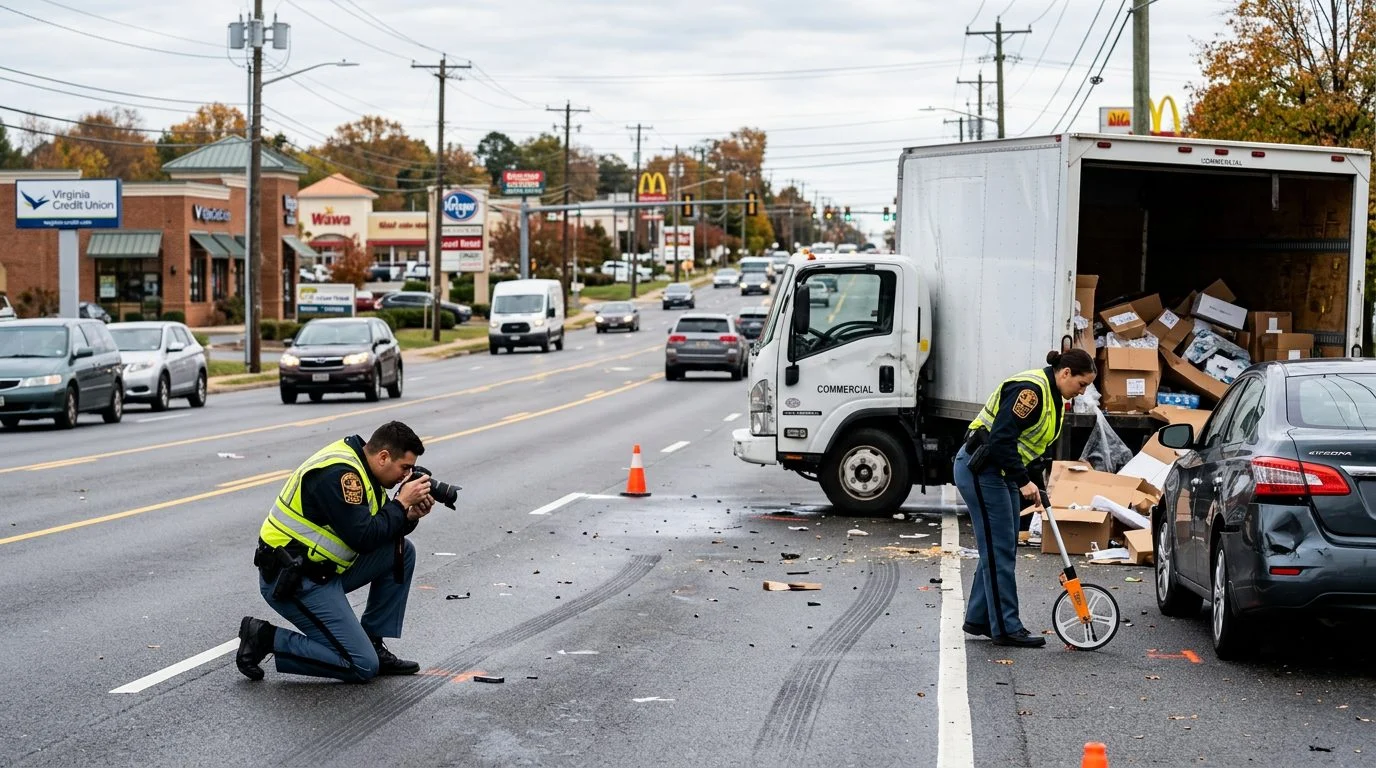
The main records in this article are the police report, post-crash test documentation, the driver qualification file, hours-of-service logs, maintenance records and the driver’s CDL history.
A useful first step is matching each record to the date and vehicle involved in the crash. Organize questions by record type so that each answer ties to one document. Ask whether a required test is documented, whether the qualification file holds the items the rule lists, whether the logs cover the day of the crash, and whether repairs appear before the crash.
FMCSA explains federal hours-of-service limits and rest rules on its hours-of-service page. For the wider set of questions, see the firm’s page on commercial vehicle accidents in Virginia.
What is a commercial motor vehicle (CMV)?
A CMV is the kind of vehicle that the federal CDL rules in 49 CFR Part 383 apply to.
Does a crash always lead to losing a CDL?
No. Under the federal rules, disqualification follows certain listed convictions, not the crash by itself.