
Pedestrian Injuries | Virginia
Hit by a Commercial Vehicle in Virginia? Start With the Key Facts
A plain-language guide for injured pedestrians and their families in the Shenandoah Valley, Richmond and Henrico County.
Published November 11, 2026
If a truck or other commercial vehicle hits you while you are on foot in Virginia, get to safety if you can and call 911 right away. Those first steps protect your health and start the record of what happened.
This guide explains what a pedestrian hit by a commercial vehicle in Virginia should know next. It covers the scene, the crash record, medical care, insurers, deadlines and the path when a pedestrian dies. Every crash has its own facts, and those facts shape what applies.
What Happens First When a Commercial Vehicle Hits a Pedestrian
Get to safety if you can, then call 911 even if the injury looks minor.
Move away from traffic only if you can do it safely. If you are badly hurt, stay still unless you are in immediate danger, such as fire or moving traffic. Moving someone with a serious head, neck or back injury can make the harm worse.
Tell the dispatcher where you are, that a truck or commercial vehicle struck a pedestrian, and whether anyone is badly hurt. Ask for medical help even if you feel only bruised. Some injuries show up hours or days later, so an early check gives your doctors a starting point.
Ask the officer for the crash report number and the agency that wrote it. The firm’s commercial vehicle accidents guide gives the wider picture of these crashes.
If a commercial vehicle hurt you or someone in your family while on foot, you may have a claim, and the firm is glad to talk through your situation with you. Talk it through with Correll Law Firm — we can walk you through how a situation like yours is usually handled and what your options are.

Why a Commercial Vehicle Crash Involves More Records
A commercial vehicle crash often involves more parties and more paperwork than a crash with a family car.
Many trucks and vans belong to a company, not the person driving. The driver, the vehicle owner and the carrier may each play a role. That is why the details on the vehicle matter early.
Look for the company name on the door or cab, the unit or fleet number and the USDOT number, if one is shown. The number ties a commercial carrier to federal motor-carrier safety rules. The Virginia DMV’s USDOT page describes which carriers and vehicles need one. Photograph these markings or write them down.
In a serious case, other records may matter too. Driver logs, maintenance files and inspection records can become part of the picture. The crash report and witness statements usually form the starting point. What those records show depends on the facts.
Documenting the Scene and Recording Key Information
Write down what you can while the details are fresh, and keep every record after that.
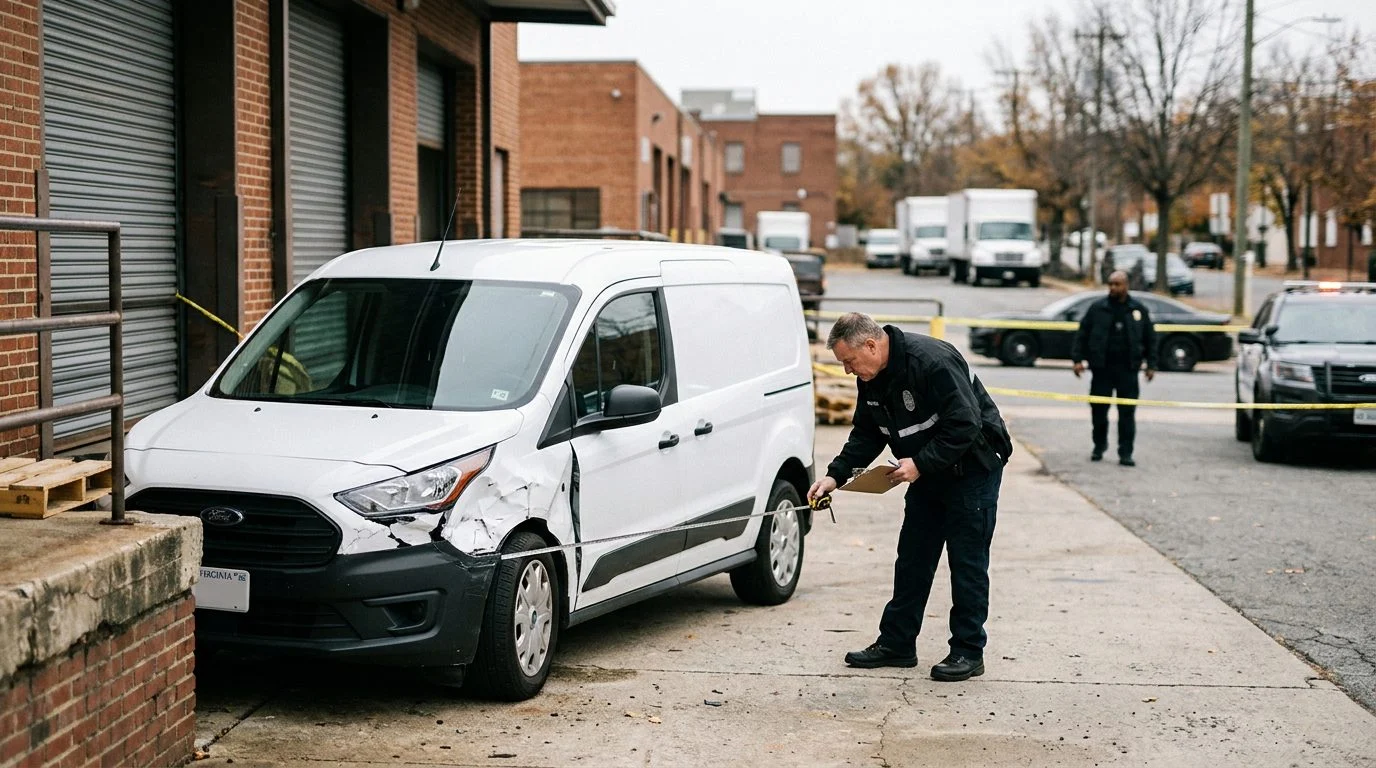
If it is safe, photograph the vehicle, its markings, the license plate, the road, traffic signals, skid marks and debris. Photograph your visible injuries and where you were standing. Photos taken that day capture details that memory later loses.
Note the driver’s name, address, driver’s license number and vehicle registration number. Add the employer’s name if the driver shares it. Stick to facts. Do not argue about who caused the crash, and avoid saying you are sorry or that you were not paying attention.
Ask witnesses for their names and how to reach them. Note the time, the direction you were walking and the crosswalk or sidewalk you used.
Keep every bill, prescription receipt, discharge paper and visit summary in one folder. Write each provider’s name next to the papers they gave you.
Hit-and-Run Crashes Involving a Pedestrian
If the driver leaves, report the crash to police as soon as you can and give them every detail you have.
Describe the vehicle’s type and color, the direction it went and any part of the plate you saw. Even a partial detail can help investigators narrow the search.
Virginia requires a driver involved in a crash with injury or death to stop and report it to police immediately (Va. Code §§ 46.2-371, 46.2-894).
The stop-and-aid duties in Va. Code § 46.2-894 also require the driver to stop as close to the scene as possible without blocking traffic. The driver must give reasonable help to an injured person. That includes taking the person to medical care when treatment is apparent or requested.
When the driver cannot be identified, Virginia law allows an action against an unknown defendant as “John Doe” (Va. Code § 38.2-2206). Under Va. Code § 38.2-2206(G), filing a John Doe action against an unknown owner or operator pauses the statute of limitations against the driver who caused the injury until that driver’s identity becomes known.
Medical Care, Records and Delayed Symptoms
Get a full medical check after any pedestrian crash, even when the injury seems small.
Some injuries do not show their full effects right away. Head injuries, internal injuries and spinal injuries can appear hours or days later. Tell every provider about the crash, each symptom and each limit on daily life.
Keep a simple symptom journal. Note the date, the symptom, a pain level from zero to ten, missed work and tasks you can no longer do. The journal gives doctors and family members a clear picture of how the injury affects life.
Follow the care plan your providers give you and keep your appointments. Gaps in care can be used by an insurer to question how serious an injury was.
A serious spinal injury calls for its own focused review. The firm’s page on spinal cord injury after a truck crash covers that path in more detail.
Talking With Insurance Companies After a Pedestrian Crash
You may wish to speak with a lawyer before you give any recorded or detailed statement to an insurer.
An adjuster may call soon after the crash. Stick to what you know, and say so when you don’t know something. Avoid guessing about speed, timing, injuries or fault.
Several insurers may be involved. The commercial carrier’s insurer, the driver’s own insurer and your own auto policy may each play a role. Ask each one for a claim number and the name of the person you speak with.
Keep copies of every letter. Write notes after every call, with the date and who you spoke to. Read any document before you sign it, and ask what each part means.
Not sure what your next step is?
Talk it through with Correll Law Firm — we can walk you through how a situation like yours is usually handled and what your options are.
How Fault Works When a Pedestrian Is Partly Responsible
Virginia follows contributory negligence: if you are found even partly at fault, you may be barred from recovering, with limited exceptions. Talk to a lawyer about your facts.
Questions about a pedestrian’s own conduct come up often, such as crossing outside a crosswalk or walking at night. Whether those facts matter depends on the facts of the crash. Lighting, signals, where you stood and who had the right of way all matter.
How Long Virginia Gives You to File a Claim
Virginia generally allows two years from the date of injury to file a personal injury lawsuit (Va. Code § 8.01-243(A)); the clock runs from the date of injury, not the date of discovery, with narrow exceptions.
Some claims carry notice requirements that run out sooner. A claim against a county, city or town for negligence is barred unless a written statement of the claim is filed within six months after it accrued, as set out in Va. Code § 15.2-209. An exception applies when the locality’s attorney, chief executive or mayor, or any insurer or entity providing coverage or indemnification of the claim, had actual knowledge of the claim, which includes the nature of the claim and the time and place at which the injury is alleged to have occurred, within six months after it accrued.
That matters if a city bus, county work truck or other municipal vehicle is involved.
When a Pedestrian Dies in a Commercial Vehicle Crash
A Virginia wrongful death action is filed by the decedent’s personal representative within two years of the death (Va. Code §§ 8.01-50(C), 8.01-244(B)), on behalf of the family members the statute protects.
Virginia wrongful death damages cover the family’s sorrow, mental anguish and loss of the decedent’s companionship, guidance and care; lost income and services; medical expenses from the injury; funeral expenses; and, for willful or wanton conduct, punitive damages (Va. Code § 8.01-52).
The first weeks after a death are hard. Many families find it helps to keep a written list of the crash facts, the hospital records and the police report number. The firm’s page on family questions after a fatal truck crash covers those questions in more detail.

Punitive Damages and What a Jury Must Find
Virginia allows punitive damages for actual malice, or for willful or wanton conduct or recklessness showing a conscious disregard for the safety of others, capped at $350,000 (Va. Code § 8.01-38.1).
Ordinary negligence is not enough. Virginia allows punitive damages for actual malice, or for willful or wanton conduct or recklessness showing a conscious disregard for the safety of others (Va. Code § 8.01-38.1).
Under the statute, the jury is not told about the cap.
Frequently Asked Questions
Does a pedestrian’s own mistake always stop a claim?
The answer depends on the facts of the crash, and the rule described above applies.
Who files a wrongful death case in Virginia?
The decedent’s personal representative files it. The family shares in any recovery.