
Car Accidents | Shenandoah Valley and Richmond
Asked for a Recorded Statement After a Crash? Pause and Plan Before You Answer.
An insurance adjuster may ask to record your account soon after a crash. Learn who is calling, what they may ask, and how to protect your own account of events.
Published October 28, 2026
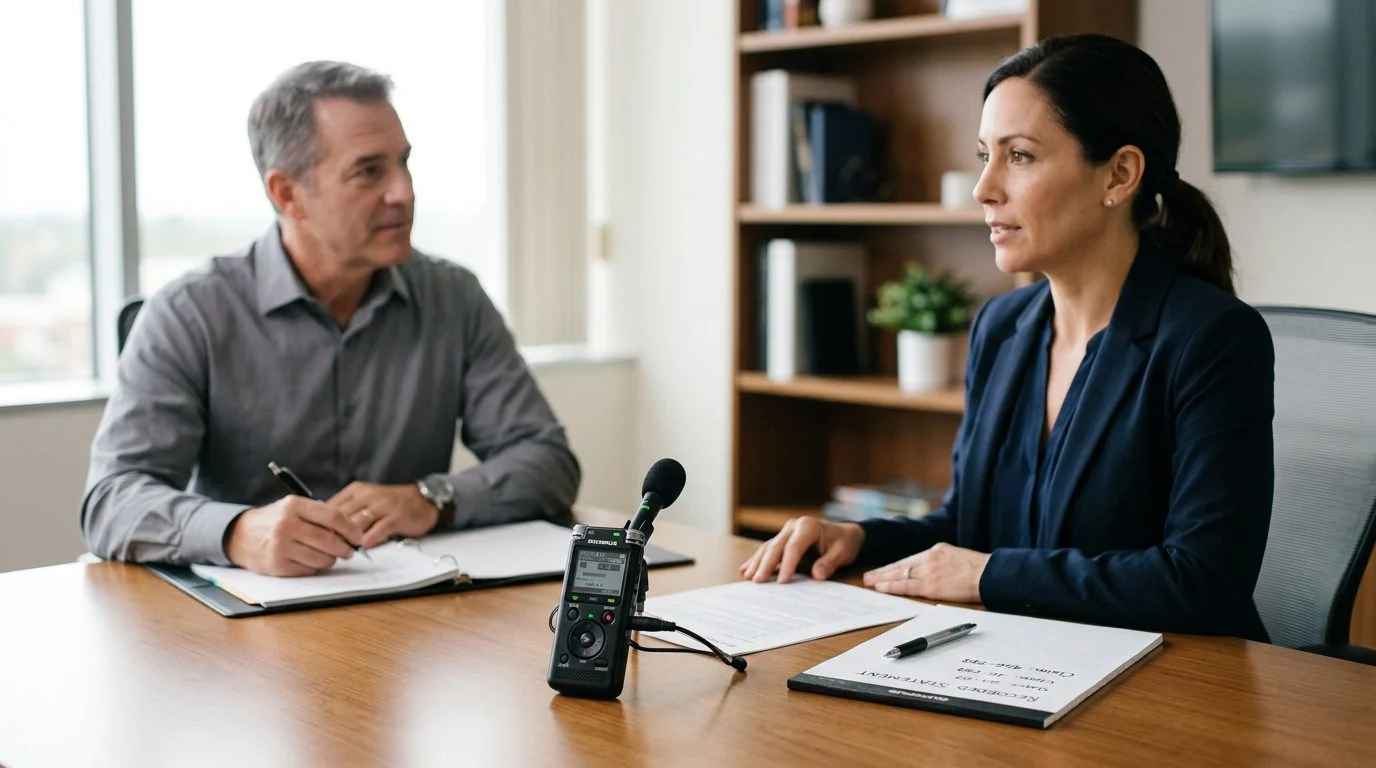
Should I give a recorded statement to an insurance company? You don’t have to answer on the spot. A recorded statement is an audio-recorded question-and-answer session with an insurance representative about how a crash happened and how you were hurt. This guide explains what the request means in Virginia, why insurers ask for it, and what to think through before you decide. It is general information, and every crash and every claim is different.
What a Recorded Statement Is and Who Usually Asks for One
A recorded statement is a taped interview in which an insurance representative asks you about the crash and your injuries. The request usually comes from an insurance adjuster, a claims worker who handles the claim for an insurance company.
The call may come from the insurer covering the other driver, the insurer for a commercial truck, or your own insurer. Each company has its own adjuster and its own reasons for the call. The adjuster’s job is to evaluate the claim for the company that employs them.
That is the key point to keep in mind. Adjusters are often courteous, and a friendly voice is easy to trust. A friendly tone does not change who the adjuster works for.
The call can come at any time after a crash, including before your medical care is finished. You may get it while you’re still sore, tired and short on information.
If an adjuster has asked for your recorded statement and you're unsure what to say, you don't have to face it alone. The firm is glad to talk through your situation with you. Talk it through with Correll Law Firm — we can walk you through how a situation like yours is usually handled and what your options are.

Why Insurance Companies Ask for Recorded Statements
Insurers ask for recorded statements to get an early, detailed account of the crash while memories are fresh. A recording gives the company a fixed record of exactly what you said.
The adjuster can compare that record with the police crash report, photos of the vehicles and any medical records the company receives. The statement often helps the company decide two things: who was at fault, and how serious the injuries appear to be.
Because the recording is kept on file, the words you use matter. A clear, accurate answer is more useful to everyone than a quick guess. Follow-up calls often build on what you said first.
The statement is one tool the company uses to evaluate your claim.
Do You Have to Give One?
A request for a recorded statement is a request, and you can ask questions before you agree. Whether you must cooperate depends on the facts, including whose policy applies and what that policy says.
Start by asking the adjuster three things. Ask which insurer they represent, what the statement is for, and which topics it will cover. You can also ask whether the questions can be sent in writing instead. A written answer lets you read each question and think before you reply.
Knowing those limits helps you set realistic expectations for the call.
You may wish to speak with a lawyer before agreeing, especially when injuries are serious or fault is disputed.
What to Be Careful About When an Adjuster Asks Questions
Answer only what you actually know, and say so when you don’t know or don’t remember. Guessing is the easiest trap to fall into. Speed, distance, timing and the order of events can be hard to judge after a shock. A guess given on a recording can later be treated as a fact.
Also avoid calling an injury minor before a medical evaluation is finished. Symptoms can develop or change over time, and an early description may not match later findings.
If the adjuster asks who caused the crash, slow down. Describe what you saw and did, and leave out conclusions about the other driver’s state of mind. Virginia follows contributory negligence: if you are found even partly at fault, you may be barred from recovering, with limited exceptions. Talk to a lawyer about your facts. Fault answers deserve extra care for that reason.
Questions about earlier injuries or past medical care also deserve a pause. Ask what records the insurer plans to request before you answer.
If You Decide to Give a Statement: Practical Steps
If you decide to go ahead, keep the call organized and on the record.
At the start, confirm the date, the time, the claim number and the adjuster’s name. Ask for a copy of the recording or a written transcript.
Take breaks when you need them. Ask for any question to be repeated, and don’t rush.
If you notice a mistake, correct it right away, and say which answer you’re correcting.
Keep a personal written log of the call: who called, when, what you were asked and what you said. Store that log apart from the insurer’s files.
Do not sign a release or accept a settlement offer during the call or right after it. Read every document slowly, and take time to review it before signing anything.
Common Mistakes People Make With an Insurance Claim
A common mistake is giving a detailed statement before the full extent of injuries is known. Later symptoms can look inconsistent with an early account, even when that account was given in good faith.
Social media is another trap. Posts about the crash, your injuries or your activities can be seen by the insurer and read out of context. Accepting an early settlement offer before the medical picture is clear is also a mistake people make.
Timing matters in court, too. Virginia generally allows two years from the date of injury to file a personal injury lawsuit (Va. Code § 8.01-243(A)); the clock runs from the date of injury, not the date of discovery, with narrow exceptions. Some claims carry notice requirements that run out sooner. Keep track of the dates that matter in your claim, starting with the crash date.
Not sure what your next step is?
Talk it through with Correll Law Firm — we can walk you through how a situation like yours is usually handled and what your options are.

Recorded Statements in Truck and Commercial Vehicle Crashes
In a truck or commercial vehicle crash, the questions can reach well beyond the crash itself.
More than one insurer may call. The trucking company’s insurer may request a statement, and company representatives may reach out as well. Questions may cover the driver’s logs, the load, the route or vehicle maintenance, which you may know little about.
Federal rules set out the records behind those topics. The rules also cover the driver vehicle inspection report, which lists any defect or deficiency the driver finds or is told about that would affect the vehicle’s safe operation or cause it to break down. The carrier must keep that report for three months from the date it was prepared (49 CFR 396.11).
Ask which records the insurer is asking about before you answer questions on those topics.
Virginia requires a driver involved in a crash with injury or death to stop and report it to police immediately (Va. Code §§ 46.2-371, 46.2-894). The two-year period is the deadline to file a lawsuit, not to report a crash.
The firm handles truck accidents, commercial vehicle accidents and wrongful death claims in Virginia.
Should I give a recorded statement to an insurance company?
Learn who is asking and why first. Then you can decide whether to answer, now or later.
Can I say I don’t remember something?
Yes. Saying you don’t remember is an honest answer when it’s true. Don’t guess to fill the gap.
Related practice areas
- Commercial Vehicle Accidents in Virginia: What Injured People and Families Should Know First
- Work Van Accident Lawyer in Virginia: Crashes Involving Work Vans and Delivery Vehicles
- Tanker Truck Crash on I-81 in the Shenandoah Valley
- Truck Accident Hours of Service Rules in Virginia